User Guides
AI Keyword Targeting
Learn how to use Rezi’s AI Keyword Targeting tool to tailor your resume faster, improve ATS compatibility, and add the right keywords for every job application.

Published on
July 16, 2026
Updated on
July 16, 2026
“Tailor your resume for every job.” Well, that’s easier said than done when you’re applying to multiple jobs a day and dealing with some serious burnout. Luckily, you don’t have to make the job search harder than it already is. A few smart tools can save your time and sanity.
Instead of manually going through job listings and guessing which skills matter most, AI Keyword Targeting scans your resume against the posting and points out what’s missing. Even better, it helps you work those keywords into your resume, so you can tailor your application faster while still keeping it authentic to your experience.
I’ll walk you through this feature step by step and share tips to help you get the most out of it.
And if you want to see the tool in action, try our free AI Resume Builder for tailored bullet point suggestions and specific ATS feedback to help you improve.
You can also check out our other tools to build a stronger resume:
And take a look at our expert guides for more tailoring tips:
- How to Tailor Your Resume
- How to Find Keywords Missing on a Resume
- How to Tailor Your Resume to a Job Description With AI
What Is AI Keyword Targeting?
AI Keyword Targeting scans your resume against a specific job posting and shows you which important keywords you’re missing. Its goal is to align your resume with what hiring managers and Applicant Tracking Systems (ATS) want to see and prove you’re the right fit.

Why does this matter? Most companies use ATS software to scan resumes and filter for keywords. If your resume doesn’t include the right skills, qualifications, or expertise from the job description, it can get filtered out or buried under more relevant applications.
Here’s what AI Keyword Targeting does to help with this:
- Scans your resume against a job description to identify missing or weak keywords.
- Suggests relevant terms and phrases employers expect to see for the role.
- Shows ways to include keywords naturally in your resume bullet points.
- Improves ATS compatibility to help your resume pass automated screenings.
- Boosts your Rezi Score, giving you a clearer picture of how well your resume is doing.
So, if a marketing job listing repeatedly mentions “SEO” and “Google Analytics,” and your resume never uses those exact terms, AI Keyword Targeting will flag them. From there, you can update your resume bullet points with AI or manually edit to reflect the language employers are using in the job posting.
Here’s what one of our users, Rahul, shared about his experience with the tool:
Celine also shared how AI Keyword Targeting strengthened her resume:
You can also tailor resumes to any job description in seconds with the Rezi MCP Toolkit by connecting Rezi with AI tools like Claude, Codex, and Gemini.
How to Use AI Keyword Targeting?
Here’s the quick version of how to use AI Keyword Targeting:
- Upload your resume by adding an existing file, creating a new resume, or importing your LinkedIn profile so Rezi can organize your information and prepare your resume for AI-powered suggestions.
- Target a job description by entering the job title, company name, and job posting details so AI Keyword Targeting can identify the most important skills, qualifications, and keywords.
- Check the keyword suggestions to review missing and included keywords and track your progress with highlighted terms and green checkmarks.
- Add keywords to your resume by generating AI-powered bullet points, editing suggestions to better reflect your experience, or manually adding terms.
Let’s get into the details of how AI Keyword Targeting works from start to finish.
1. Upload your resume
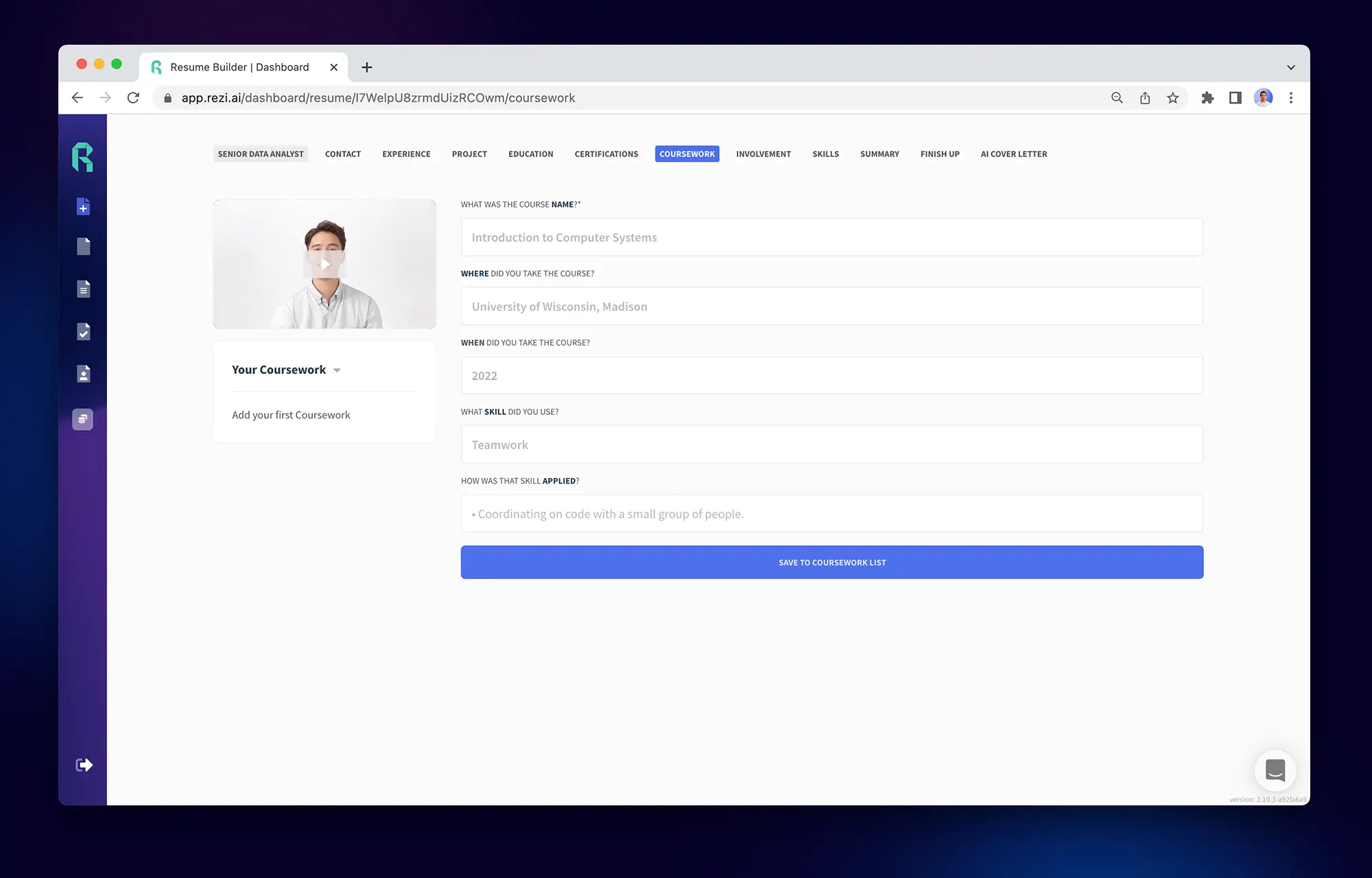
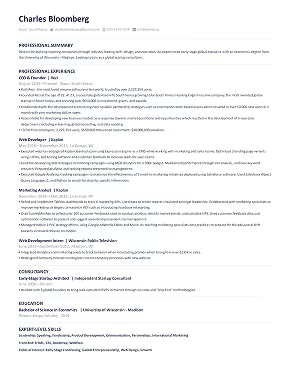
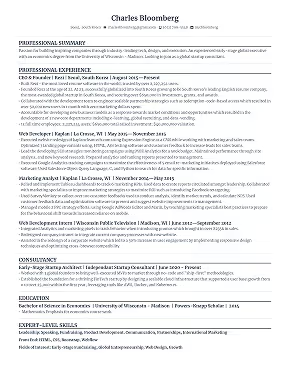
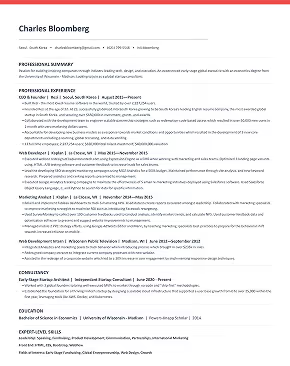
Start by uploading an existing resume as a PDF or DOCx file, and Rezi will transfer your details while organizing the formatting for you. During setup, you’ll also have the option to name your resume and choose your experience level, which helps personalize recommendations.
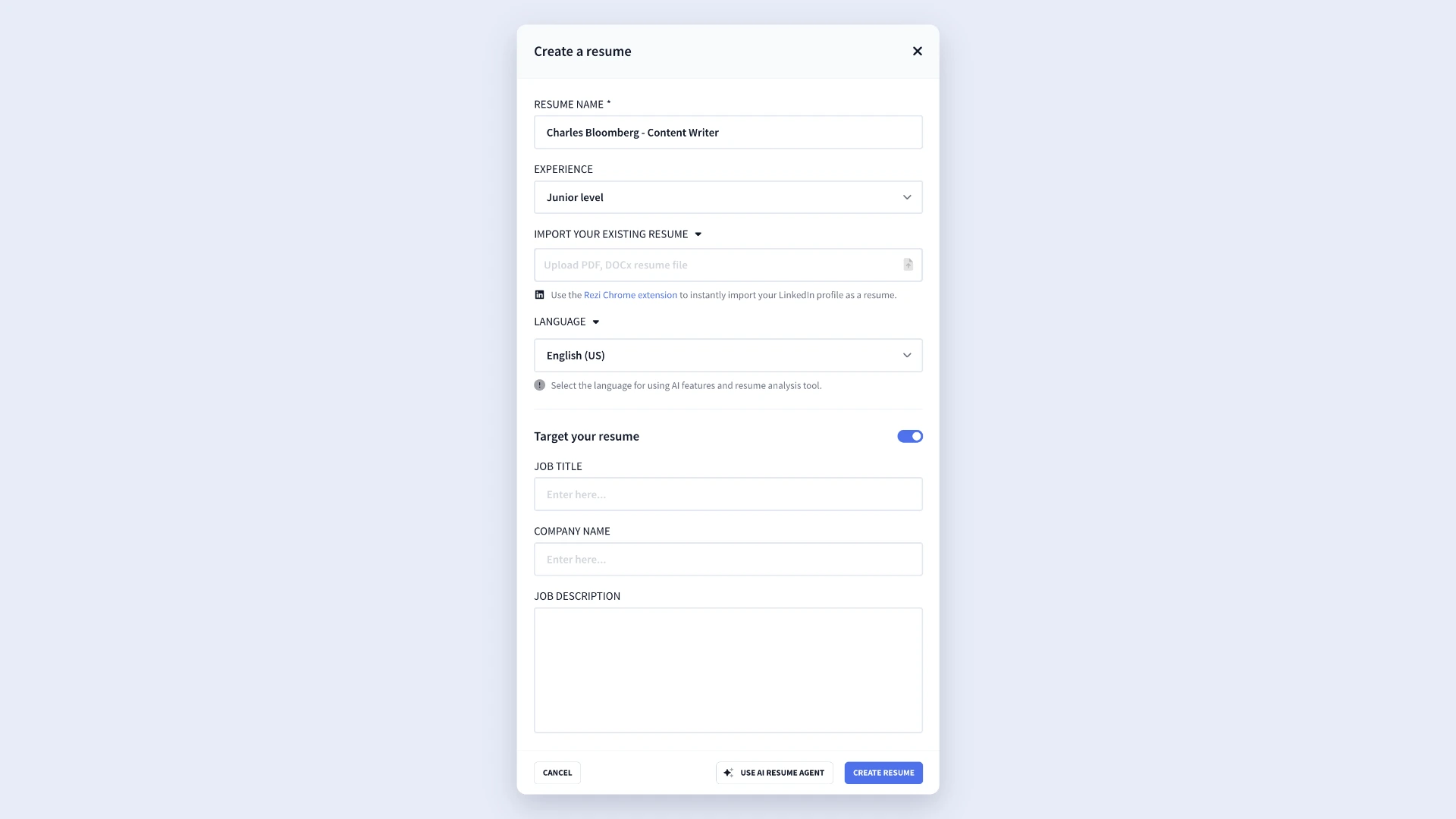
Don’t have a resume? No problem. You can either create one from scratch or connect to LinkedIn. Rezi lets you import your profile with a single click to give you a strong starting point without manually typing everything out.
You can also build your resume through a guided conversation and prompts with our AI Resume Agent to take you through the process step-by-step.
Here’s an overview of how to get started:
- Upload an existing resume (PDF or DOCx)
- Create a brand-new resume using the builder
- Import your LinkedIn profile for a fast setup
- Use AI Resume Agent with custom prompts
2. Target a job description
To use the AI Keyword Targeting tool, Rezi will need to know more about the job you want. Before you start building your resume, select Target Resume and enter details about the role, including:
- The job title
- The company name
- The full job description (copy and paste it directly)
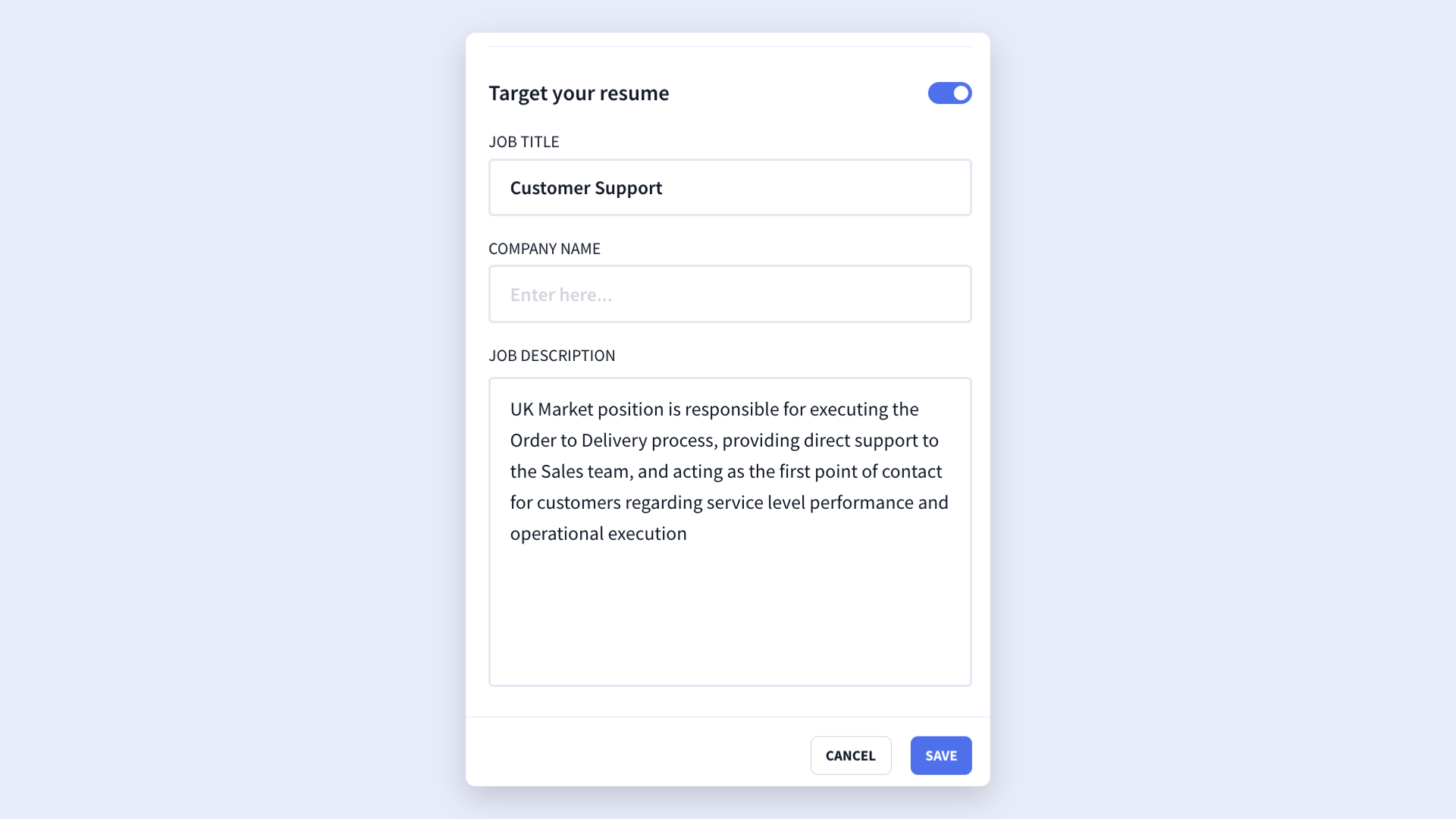
AI Keyword Targeting uses the job description to understand which skills, qualifications, and phrases employers care about most. Later, it compares your resume against that information and suggests ways to strengthen your content.
And targeting a job ad also powers other Rezi AI features. For example, tools like the AI Bullet Point Writer can generate stronger, more tailored suggestions based on the exact role you want.
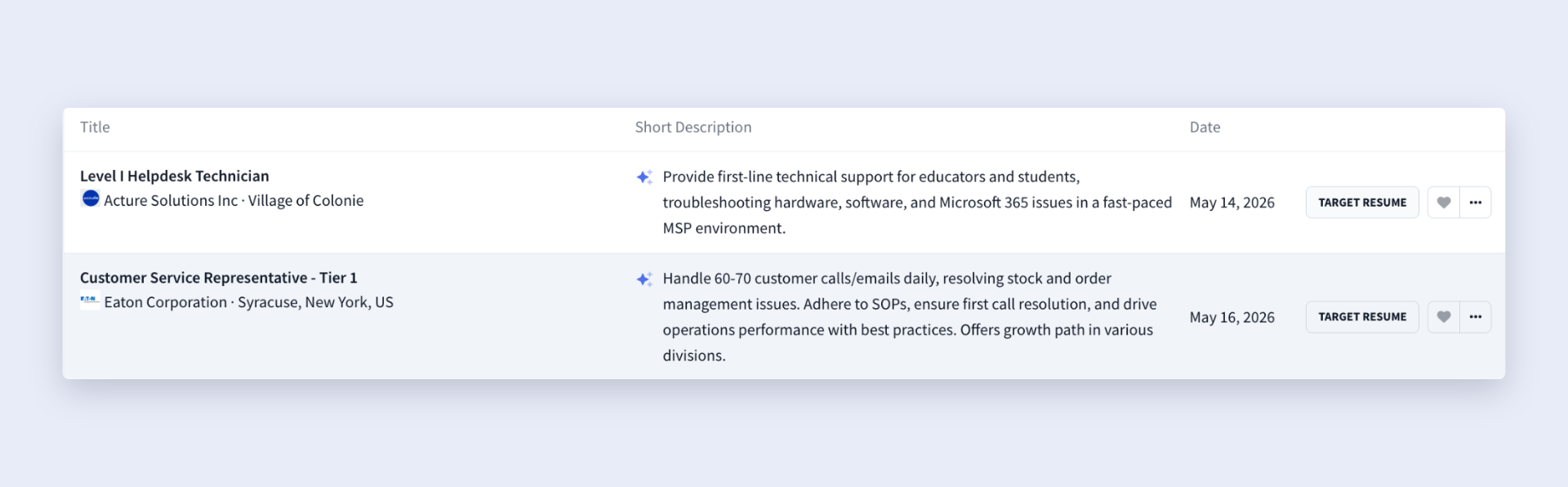
Another way to link your resume to the job description is through AI Job Search. You can target a role directly from a job listing by clicking Target Resume and choosing which resume from your dashboard you want to tailor.
3. Check the keyword suggestions
Once your resume is done, head to Finish Up & Preview to see the completed version. This is where you can really explore and use the AI Keyword Targeting feature.
You’ll see the AI Keyword Targeting tool listing important terms from the job description that you have and haven’t included yet. These are often skills, software, certifications, or role-specific phrases employers mention throughout the posting.
Here’s what the AI Keyword Targeting tool will show you:
- A list of missing keywords that you have the option to add to your resume bullet points.
- All the keywords that you’ve included, marked with a green checkmark and highlighted throughout your resume.
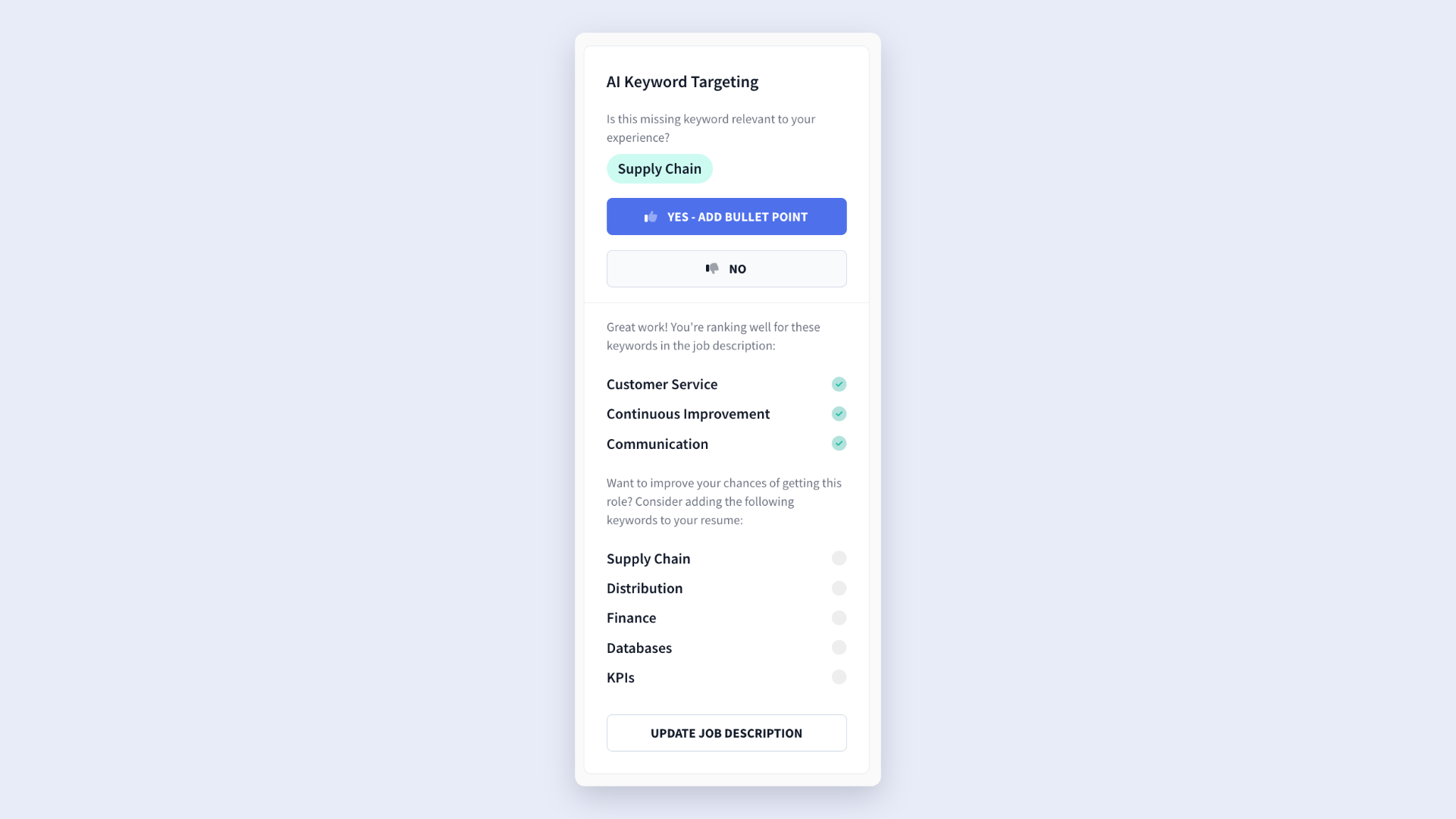
And yes, this feature saves you a ton of time. Instead of manually scanning a job description and guessing what matters, Rezi already pulls the most important terms into one place for you.
4. Add keywords to your resume
Now that you’ve reviewed the ATS keywords, you can use them to improve your resume.
For each missing keyword, Rezi gives you the option to generate a new bullet point that naturally includes the term. You can accept the suggestion, rewrite it for more options, or tweak the wording until it feels right.
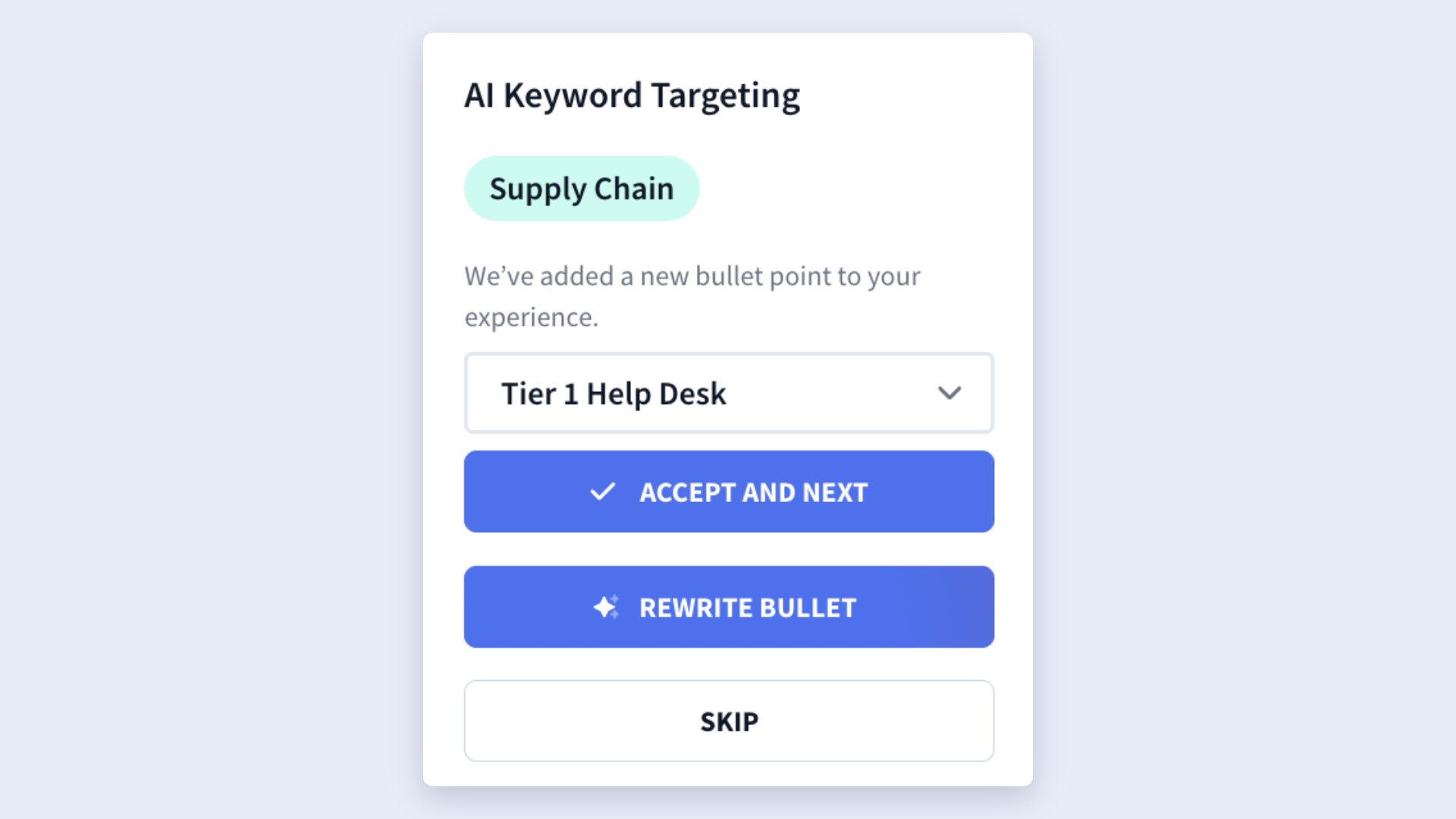
And AI Keyword Targeting doesn’t just randomly drop content anywhere in your resume. It places new bullet points under the job title that best match the keyword. And if you feel it fits better elsewhere, you can ask the tool to move the point to another role.
If you prefer a hands-on approach, you can skip AI-generated points entirely and update your resume yourself. The missing keyword list still acts as a guideline, so you know exactly which terms to work with. And as soon as you add a keyword, Rezi checks it off automatically.
Want even more control? You can also use our AI Resume Agent to get specific tailoring suggestions or to check how well your resume matches the job description.
How to Get the Best Results
AI Keyword Targeting can save you time, energy, and stress, but don’t forget to add your unique touch. AI tools can point you in the right direction, suggest strong keywords, and generate bullet points, but you’ll get the best results when you review and personalize what they give you.
Here’s how to work with AI Keyword Targeting to get the best results.
Make the bullet points unique to you
With so many job seekers using generic ChatGPT phrases, the strongest resumes are standing out for being more personal and specific. Instead of using AI suggestions word-for-word, tweak them to highlight your resume achievements, responsibilities, and wins.
Try to include:
- Key accomplishments that show results
- Relevant skills tied to the job description
- Responsibilities with impact, not just tasks
- Metrics or numbers, whenever possible
Don’t have exact numbers? That’s fine. Use specific examples instead. You can still show what you achieved through outcomes, improvements, or problems you solved.
Learn more about how to make an impact: How to Write a Perfect Work Experience Section
Don’t lie or exaggerate your skills
Slightly exaggerating your abilities? Most of us do it. And if you’ve worked with a skill or achieved impressive results, you can absolutely frame that experience in a strong way. Just make sure you can back yourself up in an interview.
But completely inventing skills? You’re entering risky territory. Imagine being asked to do something on the first day of the job, and having no idea where to even start.
Rather than lying on your resume, focus on presenting your real experience in the strongest possible light. Even small contributions can sound impressive when you clearly explain the impact and your eagerness to grow your expertise.
Prioritize your most relevant bullet points
Many recruiters skim resumes, naturally starting at the top of each role and scanning downward. So let me state the obvious: your strongest, most relevant bullet points should appear first.
When you use AI Keyword Targeting, you’ll probably end up with several new keyword-rich bullet points. Don’t just leave them at the bottom and hope for the best. Move the most relevant content closer to the top of each job entry so recruiters see it immediately.
Focus on bullet points that:
- Match skills listed in the job description
- Highlight relevant accomplishments
- Show experience closely tied to the role you want
You should also give more attention to recent positions. In most cases, your latest roles deserve the most detail because they’re usually the most relevant. Older jobs can have fewer bullet points, especially if they don’t connect directly to the position you’re targeting.
Remove the fluff and repetition
Our AI tools can produce some pretty impressive results, but don’t go crazy by adding too much information. After reviewing keyword suggestions, you might end up with plenty of new bullet points. That’s great, but if your resume looks crowded, it’s okay to cut content.
Actually, you should cut the content.
If a bullet point doesn’t support the role you want or fails to show your value, ask yourself whether it still deserves space. Keep these things in mind:
- Remove bullet points that don’t support the target role
- Cut repetitive information so every point adds something new
- Avoid stuffing keywords into every sentence
- Prioritize clarity and impact over length
Recruiters care more about a focused, relevant resume than one packed with overused filler. In many cases, a sharp one-page resume makes a stronger impression than two pages filled with repeated responsibilities and vague descriptions.
Summary
Here’s an overview of everything you need to know about AI Keyword Targeting:
- AI Keyword Targeting compares your resume to a specific job description and identifies missing keywords, skills, and phrases employers want to see.
- You can start by uploading an existing resume, creating one from scratch, or importing your LinkedIn profile.
- Before editing your resume, add the job title, company name, and full job description to give the AI context so it can generate smarter keyword suggestions.
- After finishing your resume, Rezi highlights missing terms from the job description, marks included keywords with green checkmarks, and tracks your optimization progress.
- AI Keyword Targeting can generate new resume bullet points that naturally include missing keywords to help you improve ATS compatibility without keyword stuffing.
- Review each recommendation and adjust wording so it accurately reflects your experience, skills, and achievements.
- Focus on relevant, results-driven bullet points and place your strongest examples near the top of each role.
- AI can help you align your resume with employer expectations, but your goal should always be to present your real experience in the strongest, most credible way.
- Keep your resume concise and relevant. If new keyword-focused bullet points make older content less useful, cut the fluff, reduce repetition, and prioritize quality.
FAQ
Is the AI Keyword Targeting tool free?
You can access Rezi’s AI Keyword Targeting tool for free at a limited capacity, which gives you a chance to explore the basics. If you want full access, Rezi offers a $29 monthly subscription or a $149 lifetime plan if you prefer a one-time payment.
What are the keywords AI looks for in a resume?
AI tools and Applicant Tracking Systems (ATS) usually look for keywords from the job description. These often include hard skills, software, technical tools, job titles, industry terms, and core responsibilities. AI also looks for context, not just isolated words. That means adding keywords naturally into achievement-focused bullet points works much better than stuffing random phrases throughout your resume just to check boxes.
Is it worth it to tailor your resume?
In most cases, yes. Tailoring your resume can significantly improve your chances of landing interviews because recruiters and ATS software want to see alignment between your experience and the role. But you don’t need to rewrite your resume from scratch for every application. Small changes, like adjusting skills, reordering bullet points, and using language from the job description, can make your resume sound less generic and more unique to you.
Can ChatGPT tailor your resume?
Yes, ChatGPT can help tailor your resume, especially if you paste in your current resume and a job description. That said, specialized resume tools like Rezi usually do a better job for resume targeting because they’re built specifically for ATS optimization. Rezi’s AI Keyword Targeting tool automatically scans job descriptions, highlights missing keywords, and places suggestions directly into your resume, which saves time and creates a more structured workflow.
Learn more about using ChatGPT for job applications:

Lauren Bedford is a seasoned writer with a track record of helping thousands of readers find practical solutions over the past five years. She's tackled a range of topics, always striving to simplify complex jargon. At Rezi, Lauren crafts genuine and actionable content that guides readers in creating standout resumes to land their dream jobs.