
CVs
15+ CV Profile Examples: How to Write a Personal Statement
Explore our range of CV profile examples and learn how to write a personal statement that shows your skills, experience, and career goals to impress recruiters.
.webp)
Published on
September 9, 2025
Updated on
March 11, 2026
Do you have to include a profile on your CV? Honestly, no. But does it give you a chance to stand out from the crowd? Absolutely. When a job’s on the line, why wouldn’t you take every opportunity to make a strong first impression? One of the biggest mistakes I see is treating your CV profile as an afterthought — but this little section is often the first thing a recruiter notices.
Like everything on your CV, your professional statement needs to add value and help them see your potential as an employee. It gives them an idea of who you are and what you can contribute to the company before exploring the rest of your CV.
Want to make sure they start on a positive note and keep reading? This guide will cover:
- How to make your profile stand out.
- What to put in a CV profile.
- My top CV profile examples and tips.
If you don’t want to tackle your job application alone, check out our free AI Resume Builder. Our technology gives you tailored suggestions and feedback to generate your resume in minutes.
And check out these handy guides covering different types of CVs:
- How to Create a Europass CV
- UK CV Format: Examples & Advice
- Academic CV: How to Write a Curriculum Vitae
- CV (Curriculum Vitae) vs. Resume: The Difference Explained
What Is a CV Profile
Your CV profile is a brief opening paragraph on your job application, also known as a personal statement, summary, or profile. This short ‘about me’ section gives employers a quick snapshot of who you are and why it’s worth reading the rest of your CV.
Technically, you don’t need to include a CV profile. But in the UK job market, a well-written profile can give you an edge because it frames your experience and skills before the recruiter dives into the details. But this only works if you do it right.
A good profile should be upbeat, professional, and concise — usually about three to five lines. This isn’t your life story (and neither is your CV). The aim is to highlight your key skills, experience, achievements, and what makes you a strong candidate (without rambling).
Want to speed up the process? Check out our AI Summary Writer. Use our expert technology to generate a customised profile that reflects your skills and accomplishments.
How to Write a CV Profile
Here’s a quick overview of how to create a CV profile:
- Keep your statement concise but impactful by sticking to three to five sentences (around 50–100 words) that highlight your strongest skills and achievements.
- Tailor to the job ad and role by mirroring the language of the job description and weaving in relevant keywords.
- Show how you can contribute rather than just listing duties by focusing on the value you’ve added in past roles.
- Make your achievements specific and measurable so you stand out from generic claims. Use numbers, percentages, or project outcomes to prove your skills.
- Avoid vague buzzwords and complex jargon by keeping your language clear, natural, and human.
Now, let’s explore these elements more closely with examples of what you can include.
1. Keep your statement concise
Nobody likes a rambler. Want to keep the recruiter interested? Keep it concise. Aim for three to five sentences, or around 50 to 100 words. Too long, and you’ll lose the reader before they’ve even reached your work experience section. Too short, and you risk sounding vague.
And I get it; summarising your entire professional background into a few lines isn’t easy. That’s why it’s better to write your CV first and then pick out the highlights to include in your profile. Try to target your most impressive skills and accomplishments that are tied to the job description.
Need to chop it down even further? Remember, recruiters don’t have time to unravel complicated sentences, so stick with simple, direct language. Say who you are, what you do well, and where you’re heading.
Check out this concise CV profile example:
Motivated finance graduate with internship experience in investment analysis and risk management. Strong Excel and data-modelling skills, with the ability to deliver accurate reporting under pressure. Looking to build a career in corporate finance with a firm that values analytical thinking and initiative.
Check out more examples: 100+ Professional Resume Profile Examples for all Careers
2. Tailor to the job ad and role
A generic profile feels like beige wallpaper (sorry, millennials). It’s fine, but it doesn’t grab attention. Now, imagine a room that’s been personalised to your taste. The same applies to your job application. By tailoring your profile to the role, you’re showing that you’ve actually read the job ad and understand what they’re looking for.
Scan the job description and pull out the keywords, such as “project management,” “client-facing,” or “compliance.” Including these phrases will help with Applicant Tracking Systems (ATS), while reassuring the recruiter that your experience is relevant.
Here are some quick tips when tailoring your CV profile:
- Match your profile to the role, not the other way around.
- Don’t just stuff in all the keywords. Use them naturally and be honest.
- Cut anything irrelevant, even if you’re proud of it.
Take a look at this job description for an admin role:
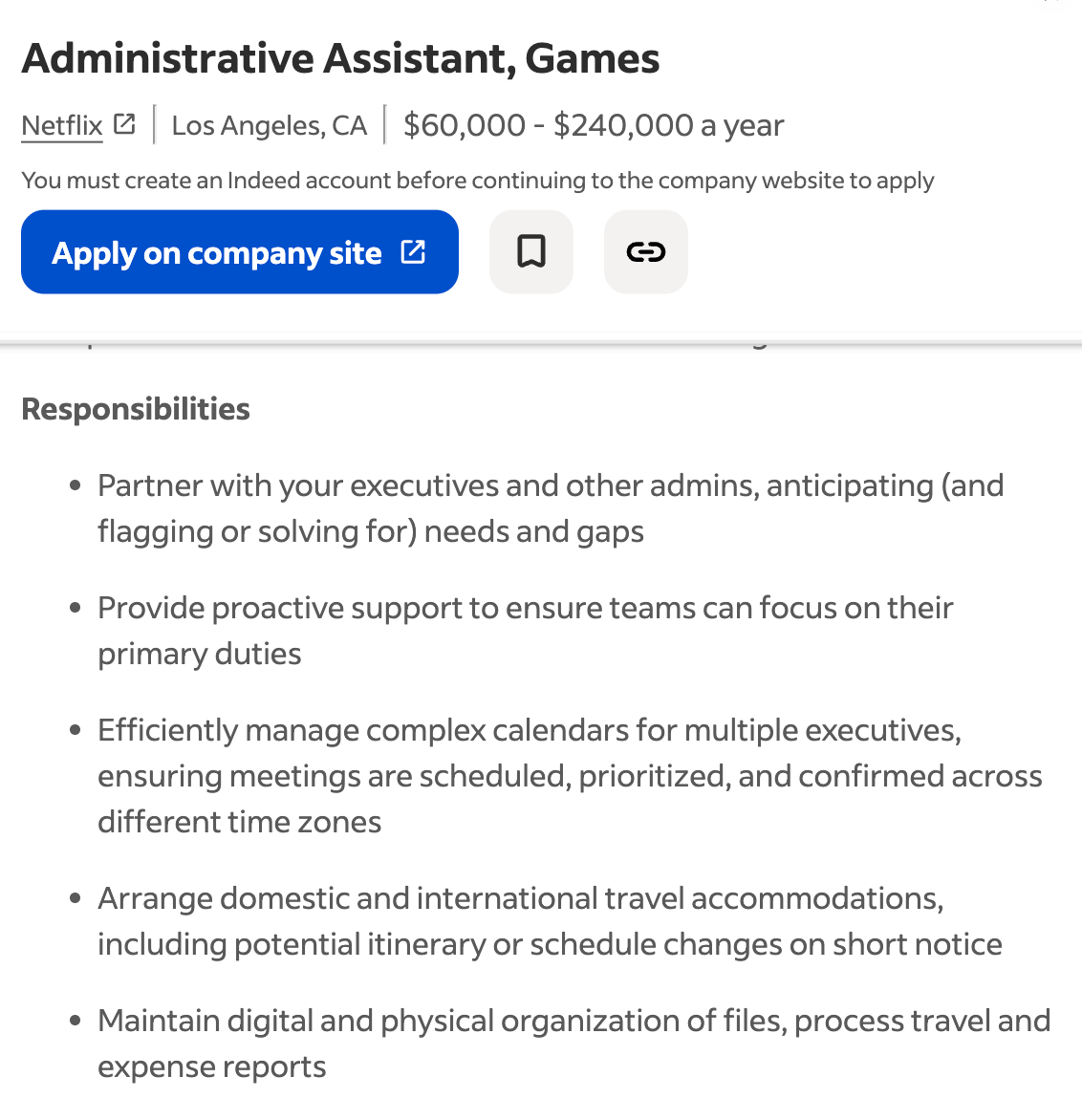
And here’s how you can tailor your CV profile based on the job ad:
Proactive administrative assistant with experience supporting executives and managing complex calendars across multiple time zones. Skilled at anticipating needs and arranging domestic and international travel. Known for providing seamless support that allows teams to focus on their core priorities while handling changes and last-minute requests. Excited to bring these skills to Netflix’s Game Studio, contributing to a creative environment.
Learn more about tailoring your job application: How to Tailor a Resume to a Job Posting
3. Show how you can contribute
The best CV profiles aren’t just “me, me, me”. Yes, employers want to know what you can do, but they also need to know what value you can bring to the company. The recruiter’s main question is: “Can this person help us solve our problems?” Your profile should leave them with a confident “yes.”
Think about times you’ve added value. Did you improve sales, increase revenue, train staff members, or reduce errors? These examples show what you’ve done and your potential to contribute in a new role.
What do all these examples have in common? They focus on results. Simply listing your duties doesn’t mean you were any good at them. I spent one Christmas break pouring pints in a pub. Were they any good? Let’s just say I got a few side eyes. Long story short: focus on impact to show how you can bring success to a company.
And focusing on results isn't limited to your profile. If you want to make a real impact, take this approach throughout your entire CV. If you need some help, try our free AI Resume Bullet Point Generator to get memorable bullet points tailored to your professional background.
4. Make your achievements specific
This is where a lot of profiles fall flat. Generic claims like “excellent communication skills” sound nice, but mean very little. Can you deliver informative and engaging presentations, or are you just the most vocal about the faulty printer? Don’t leave the recruiter guessing.
Back up your skills with examples, numbers, outcomes, and projects you delivered. The more concrete you can be, the more credible you’ll sound. Just don’t be tempted to exaggerate — recruiters are skilled at spotting fluff. Keep it honest and let your best achievements shine through.
Here are some ways you can be more specific:
- Replace “team player” with an example of collaboration
- Replace “detail-oriented” with an achievement showing accuracy
- Replace “strong leadership” with a project where you led successfully
Find out more: How to Show Achievements on a Resume
5. Avoid vague buzzwords and complex jargon
CV buzzwords might sound impressive, but let’s be honest, you’re mostly using them for filler. The quickest way to make a recruiter’s eyes glaze over? Throw in too many clichés or overly technical jargon.
Yes, you want to come across as professional, but you also want to sound like a human being.
All you need to do is keep it natural and readable. If you had 20 seconds to tell a stranger what you do and why you’re good at it, you wouldn’t say, “I’m a highly motivated team player who drives synergistic outcomes.” Get on their level by simply explaining your role and impact in straightforward terms.
Here are a few top tips:
- Cut vague buzzwords like “multitasker,” “dynamic,” and “self-starter”.
- Use everyday language that anyone could understand.
- Give real-life examples instead of abstract qualities.
Check out more red flag buzzwords: Top Resume Buzzwords to Avoid
What to Include in a CV Profile
Introductions are never easy. You only get one shot at a great first impression, and in this case, there’s also a job on the line (no pressure). Lucky for you, I’ve broken down the key elements to use as a guideline for structuring your CV profile.
Here’s a CV profile example that ticks all the boxes to grab a recruiter’s attention.
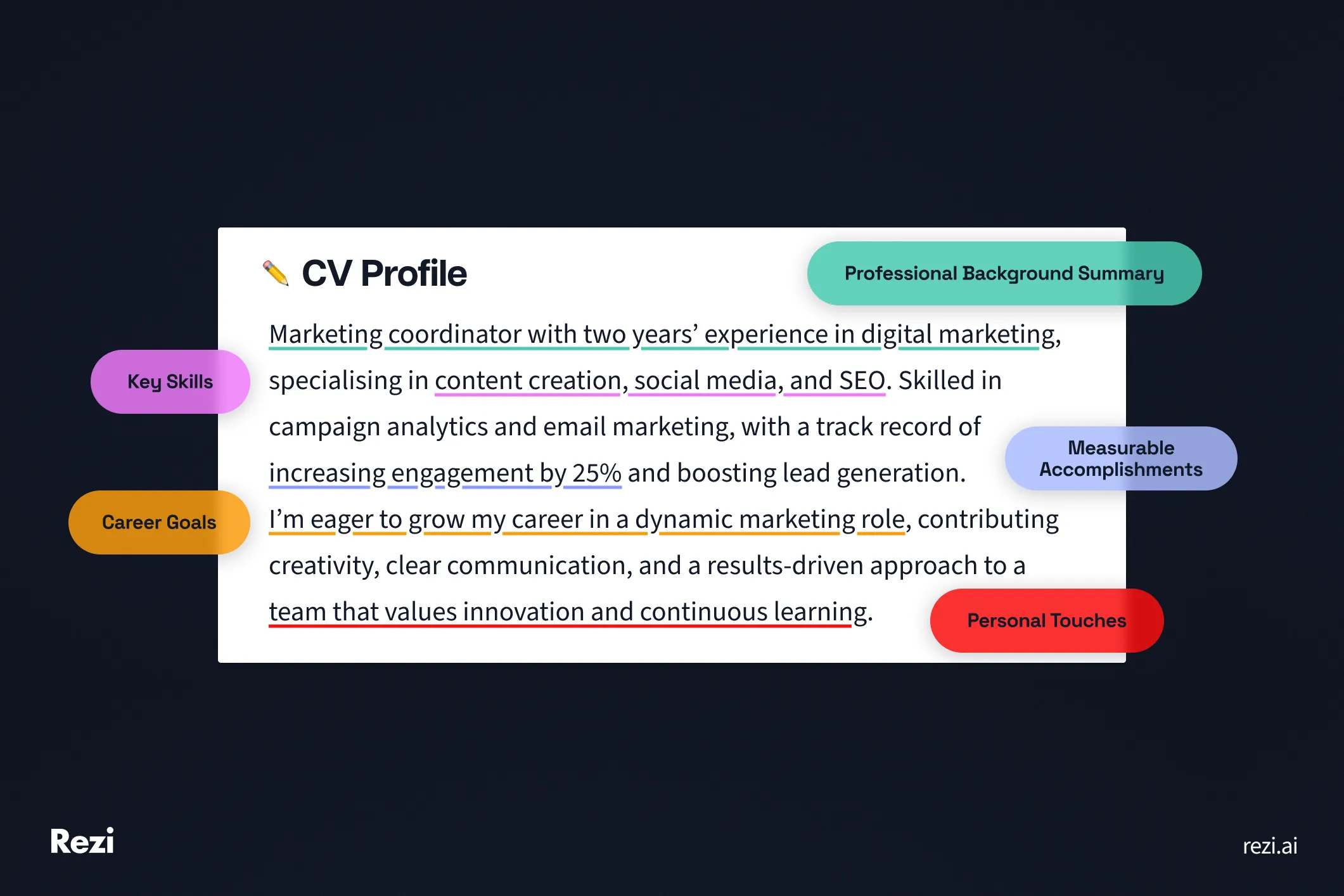
Why are these elements important? Keep reading to find out.
Summarise your professional background
Start strong by giving the reader a sense of who you are as a professional. Here are some points you can mention when introducing yourself:
- Your current job title (or most recent if you’re unemployed)
- How many years of experience
- The direction you want your career to go
If you’re a graduate or early-career job seeker, your degree and area of study can stand in for experience. It’s also a smart move to mirror the job title from the ad, so recruiters can instantly see that you align with the position.
Cover your key skills
Don’t just reel off a long list of generic skills. Instead, include skills that tie back to what the job actually requires. You can mention 2–4 of your top hard skills (like software knowledge or technical expertise) in your CV profile, while soft skills (like teamwork or communication) should ideally be shown through your work history or backed up with examples.
Add measurable accomplishments
Numbers carry weight because they prove impact. If you can say you “increased sales by 20%” or “reduced errors by 15%,” that’s much more persuasive than just “helped improve sales” or “maintained records.” But don’t panic if you don’t have stats. Focus instead on describing outcomes, improvements, or benefits your work has delivered.
Outline your career goals
Your profile isn’t just about past achievements; it’s also a chance to show where you want to go. A single line about your career aspirations can help employers see you as a long-term investment. Keep it aligned with the role you’re applying for, though. This isn’t the place for “I’d love to become a chess champion one day.”
Include personal touches
Personalising your CV profile doesn’t mean mentioning your love of cheese or medieval history. Instead, it’s about making your profile feel like you wrote it, not a generic template. Tailor the tone to match the company’s culture and highlight your enthusiasm for the role. A profile that feels specific and positive will stand out much more than one filled with stock phrases.
CV Profile Examples
Every industry has its own “must-haves,” and your job is to reflect those in your summary. Does the role want someone who thrives independently? Then I wouldn’t waste space banging on about how great I am at teamwork. Mirror the employer’s priorities, and you instantly increase chances of landing that interview.
Check out these CV profile examples for different industry types.
Sales
Focus on your communication skills, enthusiasm, and ability to build relationships. Highlight any experience where you persuaded, negotiated, or influenced outcomes. Include tangible results and show a willingness to learn and develop.
Motivated sales professional with experience in retail and B2B environments. Skilled in customer engagement, lead generation, and CRM systems, achieving a 10% increase in sales during placement. Eager to develop further in a target-driven sales role while building strong client relationships.
Finance
Emphasise analytical skills, attention to detail, and numerical accuracy. Mention technical skills like Excel, SQL, or financial software. For entry-level professionals, include any internships or projects where you applied finance knowledge and include measurable outcomes.
Finance analyst with a strong foundation in accounting and financial modelling. Experienced in preparing reports, reconciling accounts, and using Excel to analyse budgets. Achieved a 5% cost reduction during my internship project, and I’m eager to contribute these financial management skills within a dynamic team.
Engineering
Highlight key achievements and successful engineering projects. Focus on problem-solving, process improvements, and innovations. Include measurable impacts, such as cost savings or technical milestones. Make it clear how your expertise contributes to organisational success.
Mechanical engineer with 12 years’ experience designing and managing large-scale industrial projects. Led a team to develop a new assembly line that improved production efficiency and reduced costs by £250k. Skilled in CAD, lean manufacturing, and team mentorship.
Customer Service
Show enthusiasm, adaptability, and strong communication skills. Highlight transferable skills such as teamwork, active listening, or conflict resolution. Use examples from past work experiences, education, or volunteering to highlight your ability to handle customer-facing situations and work well under pressure.
Reliable professional with strong interpersonal skills, eager to start a career in customer service. Demonstrated adaptability and communication abilities during volunteer projects, resolving inquiries and supporting team activities. Motivated to learn and grow in a fast-paced, customer-focused environment.
Teaching
Focus on personal qualities such as patience, communication, and organisation. If you’re new to the field, highlight academic achievements, relevant coursework, or volunteer experience like tutoring or mentoring. Show your enthusiasm for supporting learning and contributing to a positive educational environment.
Recent early-child development graduate with experience mentoring students and delivering workshops. Skilled in lesson planning, classroom management, and adapting teaching methods to individual needs. Committed to encouraging an inclusive learning experience, with a passion for inspiring student growth and academic achievement.
IT and Technology
Highlight technical abilities like programming skills, software knowledge, and problem-solving. If you lack experience, include personal or internship projects that demonstrate your coding or IT competence. Show enthusiasm for learning and contributing to IT solutions or software development projects.
Software developer with hands-on experience in Python, Java, and SQL through internships and personal projects. Developed a task automation tool, reducing processing time by 30%. Passionate about building scalable applications and continuously learning new technologies within forward-thinking development teams.
Hospitality
Emphasise customer care, adaptability, and teamwork. Highlight experiences where you provided excellent service, managed busy environments, or handled challenging situations. Include enthusiasm for learning about customer experience and operational processes.
Friendly hospitality professional with experience in fast-paced restaurant settings. Skilled in customer service, teamwork, and problem-solving, ensuring guest satisfaction. Motivated to develop further in hospitality management while delivering excellent service and maintaining your famous family-friendly environment.
Healthcare
Give examples of your empathy, attention to detail, and patient care skills. Highlight any relevant training, placements, or volunteer work if you’re going for an entry-level position. Emphasise reliability, ability to follow protocols, and your commitment to supporting healthcare teams.
Junior healthcare assistant with practical experience supporting patient care during clinical placements. Skilled in patient observation, documentation, and basic medical procedures. Dedicated to delivering compassionate care and learning innovative clinical skills to contribute to a safe healthcare environment.
Marketing
Outline your creativity, communication, and digital marketing abilities using concrete skills and examples. Include experience with social media, content creation, or campaigns, even if they were part of personal projects. Show a desire to learn and contribute to marketing strategies that deliver measurable results.
Marketing assistant with experience creating content and managing social media campaigns during several internships. Skilled in SEO, email marketing, and audience engagement. Enthusiastic about applying creativity and analytical skills to support brand growth and deliver measurable marketing results.
Administration
Show organisation, attention to detail, and the ability to multitask. Demonstrate a willingness to learn and adapt to administrative systems and office procedures. Give examples of supporting the team and working independently to keep everything running smoothly.
Organised individual with strong attention to detail, seeking an administrative position. Demonstrated ability to manage schedules, organise documents, and support team activities in previous roles. Eager to develop practical skills and contribute efficiently to your office operations.
You can also tailor your CV profile depending on your experience level. Take a look at these examples and what to include.
No Experience
If you’re just starting out, emphasise enthusiasm, adaptability, and transferable skills. Highlight examples from school, volunteering, or relevant projects where you learned quickly or contributed towards a goal. Show a willingness to develop professionally and demonstrate potential rather than past work achievements.
Motivated and adaptable individual with strong organisational and interpersonal skills. Experienced in coordinating volunteer activities and taking on leadership roles in various university societies. Eager to learn new skills, contribute to a professional team, and develop practical experience in a dynamic work environment.
Don’t let lack of experience give you writer’s block: How to Write a Resume With No Experience
Students and College Graduates
Focus on qualities that make you employable, such as initiative, flexibility, and teamwork skills. Highlight achievements during your studies, personal projects, university clubs, or part-time work. Include what you hope to achieve professionally and how your skills can benefit an employer.
Recent university graduate with a degree in Business Management and experience leading student projects and volunteering initiatives. Skilled in research, presentation, and teamwork. Enthusiastic about applying analytical skills and project management knowledge in a professional environment while contributing to organisational success.
Entry-Level Position
For entry-level roles, show motivation, a willingness to learn, and career aspirations. Include relevant coursework, certifications, or part-time work. Demonstrate potential with measurable examples where possible, showing you’re ready to take on responsibility and grow in the role.
Entry-level professional with internship experience in administrative support and project coordination. Skilled in advanced Excel, data entry, and process improvement. Eager to develop professional skills, take on new challenges, and contribute to achieving organisational goals in your team-focused work environment.
Junior Position
At a junior level, emphasise practical skills and early achievements in your role or previous internships. Highlight technical competencies, problem-solving abilities, and your contribution to team projects. Show ambition to learn and grow into more senior responsibilities over time.
Junior Software Developer with hands-on experience in Python, JavaScript, and SQL. In my last role, I developed a task automation tool, reducing processing time by 30%. Keen to expand technical expertise and contribute to new projects within a collaborative development team.
Senior Position
For senior roles, focus on career achievements, leadership skills, and measurable impact. Highlight promotions, noteworthy awards, major projects, or process improvements. Show how your expertise has contributed to organisational success and emphasise strategic vision and long-term goals.
Senior Project Manager with over 12 years’ experience leading diverse teams and delivering multi-million-pound projects on time and within budget. Skilled in stakeholder management, risk mitigation, and process optimisation. Proven track record of improving efficiency, reducing costs, and driving strategic initiatives.
Need more examples? Take a look: 100+ Resume Summary Examples for All Jobs
CV Writing Tips
The whole point of writing a winning CV profile is to introduce yourself and encourage the reader to dive deeper into your job application. Don’t disappoint them by going downhill from there. Your CV should maintain that same level of professionalism and personalisation if you want to impress your future employers.
How do you do that? Here are my top tips for creating a memorable CV.
Do your research
Applying for jobs already takes up a lot of time, so there’s no need to turn into a private investigator for every position (unless you really want the job). But tailoring your application can go a long way. Having a quick scan of their website, social media, and job description helps you highlight what matters most.
What you can do:
- Check the essentials by looking up the company’s sector, services, and culture online so you know how to match your tone and skills to their expectations.
- Scan the job ad for challenges or goals, then subtly position your experience as part of the solution in your CV profile or work history.
Consider your experience level
Don’t try to bend the truth or exaggerate if you don’t have much experience. That could backfire the moment your boss asks you to do a task you have no idea how to do. It’s about framing your experiences and skills in a way that shows you have the potential to contribute to success.
What you can do:
- New grads or students can move their education section above work history and lean heavily on training to make up for a lack of experience. You should also give examples of transferable skills like teamwork, problem-solving, or communication.
- For experienced professionals, leave out roles or details that don’t add value. Highlight results in your career that clearly prove your value. And if you’ve been working a while, don’t be afraid of a two-page CV; just make sure every line earns its place.
Outline your success stories
Recruiters don’t want to just see what you did; they want to see what you achieved. Listing duties makes your CV read like a job description; highlighting accomplishments provides proof you’re effective. Focus on results, outcomes, and measurable wins.
What you can do:
- Use action verbs for more impact. Words like “implemented,” “increased,” or “delivered” pack more punch than “responsible for” or “helped with.”
- Quantify results with metrics, statistics, or currency where possible. Saying you “increased sales by 15%” is far more powerful than “helped improve sales.”
Keep everything relevant
Imagine spending hours on your resume, only for the tech recruiter to zone in on the irrelevant bartending experience you had ten years ago. Hiring managers can spend as little as seven seconds on your resume, so make sure you only include jobs and in-demand skills that will actually get you the job.
What you can do:
- Adjust the wording so your CV reflects the specific requirements of the job ad without fabricating experience. And if you can’t match the keywords, focus on transferable skills that matter in your industry.
- Don’t fear trimming to make your CV more concise. If a recent role isn’t relevant, list only the essentials (job title, company, dates) to avoid creating gaps while keeping the focus elsewhere.
Choose the correct CV format
Formatting affects both ATS and a hiring manager’s attention span. A recruiter should be able to skim your CV and pick up key details in seconds. That means using familiar headings, professional resume fonts, and a simple structure, so they know exactly where to find what they’re looking for.
What you can do:
- In the UK, the most common format when listing your experiences is reverse chronological order. List your professional background using bullet points, starting with your most recent experiences and working backwards.
- A surefire way to distract from your content (and confuse ATS) is to clutter your CV with colours and “aesthetic” formatting. And whatever you do, skip the “progress bars” — no recruiter wants to see you rank yourself at 70% Excel proficiency.
Learn more about the best formatting practices: CV Format: Examples and Templates
Summary
Here’s a round-up of all you need to know when writing a CV profile:
- Place your profile at the top of your CV (under your contact details) so it sets the tone and encourages the recruiter to read further.
- Stick to 3–5 sentences (around 50–200 words) to keep your CV concise and relevant. The goal is to aim for clarity and brevity, so recruiters can quickly scan it.
- Start strong with your background, including your current job title or most recent role, years of experience, and a brief statement of your career focus or goals.
- Tailor it to the role by weaving in keywords and skills from the job description to show you’re a perfect fit. Avoid generic statements that could apply to any role.
- Include technical abilities and transferable skills relevant to the position. Show how these skills make you capable of succeeding in the role.
- Show measurable achievements where possible, with tangible outcomes to demonstrate impact.
- Include a brief statement of what you hope to achieve professionally, showing ambition and long-term interest in the role or company.
- Convey enthusiasm, passion, or unique qualities that make your profile stand out, while keeping the tone professional and positive.
- Avoid buzzwords, jargon, or overcomplicated phrasing. You want to make your profile easy to read and accessible to recruiters.
FAQ
What to include in a CV?
A strong CV should give a clear idea of who you are professionally while making it easy for a recruiter to see your potential.
Start with your contact details, then follow with a personal profile. Include a work experience section in reverse chronological order, emphasising achievements rather than just duties. Don’t forget your education, starting with the most recent qualifications, and any optional extras such as volunteering, languages, or awards that strengthen your application. After that, include a section on key skills tailored to the role.
And remember: only include information that supports your application and makes the recruiter want to read on.
How to write a CV for a job with no experience?
Even if you don’t have formal work experience, you probably have more abilities than you think. Focus on transferable skills like communication, teamwork, organisation, and problem-solving, and show how you’ve used them in volunteer experience, part-time work, or personal projects.
Highlight training, coursework, or projects that are relevant to the role, and consider placing your education section at the top of your CV, rather than your work history. The idea is to show employers that even if you haven’t had a job in this field before, you’ve got the potential and the skills to succeed.
How to write a CV for students?
For students, the CV should focus on potential and career goals rather than experience. Start with a personal profile that summarises your strengths, career interests, and academic focus. Emphasise education and achievements, including coursework, projects, and any awards, as well as skills gained through studies, clubs, or volunteering.
You can also include part-time jobs or internships, but the focus should be on what you learned and the skills you developed rather than the job title itself. Keep it concise, positive, and tailored to the type of role you’re applying for, so the recruiter can see your enthusiasm and capability.
Do you put your address on a CV?
In the UK, you don’t need to include your full address; just your city or general area is usually enough. This tells the employer roughly where you’re located without compromising your privacy. You should always include a phone number and professional email, as these are essential for getting in touch. If the job requires relocation or travel, you can mention your willingness to relocate, but a full home address is not necessary.
How long should a CV be?
For most UK roles, aim for a one or two-page CV, especially if you have a solid work history. For students or candidates with little experience, a one-page CV is perfectly acceptable. The key is to keep it concise and focused: include only relevant information, prioritise achievements over duties, and make every line count. Recruiters often spend just a few seconds scanning each CV, so clarity, structure, and readability are far more important than length.
Learn more: How Long Should a Resume Be?

Lauren Bedford is a seasoned writer with a track record of helping thousands of readers find practical solutions over the past five years. She's tackled a range of topics, always striving to simplify complex jargon. At Rezi, Lauren crafts genuine and actionable content that guides readers in creating standout resumes to land their dream jobs.