
Career Advice
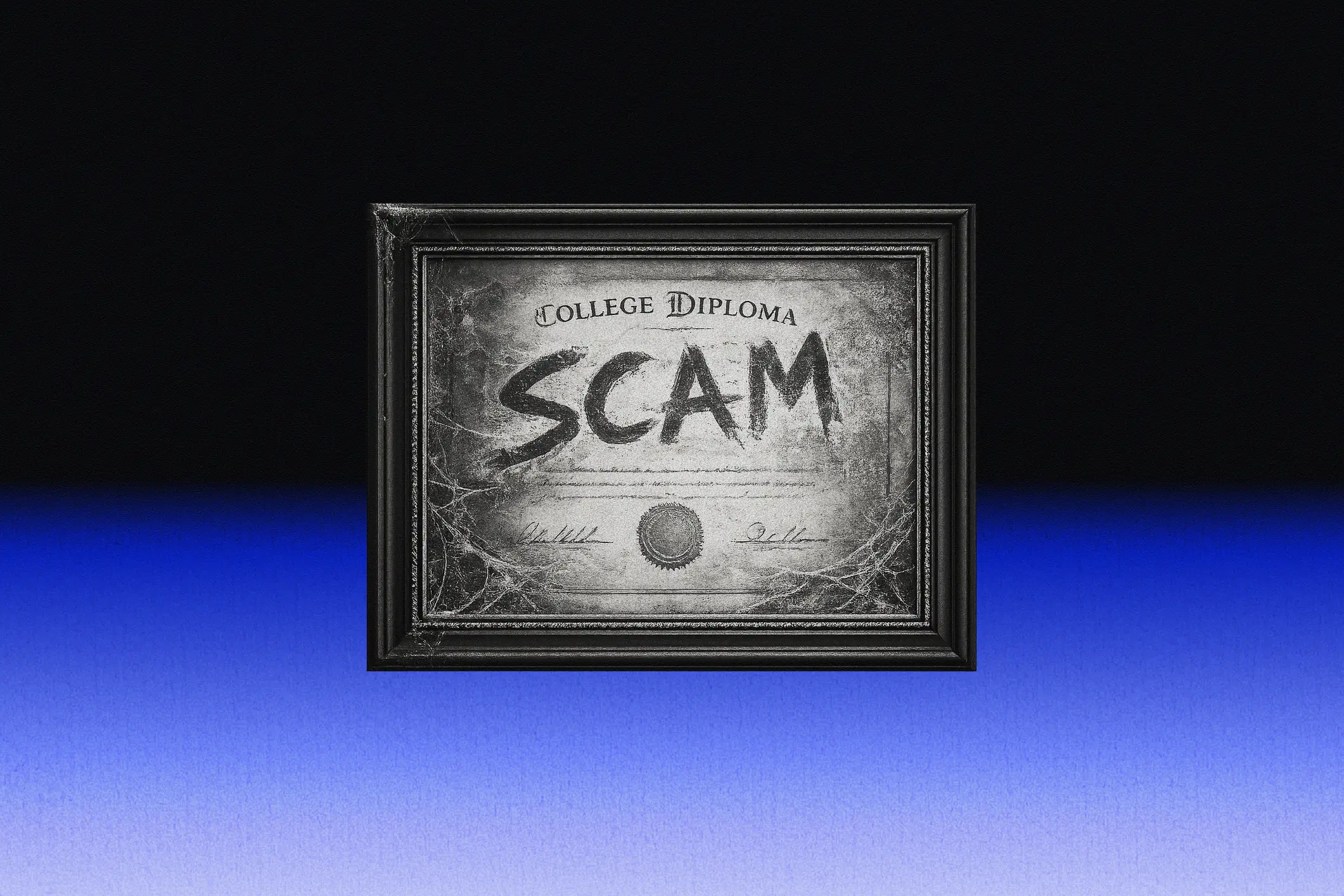
Is College a Scam? It Can Be When You Don’t Have a Plan
College can be a scam if, even after doing all the right things, you can’t land a job. But others may not agree since it’s helped them grow in their careers.
Published on
January 7, 2026
Updated on
January 7, 2026
Here’s why people believe college is a scam: rising costs and student loans, no guarantee of getting a job, some professions don’t need a degree, you can learn for free or at a fraction of the cost online, it’s not the only way into the workforce, and some courses may not lead to the outcomes you hoped for. In contrast, some may argue that college is not a scam because some jobs simply require a degree, many job postings include a degree as a requirement, and you generally have a higher chance of increasing your earning potential. Plus, college may give you transferable skills and knowledge alongside valuable connections.
We’ve all heard the question before: is college a scam?
For some people, it absolutely feels that way.
You do everything right: study hard, graduate, and still can’t land a decent job. Or worse, you realize you never even needed a degree for the career you wanted in the first place.
But for others, college ends up being a stepping stone, a qualification that adds weight to their professional background and helps them advance in their careers. In that case, can you really call it a scam?
College can either be a smart investment or a costly mistake. It all comes down to how you use your education and whether you have a plan. If you know why you’re going and how you’ll use that degree, it can open doors. But if you’re going in blind, hoping it’ll magically secure your future — that’s when it can feel like the biggest scam of all.
In this article, we’ll cover everything about why college is and isn’t considered a scam.
Why College Is Considered a Scam
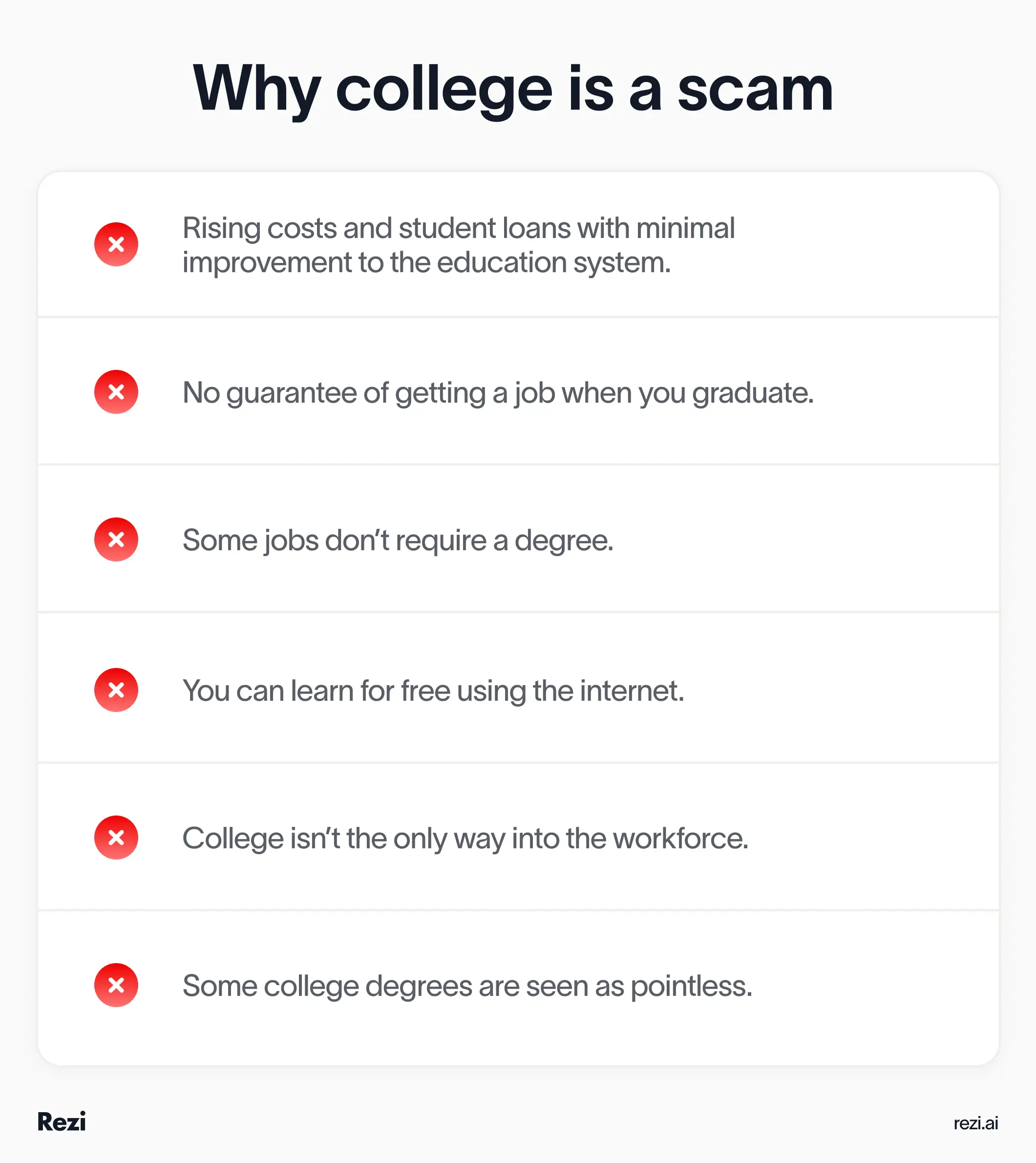
Here are the main reasons going to college is considered a scam:
- Rising costs and student loans.
- No guarantee of getting a job when you graduate.
- Some jobs don’t require a degree.
- You can learn for free using the internet.
- College isn’t the only way into the workforce.
- Some college degrees are seen as pointless.
This post on Reddit is a good example of why people believe college is a scam:
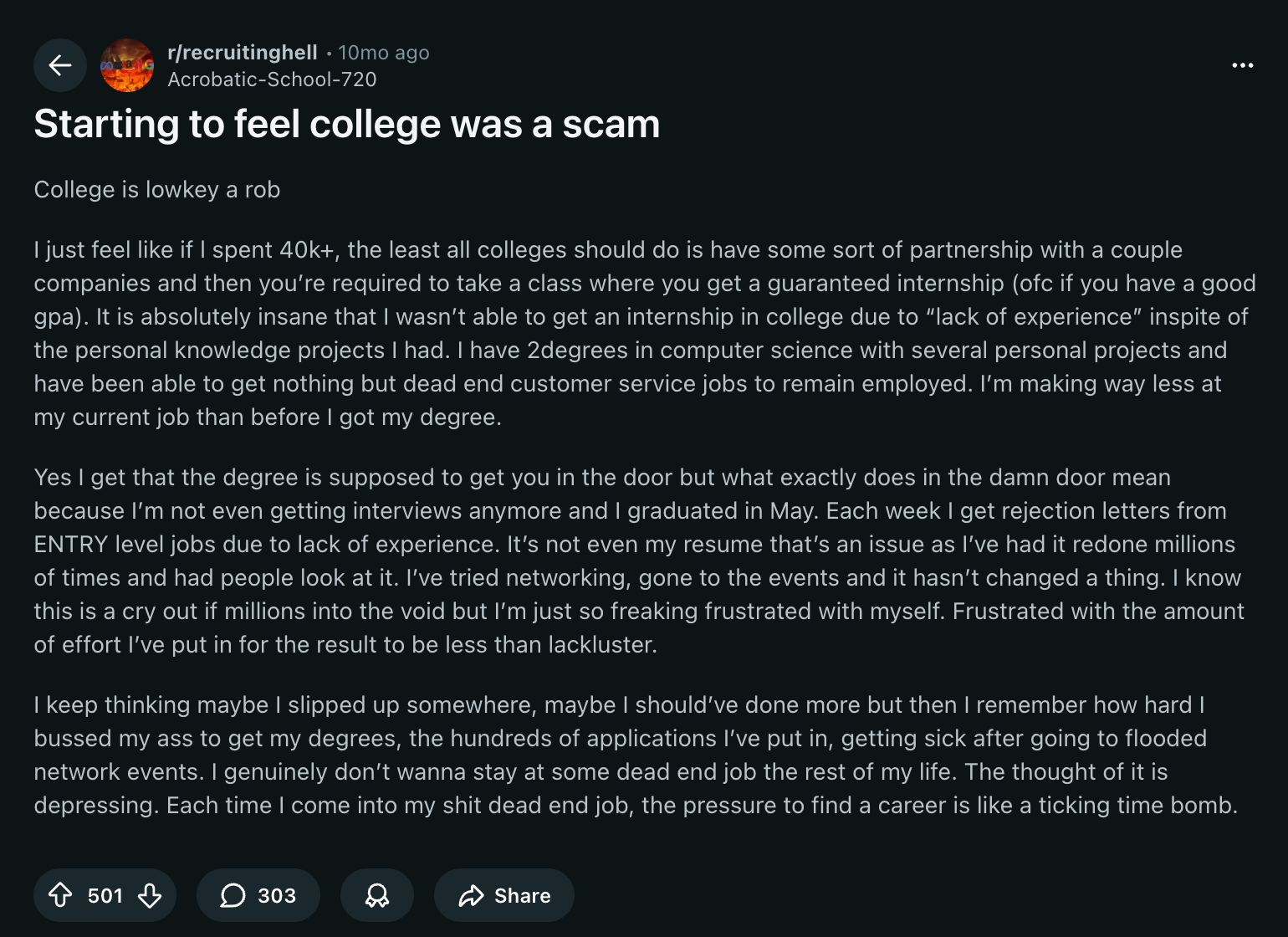
According to the Reddit user, even with two degrees and several projects under their belt, they couldn’t land an internship during college. Despite all their qualifications, they’re still struggling to find success in the job market and are now stuck in what they describe as a dead-end job. It’s a frustrating outcome that, for them (and for many others), it makes it seem that going to college is almost meaningless.
With that said, let’s take a closer look at why so many people feel college can seem like a scam.
Rising costs and student loans
It’s hard not to feel wary about the value of college when the price tag keeps climbing while the payoff feels more uncertain.
Over the last few decades, college tuition and fees have soared: from 2000 to 2019 the average cost for university students rose by about 59%, according to USAFacts.
Meanwhile, wages for most people have barely budged. The median income growth has been sluggish especially when adjusted for inflation, as shown by the Economic Policy Institute. Add in the fact that Americans now owe over $1.6 trillion in student loans, a 42% increase from what they owed a decade ago for higher education, according to Pew Research Center.
Although the cost of college has skyrocketed, many feel that the quality and relevance of education haven’t kept up. You’re paying more than ever, yet often still learning from outdated curricula with limited real-world or career-focused training. In many cases, college doesn’t prepare students as effectively for today’s job market, and unlike in the past, there’s no longer a clear job guarantee waiting after graduation (more on this in the next section).
When tuition is rising faster than salaries and the return on investment becomes murkier, it becomes easy to understand why some people label college a “scam.”
Relevant articles:
- How to Choose a Career
- Gen Z Work Ethic Explained
- The Average Salary of a College Graduate
- How the 2024 US Election Results Affected the Job Market
No guarantee of getting a job when you graduate
Just because you have a college degree doesn’t always mean you’re guaranteed a corporate job.
Only about 60% of the class of 2021 secured traditional employment six months after graduation, as revealed in an article by Duke University. Then, 15.7% of graduates were still seeking employment or education opportunities.
However, you’ll find several unfortunate stories from university graduates online. For instance, this Reddit user shared their experience about graduating in 2022 yet still being unable to find an entry-level role:
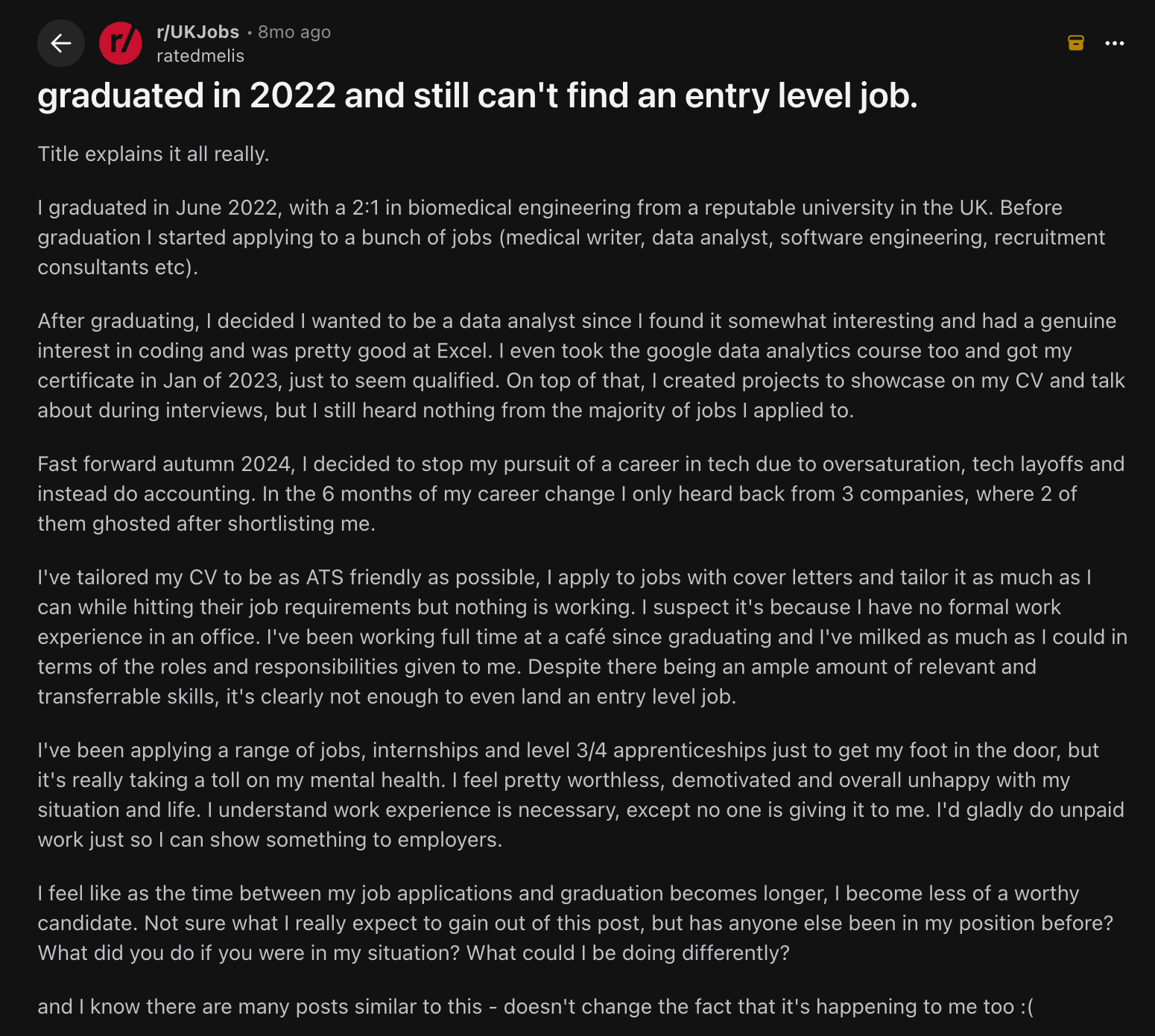
You could do everything “right,” spend years studying, and still struggle to land a job in your field. The job market today rewards skills and experience more than credentials alone, especially with the rise of skills-based hiring. The degree may still open a door — but which door, how far it leads, and how fast you’ll move through it all depend on far more factors than in previous decades.
Relevant articles:
- What to Do When You Can’t Get Hired
- What to Do When Unemployed
- How to Move Forward When You Feel Stuck in Life
- Big Company Layoffs in 2025
Some jobs don’t require a degree
More employers are dropping degree requirements altogether and focusing instead on skills, experience, and results. In fact, as of early 2024, about 52% of U.S. job postings didn’t mention any formal educational requirement, according to data from Indeed Hiring Lab.
This shift is clear in fields such as sales, marketing, and design, where your ability to perform often matters more than where (or whether) you studied. You can learn digital marketing online, for instance, build a portfolio, or sell products long before setting foot in a classroom.
With that in mind, that’s one reason why college starts to feel like a scam, because if the job you’re aiming for doesn’t require a degree in the first place, spending tens of thousands on one can be unnecessary. You don’t always need a degree to build a successful career.
- What Are the Highest Paying Jobs in the US?
- The Best Blue-Collar Jobs
- How to Make Money From Home
- How to Get TikTok Famous and Turn It Into a Career
You can learn for free using the internet
You can literally learn about almost any topic online. Gaining job-ready skills doesn’t always require you to go to college.
A report by the Society for Human Resource Management (SHRM) found that 45% of workers now hold an alternative credential. And, most employers agree that these credentials are valuable to the workplace.
Additionally, according to the Association for Financial Professionals (AFP), 87% of executives and 90% of HR professionals believe certified individuals can perform better.
Thanks to online learning platforms, you can study everything from coding and digital marketing to design and business, all from your laptop. And the best part? You can often learn for free or at a fraction of the cost of college. That’s another reason why people may question whether college is worth the cost.
College isn’t the only way into the workforce
College isn’t the only way into the workforce anymore. It’s just one of many, and not always the best one depending on your goals. There are other practical ways to spend your time and money than going to college.
For example, if you wanted to become a video editor, you’d probably learn and grow faster by working on real projects, building a portfolio, and taking specialized online courses or professional training than by spending years in a college classroom. In creative fields, employers tend to care far more about what you can actually create than about the degree on your resume.
And by the time most graduates are still finishing their studies, you could already have clients, income, and a solid portfolio.
Or take accounting, for instance. In the UK, you don’t necessarily need to go to university to become a chartered accountant. Instead of completing a full degree first, you could earn a professional diploma, then move on to the chartered accounting program directly. This route still gives you the same professional qualification but at a fraction of the cost, without the burden of tuition fees or student debt.
Depending on your career goals, online qualifications and on-the-job training could get you further ahead. These alternative paths would blend real-world experience with professional credibility, preparing you for the job market much sooner.
Of course, some fields—like medicine or law—still require formal degrees. But for many others, the return on investment from hands-on learning, mentorship, and industry certifications can be far higher than a traditional degree.
Some college degrees are seen as pointless
It’s tough to ignore when you dig into the numbers: certain college degrees won’t always deliver the return on investment you might have hoped for.
One report by The National Center for Education Statistics revealed that in 2018, the median annual earnings for bachelor’s degree holders ranged from around $40,300 in fields like liberal arts to $78,700 in STEM fields.
When you’re spending tens of thousands of dollars and 3–4 years of your life, seeing a degree that offers the same (or worse) earning potential as nondegree paths can make it feel like the degree itself wasn’t worth the investment at all.
That said, if you’re headed into a field where credentials don’t guarantee reward and alternative paths exist, it’s worth questioning whether a traditional college path is really the best choice.
Why College Isn’t Considered a Scam
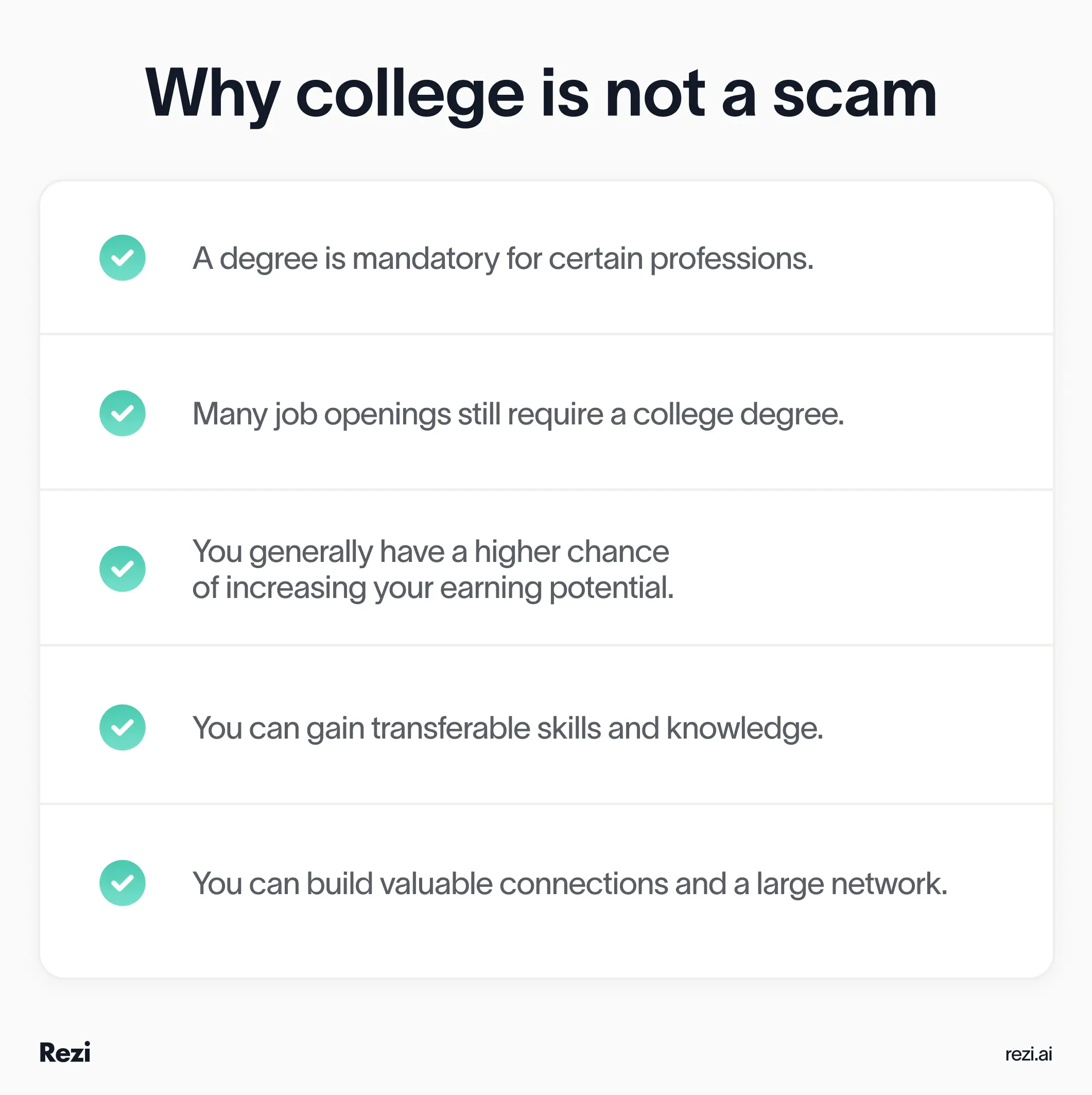
Here are the main reasons going to college is not considered a scam:
- Certain professions require a degree.
- Many job openings still require a college degree.
- You generally have a higher chance of increasing your earning potential.
- Transferable skills and knowledge.
- You can build valuable connections and a large network.
One Reddit user put it nicely in a discussion on whether college is a scam—they explained that education itself is always useful because it helps people think critically and engage with the world. The sentiment that college is a scam often comes from the fact that it’s no longer the guaranteed path to a stable job that it once was.
But even then, from an educational and credibility standpoint, college can still hold real value, depending on how you use it.
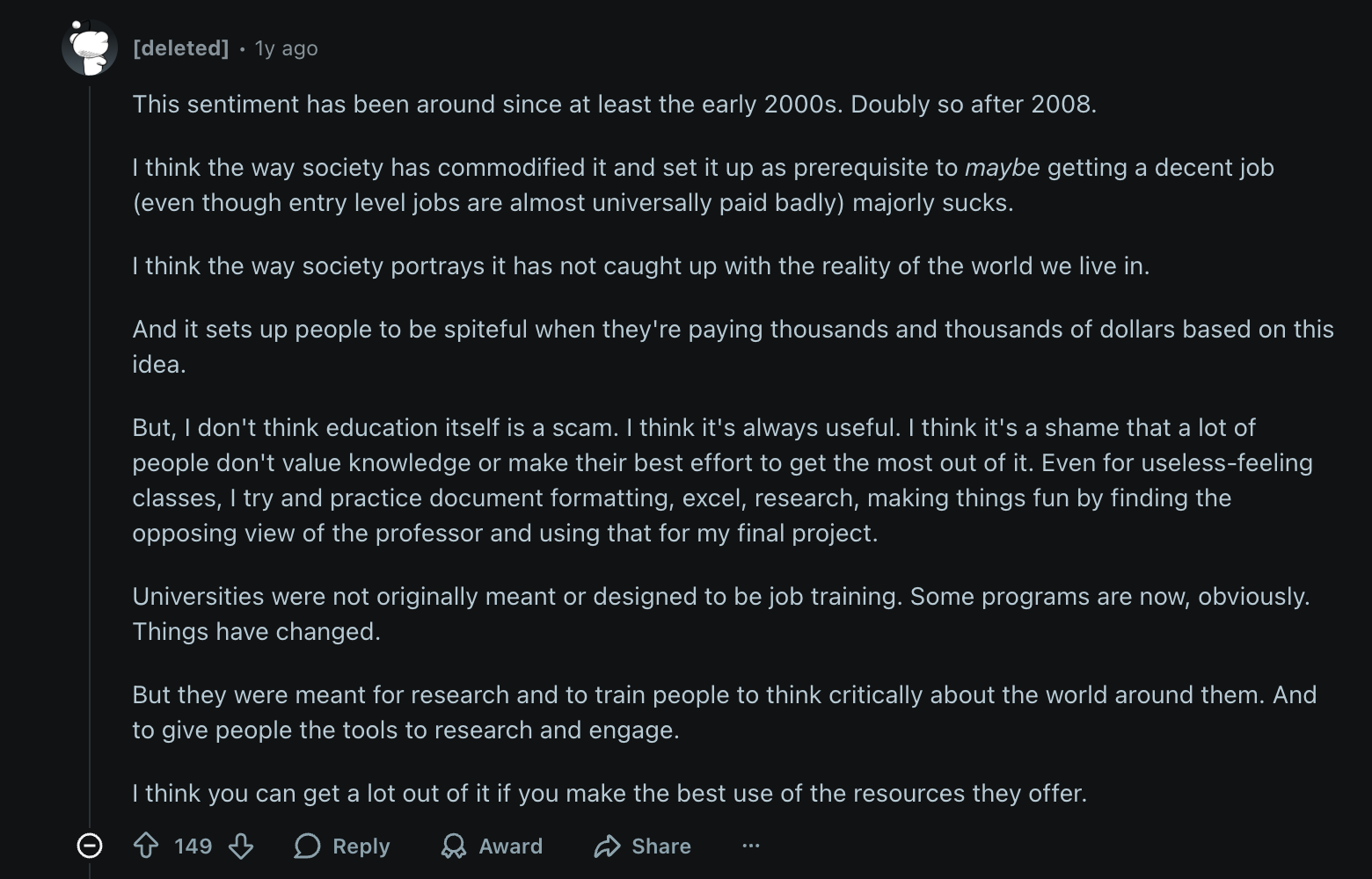
For some, college is a life-changing opportunity that opens doors. For others, it may feel like an expensive mistake that didn’t pay off. But if your university degree truly helps you build skills, credibility, and the network you need, can it really be called a scam?
The issue isn’t always with college itself (although there are valid concerns about the current education system), but often with going to college without a clear plan or purpose.
Further reads:
- How to Survive a Layoff
- How to Write a Survival Job Resume
- The Best Job Search Engines
- How Personality Type Influences Your Work Style
- How to Track Your Job Applications
Certain professions require a degree
If the job you want requires a degree then going to college is not a scam. Period.
In other words, there’s no way around college when your dream job is to become a doctor, lawyer, or architect. Formal education, professional accreditation, and years of education and training are mandatory.
In these fields where a degree is necessary, college is about earning the qualifications required to practice legally. Therefore, in this context, calling college a scam isn’t really fair because you’re paying for access to a profession, not just for the learning itself.
Many job openings still require a college degree
Companies still frequently list a college degree as a requirement in their job descriptions, especially for graduate schemes and corporate roles. The U.S. The Bureau of Labor Statistics projects that occupations which typically require a bachelor’s degree will see around 3.3 million job openings each year.
So without a college degree, you might find yourself automatically excluded from even being considered for these positions.
And while it’s true that more companies are gradually dropping degree requirements, having one still gives you more job postings that you could potentially apply for.
You generally have a higher chance of increasing your earning potential
Research from the Social Security Administration shows men with bachelor’s degrees earn roughly $900,000 more, and women around $630,000 more, than high school graduates.
People who earn a bachelor’s degree typically bring in higher wages and face lower unemployment than those who stop at high school. So if you’re in for the long haul, the investment in a degree can pay off.
And of course, it’s not a guarantee, and it depends a lot on your major and field, but statistically speaking, having a degree increases your odds of earning more and being in a better position financially.
Transferable skills and knowledge
The versatility of a college degree is often overlooked.
No, it’s not just about knowing one subject, it’s about developing a toolkit of skills that you can carry into any field or industry you wish to pursue.
Say you studied engineering but later realize you’d rather work in design. You’ve still got strong analytical, project-management and problem-solving skills from that degree. That can still give you an edge when applying for roles outside your original major.
However, the opposite can also be true: if you’re unsure about your path when you start college, those four years could instead have been spent building real work or portfolio experience. But when you do complete a degree, that qualification adds versatility and credibility. It gives you a foundation you can build on and the flexibility to shift gears when your interests or the job market change.
Read more about different types of resume skills:
- The Best Skills to Put on a Resume
- AI Skills for Your Resume
- Best Communication Skills for a Resume
- Top Computer Skills for a Resume
- Resume Hard Skills Explained
- Resume Soft Skills Explained
- Leadership Skills to Put on a Resume
- Technical Skills to Put on a Resume
You can build valuable connections and a large network
Beyond lectures and exams, college gives you something you won’t easily find anywhere else: a place to meet people of the future. You never know, that one person you had a late-night study session or played beer pong with could be your future business partner or job referral.
The college experience also lets you live in an environment that’s hard to recreate later in life. You’re surrounded by diverse ideas, backgrounds, and ambitions, all of which can help you grow personally and professionally.
Sure, tuition costs are steep, but the network and connections you build might be what pays off most in the long run.
Summary: Is College a Scam After All?
I wouldn’t necessarily say that everything about college is a scam. But when you consider how some people still struggle to find good jobs even after earning their degree and how you can now learn many of the same skills online for free or at a fraction of the cost, it’s easy to see why people question its value (and there are many times when I do too). There are definitely valid arguments on both sides.
College can feel like a scam when you do everything right: study hard, get the degree, and build a few projects, yet still struggle to find a stable job or clear career direction.
With how the world is advancing, the perceived value of a degree is simply not what it used to be. Many employers today care more about what you’ve actually done and real-world experience often speaks louder than a qualification.
That said, I personally don’t think college itself is a scam, but only if you know exactly why you’re going and have a plan for how you’re going to use your degree. If you’re intentional about what you want to learn and how it connects to your goals, college can still be a worthwhile investment.
The education system isn’t perfect. Rising tuition, student debt, and outdated teaching methods are all flaws in the system. But for the right person, in the right field, and with the right mindset, college can still open doors, boost your earning power, and introduce you to people who could change your life.
If you’re deciding on your next step and need help with job applications that will get you interviews, you can get started with our AI Resume Builder for free.
FAQs
Why do people say that college is a scam?
People say college is a scam because many graduates end up with massive debt and limited job prospects despite paying high tuition fees. Critics argue that colleges often overpromise career outcomes, teach outdated material, and prioritize profit over education quality. Nowadays, there are alternative paths that can lead you just as far (or even farther) than a college degree. For example, online courses, apprenticeships, self-taught skills, starting your own business or side project, and more. These alternative paths can still lead to high-paying careers, but at a fraction of the cost of going to college.
Is college a money making scheme?
Some argue that college has become a money-making scheme because costs keep rising while the quality of education hasn’t improved at the same pace. Tuition has grown far faster than wages, yet many students still sit through large lectures, outdated curricula, and limited real-world training. Meanwhile, universities continue to expand administrative staff, build luxury facilities, and market degrees as essential for success, often without delivering proportional value. In other words, the price of college has inflated, but the return on investment for many students has stayed the same, or even declined.
Is the entire education system a scam?
Some people call the education system a scam because they argue that it prioritizes profits, prestige, and standardized testing over genuine learning and real-world skills. Despite rising costs, many schools and universities still rely on outdated teaching methods that don’t match the demands of today’s job market. Students are encouraged to follow a one-size-fits-all path, often graduating with debt and few practical skills that prepare them for their personal and professional life.

Upload or drop your resume to get started
Upload your resume to get started
Score my resume

Astley Cervania is a career writer and editor who has been sharing resume and job search insights for 5+ years. He shapes the direction of the Rezi blog, providing practical answers for important career-related questions and helping hundreds of thousands of people navigate the job market and build resumes that land interviews.