
Career Advice
Is College Worth It Anymore? Not Always, But Here’s Why
The value of some college degrees have decreased. Experience is becoming more important, but that doesn’t always mean college isn’t worth it, and here’s why.

Published on
January 7, 2026
Updated on
January 7, 2026
Some may argue that college isn’t worth it anymore because of rising costs, debt, and the fact that it’s no longer the only path to career success. With alternatives like apprenticeships, bootcamps, and certifications, and with many fields not requiring a degree at all, its value depends heavily on your goals. Plus, the rise of skills-based hiring shows that employers increasingly prioritize experience and abilities over credentials. Still, college can be worthwhile, as data shows college graduates generally have access to more job opportunities and higher lifetime earnings.
I didn’t go to college.
I took a gap year to figure things out because I didn’t want to spend more than $50,000 studying for the next 3–4 years without knowing what I actually wanted to do.
And so far, I don’t regret that decision.
Since then, I’ve built a strong track record and now work in-house as an editorial manager for a company I’m genuinely passionate about. I’ve managed to build my career faster than many of my classmates who went to university, but that doesn’t always mean I think college isn’t worth it.
And that’s why I wrote this guide: to help you make the most informed decision on whether going to college is the right choice for you.
Too many people enroll without a clear direction. They graduate unsure of what to do next and struggle to land their first role. Entry-level jobs are asking for experience, not just a degree, and with skills-based hiring on the rise alongside AI changing the job market, the value of higher education isn’t as straightforward as it used to be.
So before you commit years of your life and tens of thousands of dollars, let’s break down the data, the pros and cons, and what it really means for your future.
College Degree vs. No College Degree
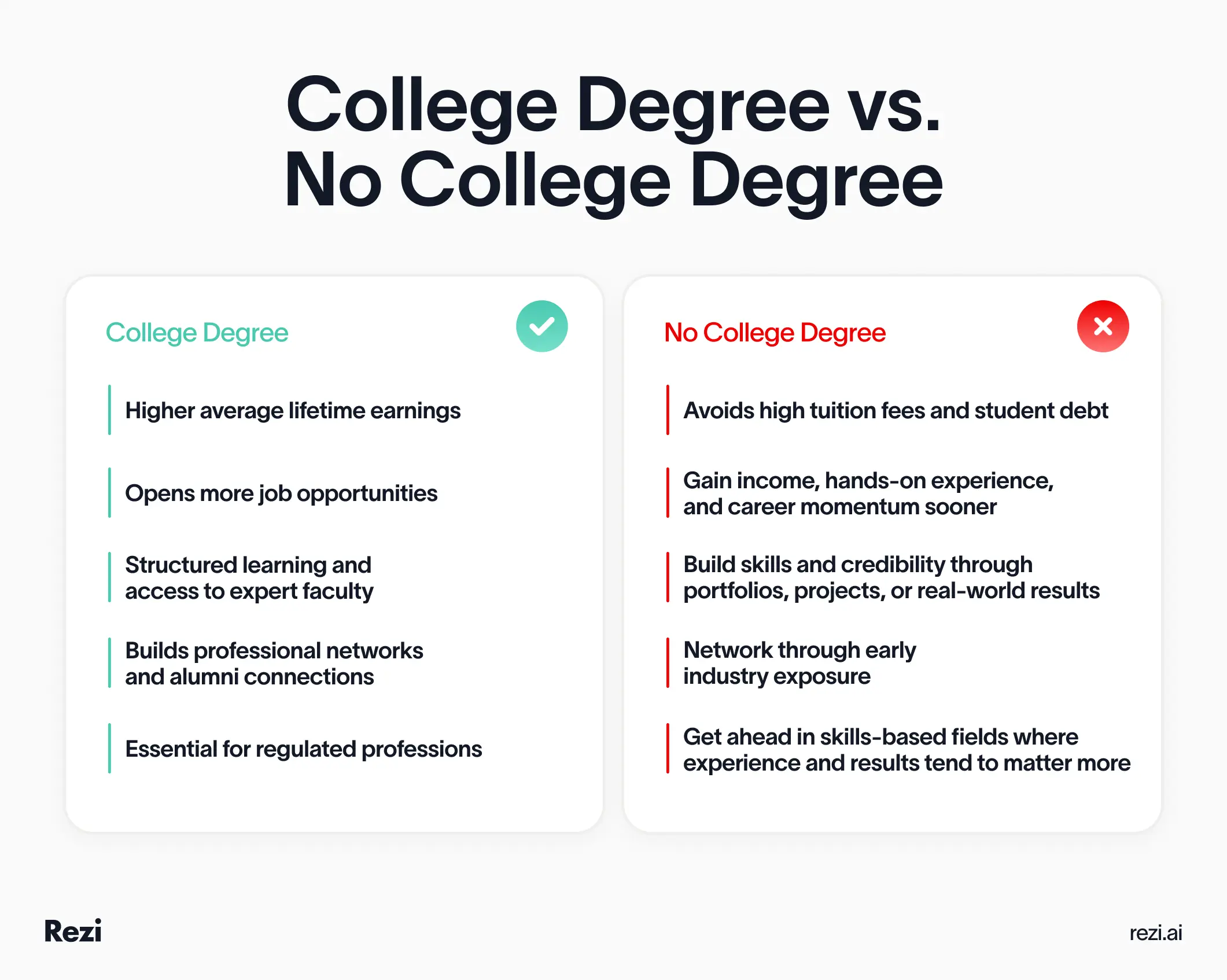
You’ll hear lots of strong opinions on this on either side of the spectrum.
Some “gurus” might say that degrees don’t matter and then proceed to promote their own course that promises to make you rich. You’ll also see famous success stories like Bill Gates, Steve Jobs, Richard Branson, or Elon Musk, who’ve all either dropped out or spoken openly about not needing college degrees.
But here’s the reality: while you can still succeed in your career without college, the odds are generally higher when you do have a degree.
A degree can lead to better employability and higher lifetime earnings, but it could also lead to regret if you dive in without a plan, especially given the financial and potential opportunity costs.
For example, you don’t need a degree to become an entrepreneur, but if your goal is to go the corporate route, then going to college or business school can genuinely give you an advantage. Top companies like Tesla, Microsoft, and Amazon still hire plenty of graduates and professionals with college degrees.
And some influencers may say they never needed to use their degree, but even just having it as a backup can be valuable, especially when it gives you useful and transferable skills or knowledge.
Again, the reality is nuanced, that’s why we’ll take a closer look below based on some key factors.
Relevant articles:
- How to Choose a Career
- The Gen Z Job Market
- Does Gen Z Lack Work Ethic?
- What to Do When Unemployed
- How to Write SMART Goals
- How to Change Careers
Do college graduates have better employability and earn more money in their lifetime?
Yes, college graduates with a bachelor’s degree usually earn more in the long run.
A report from The Bureau of Labor Statistics indicates that workers with a bachelor’s degree or higher had more earnings than those without. Another report from The Bureau of Labor Statistics also found that those with a bachelor’s degree or higher had a lower unemployment rate than those without a degree.
In the UK, an article from the Universities UK shared that between ages 23 and 31, graduates see their earnings grow by an average of about 72%, compared to 31% for non-graduates.
However, these are averages. When looking at lifetime earnings, you also have to factor in student debt. Plus, your subject, university reputation, ability to network, and your own ambition can affect where you land.
A degree doesn’t guarantee success, but it can tip the odds in your favor when you use it well.
Read more: Average Salary of a College Graduate
What are the opportunity costs for going and not going to college?
When you go to college, the main opportunity cost isn’t just tuition, it’s the years you spend studying instead of working, building experience, or even starting a business. That’s time you can’t get back, and it can feel like a setback if you graduate without a clear plan.
On the other hand, the cost of not going to college is the doors you may close off: certain careers, promotions, or even the credibility a degree provides when competing for jobs.
Regret ties into this as well. Some people may regret going to college because they chose the wrong subject, racked up debt, or realized later they didn’t need the degree for the path they wanted. Others may regret not going because, while they gained experience, they felt limited by the lack of credentials or missed out on opportunities that required one.
Read more: Highest Paying Jobs in the US
The “student experience”
Beyond classes and exams, college gives you a ready-made social life—friends, societies, events, and that sense of community that comes with being surrounded by people your age all going through the same thing. For many, it’s the first real taste of independence, living away from home, and figuring out how to manage life on their own, which can be a valuable experience.
On the other hand, not going to college usually means you need to make a more conscious effort to have a social life. You can absolutely build connections through professional events, industry groups, and early work experience, but if I’m being honest as someone who didn’t go to college, it’s not quite the same. It can also be more challenging because you have to actively put yourself out there instead of having all the social opportunities handed to you.
Why College Is Worth It (The Pros Of Going to College)
Here are the biggest pros for going to college:
- More job opportunities. Many roles still list a bachelor’s degree as a minimum requirement. Having one can open doors and give you options that simply aren’t available without it.
- Higher lifetime earnings. On average, people with college degrees earn more over their careers than those without.
- Access to regulated professions. Certain career paths like medicine, law, or engineering require formal qualifications. Without the right degree, you can’t legally practice in those fields.
- Connections and upward mobility. Beyond academics, college can provide a network of peers, mentors, and opportunities. For students from low-income backgrounds or families who have never been to college, earning a degree could be life-changing.
Although a college degree is no longer a guaranteed path to success, there are consistent links between higher education, better employability, and stronger long-term earnings. A degree isn’t everything but it can tilt the odds in your favor.
More job opportunities
A big advantage of having a degree is simply access.
Many job postings still list a bachelor’s degree as a minimum requirement, even for roles where skills and experience arguably matter more. For better or worse, some companies use this as a quick filter when narrowing down applicants.
Speaking personally, I’ve seen this firsthand. When looking through some job boards, I often come across postings that say a degree is required. At times, it makes me feel like I’m locked out even though I don’t feel any less competent. My track record and skills speak for themselves, but I’d be wrong to say the degree requirement hasn’t sometimes felt like a barrier.
Another overlooked benefit of having a college degree is flexibility. Even if you decide not to pursue a career directly tied to your field of study, just holding a degree can help open doors in other industries where it’s still valued as proof of discipline, credibility, and capability.
That said, the reality is a degree still opens more doors even if it’s not always the deciding factor once you’re through them.
Higher lifetime earnings
For many people, the biggest financial argument for college is this: over the course of a lifetime, degree holders tend to earn more.
Going back to the median weekly earnings comparison as shown on The Bureau of Labor Statistics, full-time workers in the US aged 25+ with a bachelor’s degree have median weekly earnings of $1,754 compared to $953 for those whose highest degree is a high school diploma. That gap compounds year after year, and education is one of the most consistent predictors of higher income.
However, the income from a degree has to offset the costs: tuition, fees, and student debt, plus the years you weren’t earning full-time while studying. For some graduates, debt repayments can eat into the gains, especially in lower-paying majors or early in their careers.
Now, let’s address the elephant in the room: why do people without a college degree usually earn less?
In most cases, they work in jobs with lower barriers to entry, limited career progression, or lower pay ceilings. They may also have fewer formal qualifications to move into regulated or higher-paying fields, which restricts options.
However, not everyone who doesn’t go to college follows this trend. There are always outliers. Some people who don’t go to college may still end up doing better or just as well financially than those who did go to college. It’s possible with the right mix of skills and persistence (more on that later).
Access to regulated professions
If your dream career requires a degree, then going to college makes a lot of sense.
Certain professions are regulated, which means you legally can’t practice without the right degree. Medicine and law, for example, are fields that demand formal qualifications. There’s no way around it.
So for some people, that’s exactly why college is worth it.
If you’ve always dreamed of becoming a doctor or lawyer, then going to a good college is not just an investment, it’s the only route to make that dream real. And while those degrees often come with heavy costs, they also carry strong earning potential once you’re qualified.
Even beyond earnings, the fulfillment of pursuing a career you’ve wanted for years can make the years of study worthwhile.
And so, if your goals lie in a regulated profession that requires a degree, college is essential.
Connections and upward mobility
Another major benefit of college education is the connections you make along the way.
Universities give you access to peers, professors, mentors, alumni networks, and events that can open doors later in your career. Many people land graduate programs, internships, and job opportunities through someone they met at college, not just by applying cold online. These connections can compound over time.
And for students from low-income or first-generation backgrounds, the impact can be even bigger. Going to college doesn’t just give you a qualification, it can quite literally shift the trajectory of your life. It might be the first step toward breaking into higher-paying industries, building financial security, and creating opportunities that weren’t available to your parents or family.
Why College Might Not Be Worth It (The Cons of Going to College)
Here are some of the top reasons why college might not always be worth it:
- Not all professional fields require a degree. Some professions, especially in tech, the arts, or skilled trades, don’t need a traditional degree. Certifications, apprenticeships, and portfolio work can often get you further, faster, and for less money.
- Risk of regret and not using your degree. Graduates may end up finding out that their degree isn’t relevant to the career they want, or that the subject they studied doesn’t match what they actually want to do. This can lead to regret—both about the money spent and the years invested—when the qualification feels disconnected from their long-term goals.
- Student debt and rising costs. Tuition, living expenses, and student loans are higher than ever. Add to that 3–4 years out of the workforce, and the opportunity cost could become significant.
- Shifting value of degrees. Many employers are moving toward skills-based hiring and placing more weight on work experience and portfolios. With alternatives like bootcamps, online learning, certifications, and apprenticeships becoming more credible, a degree doesn’t carry the same guaranteed advantage it once did for older generations.
An article from Inside Higher Ed shared that around 25% of graduates admitted that they regret going to college. And in the UK, it was shared by Times Higher Education that about half of university graduates regret some of their studying choices. This highlights how crucial it is to make the right decision upfront.
And honestly, this is where the education system could do better.
Students aren’t always given the tools or guidance to think long-term about their degree choices and how those decisions connect to future careers. Additionally, not all graduates are equipped with everything they need to know to succeed in a broken job market. That’s one reason why we often see a lot of common resume mistakes among students and graduates.
And from speaking with friends and other students, I’ve noticed many chose their courses based mainly on what they found interesting at the time without as much consideration for where it might lead professionally.
To be clear, I’m not saying you shouldn’t follow your passion—you absolutely should. But pairing that passion with some foresight about career options, skills you’ll gain, and the opportunities your degree could unlock can make the difference between a choice you’re proud of and one you might regret later.
Not all professional fields require a college degree
In fields like sales, marketing, tech, and design, what employers really want to see is results. Skills, experience, and a proven track record often matter more than a qualification.
Some examples of alternatives to college include:
- Apprenticeships
- Professional diplomas
- Certifications
- Online courses
- Bootcamps
These options let you build credibility without taking on student debt. That was one of the biggest reasons I decided not to go to college.
From early on, I knew one of my strengths was writing. I enjoyed it, I felt like I was good at it, and over time I learned I could turn it into a career. That eventually led me to where I am now—working as an editorial manager in marketing for a resume software company.
During my gap year, I explored different jobs, mostly in sales. Those experiences gave me valuable skills and helped me discover copywriting as a profession. Soon after, I started freelancing and taking online courses, building my portfolio, learning, and earning.
Even as freelancing grew, I felt I should have a more “safe” option by pursuing some kind of degree or higher education. At the time, accounting looked like the most practical path. Here in the UK, you can either take the traditional route of an accounting degree followed by a chartered program, or the alternative AAT qualification, which lets you bypass university and still reach the same programs. I chose the latter while continuing to freelance in marketing.
But after completing the first level of AAT, I realized an important truth: practicality without passion is hard to sustain. I didn’t enjoy accounting the way I enjoyed marketing, and freelancing was gaining momentum. That’s when I decided to leave accounting behind and commit fully to marketing—a path that felt aligned with my core strengths and interests.
Bottom Line: Whether you choose a college degree or an alternative, the best path is the one that combines your strengths with long-term opportunities.
Degrees aren’t always the gatekeepers they once were. Many of today’s highest-paying fields are open to people who can prove their skills. Yet some professions will always require a degree, and in those cases, pursuing one isn’t just the best option, it’s one of the smartest investments you can make.
Read more:
Risk of regret and not using your degree
Another potential downside of going to college is that you might finish your degree only to realize you don’t want to use it. This happens more often than people expect.
Sometimes it’s because your interests change. Other times, it’s because the degree doesn’t align with the career path or lifestyle you’re aiming for.
Why does this happen so often? A big reason is that many students choose their degree based on short-term interest or external pressure rather than a clear vision for the future. It’s common to commit to a subject only to realize a few years later that your goals have shifted, or that the qualification doesn’t open the doors you thought it would.
Now, this doesn’t necessarily make degrees worthless. Most people still gain useful skills and discipline from the process but the regret often comes from wishing they had made the decision with more long-term foresight.
Student debt and rising costs
The average student loan debt in June 2025 is $39,376, according to The Motley Fool. For many, that number comes with long repayment periods, interest compounding, and restricted financial flexibility.
The impact isn’t just monetary. Debt payments often push graduates into higher-paying roles they may not want, delay major life decisions like buying a home or starting a business, or limit their ability to take career risks.
On top of that, there’s the opportunity cost you give up while studying: the salary, experience, and momentum you could’ve gained if you’d been working instead. Depending on your major and career field, the return on that investment may or may not justify the cost.
Shifting value of degrees
For older generations, a college degree was almost synonymous with success. It shaped the traditional expectation: get good grades, go to university, and you’ll secure a stable, well-paying career.
Now? Things look very different.
Employers are shifting toward skills-based hiring, where your abilities matter more than the credential you hold. A report from LinkedIn revealed that globally, companies taking a skills-based approach can grow talent pools by 6.1x. It was also shared on Forbes that 90% of companies make better hires when focusing on skills rather than college degrees.
For graduates and job seekers, the takeaway is clear: your degree may open doors but it’s your skills and track record that will set you apart.
The Workplace Is Changing Fast and More College Graduates Are Struggling
Times have changed. A degree used to be your golden ticket to corporate success and climbing the ladder. It carried significant weight, signaled credibility, and opened doors. But today, that’s no longer guaranteed. College alone doesn’t mean you’ll have a smooth transition into the workforce.
And the truth is, a degree isn’t as valuable as it was in previous generations.
To put it bluntly, the current job market is awful.
In the US, the unemployment rate for recent college graduates (ages 23–27 with a bachelor’s degree) rose to 4.59% and 2.42% for older college graduates (ages 28 and older with a bachelor’s degree), as shared in an article from the Federal Reserve Bank of St Louis.
Meanwhile, underemployment—graduates working in roles that don’t require a degree—has also stayed stubbornly high.
And in the UK, the graduate unemployment rate nudged up to about 6% as shared by Universities UK.
What’s driving this? Good question. Here are some of the main factors:
- Degree inflation. Over time as more people kept earning degrees, the perceived value of a degree itself has decreased.
- Skills-based hiring is increasing. Many employers are starting to care more about your experience and what you can do than where you studied.
- A bad economy. Hiring freezes, automation, and tighter budgets all account for increasing company layoffs and even having unrealistic expectations for entry-level roles.
Related articles:
- AI is Reshaping Work: How Learning Platforms Can Help You Stay Relevant
- Why Is It So Hard to Get a Job
- Why You’re Struggling to Find a Job
- What to Do if You Feel Stuck in Life
- I Hate My Job, What Now?
- Top Signs You’re Getting Fired
Now, this doesn’t always mean that pursuing a college degree isn’t worth it
If anything, this should emphasize how important it is to really think about your decision—why you’re going to college and where you want it to take you. Having a plan or at least a direction matters.
If I were going to choose a course to study, I would consider these key factors:
- Talents. Think about what you’re naturally good at. Choosing a subject aligned with your talent reduces friction and can give you an edge in learning and working long-term.
- Subject. Not all subjects carry the same weight. For example, graduates with a bachelor’s in STEM fields had higher annual earnings, according to NCES.
- Modules. Look at the specific courses you’ll take. Ideally, you want topics that are relevant and interesting, otherwise you could risk going through years of material you hate.
- Skills. Consider the real-world capabilities you’ll gain. Go for something where you’ll walk away with practical or transferable skills that employers value.
- Passion. Pick something you’re genuinely passionate about.
- Possible alternatives. Could an alternative path like an apprenticeship not only get you to your goal faster and more affordably, but also provide experience and skills that are just as valuable as a degree, or even take you further?
Summary: Is College Worth It After All?
Let’s recap the main points on why college might and might not be worth it:
- More opportunities. Degrees still open doors, with many employers using them as a filter and graduates often enjoying higher lifetime earnings.
- Not always necessary. In skills-driven fields like sales, tech, marketing, and design, proven results and experience often matter more than a degree.
- Strong alternatives. Apprenticeships, bootcamps, certifications, online courses, and freelancing can all help you build credibility without the debt.
- Risk of regret. Choosing a subject without long-term foresight can leave graduates wishing they had taken a different path.
- Rising costs. Tuition and student loans continue to climb, making the return on investment uncertain for some.
- Shifting value. Employers are increasingly adopting skills-based hiring, where abilities and portfolios carry more weight than credentials.
College can be worth it, and so can the alternatives, but only if you’re clear on what you want to gain from the journey: the skills, knowledge, and opportunities you’ll walk away with, and how you plan to use them.
With the right plan, either path can lead to success. What matters most is knowing why you’ve chosen your route and how it connects to where you want to go.
FAQs
When does more education lead to more earnings?
More education can lead to higher earnings, but the correlation really depends on the level of study and the field. On average, bachelor’s degree holders earn more than those with only a high school diploma, and generally, master’s degree holders often earn more than bachelor’s graduates. However, the jump to a PhD or professional degree only translates to higher pay in certain careers (like medicine, law, or research-driven fields) where those credentials are essential. In other industries, a master’s may offer a salary boost while a PhD could lead to limited job options or slower entry into the workforce. In short, higher education tends to pay off most when the advanced degree is directly tied to a career path with strong demand and high salaries.
Is college a waste of time?
College isn’t inherently a waste of time, but ultimately, it depends on your goals, financial situation, and chosen field. It’s essential for careers that require a degree like healthcare, law, or engineering. Even if you don’t end up pursuing a career in your chosen field, the credentials can help boost your job prospects. On the other hand, if your interests lie in fields where skills, experience, or entrepreneurship matter more, alternatives like apprenticeships may offer a faster path at minimal financial cost. The key is whether college provides a clear return on investment for your career path.
What is one benefit for us workers who have a college degree rather than a high school diploma?
One clear benefit is higher earning potential. Data shows that those with a college degree tend to earn more over their lifetime than those with just a high school diploma. A degree also tends to open the door to more job opportunities, greater job security, and roles that offer benefits like healthcare and retirement plans, which tend to be less common in lower-education jobs.

Upload or drop your resume to get started
Upload your resume to get started
Score my resume

Astley Cervania is a career writer and editor who has been sharing resume and job search insights for 5+ years. He shapes the direction of the Rezi blog, providing practical answers for important career-related questions and helping hundreds of thousands of people navigate the job market and build resumes that land interviews.