
Other
AI Impact on White-Collar Jobs: Is the Threat Real?
Discover the real AI impact on white collar jobs. What’s changing, what’s at risk, and how can professionals adapt in the new world of work?


Published on
October 24, 2025
Updated on
October 24, 2025
AI is reshaping white-collar work, but not by wiping it out overnight. It’s automating many repetitive and entry-level tasks across industries like tech, finance, admin, and law, meaning fewer people will be needed for routine work. However, it’s also creating new roles that blend human judgment with AI tools, like AI specialists and creative strategists. AI will replace parts of many jobs, especially predictable ones, and that’s why it’s crucial to adapt by learning AI tools, strengthening creativity, and developing problem-solving or leadership skills.
This question isn’t just floating around boardrooms and tech panels anymore. It’s coming up over coffee, in Slack channels, and probably in your group chats. We’re all trying to make sense of how artificial intelligence is impacting our lives, and white-collar jobs aren’t exempt.
But there are mixed messages. News outlets will make it sound like a robot apocalypse is days away, while others insist there’s no real threat. While nothing is guaranteed, we can make some pretty solid predictions based on voices from the top, firsthand experiences, and in-depth studies.
So, let’s explore the reality surrounding the red flags. This guide will explore:
- If AI is really coming for white-collar jobs.
- Which positions are the most vulnerable.
- How to protect yourself from AI disruption.
And if you’re on the hunt for your next AI-proof job, give yourself the best shot with our AI Resume Builder.
Is AI Going to Replace White-Collar Jobs?
AI is going to replace parts of many white-collar jobs, and in some cases, entire roles. Companies can use AI to code, write, analyze, and make decisions, often faster than humans. Entry-level and routine work will likely be hit first, but no desk job is fully immune.
Some of us might remember the days before the internet, back when most businesses thought it was just a passing trend. But now? We can’t imagine life without it. That’s where AI is heading: early, but enormous. The risk for leaders and their employees isn’t thinking too big about AI; it’s thinking too small.
Generative AI can write, design, analyze, code, summarize, reason, and even brainstorm like a human (sometimes better). It’s not just taking over routine work; it’s stepping into the creative and cognitive spaces that used to feel uniquely human.
What are business leaders saying about AI?
We’ve all seen the headlines claiming AI is going to take over all our jobs. And yes, many of these are just fearmongering clickbait, but there is some truth behind the warnings.
Even the biggest names in business are sounding the alarm:
- Amazon’s CEO, Andy Jassy, admitted that AI will make some corporate roles redundant. He said, “We will need fewer people doing some of the jobs that are being done today, and more people doing other types of jobs.” Since 2022, Amazon has trimmed over 27,000 roles as the company focuses on AI-driven efficiency.
- Dario Amodei, CEO of Anthropic, was even more blunt in his warning. In an Axios interview, he claimed “AI could eliminate half of all entry-level white-collar jobs, bringing unemployment to 10-20% in the next one to five years.” He said: “AI companies and the government need to stop sugar-coating the possible mass elimination of white-collar jobs across various industries.”
- Over in the finance and tech world, Doug Clinton of Intelligent Alpha told Investor's Business Daily that what he once thought would be a “50% job replacement rate” from AI might actually climb “closer to 80%” within the next couple of decades.
- Fiverr’s CEO, Micha Kaufman, also sent this viral email to his employees: “AI is coming for your jobs. Heck, it’s coming for my job too. This is a wake-up call. It does not matter if you are a programmer, designer, product manager, data scientist, lawyer, customer support rep, salesperson, or a finance person. AI is coming for you.”
I won’t list every CEO warning, but trust me, there’s plenty more like this.
And the statistics reflect these statements. The latest Future of Jobs Report found that 40% of employers expect to reduce their workforce where AI can automate tasks. Meanwhile, 61% of CEOs say they’re already rolling out AI agents (smart systems that can predict, adapt, and make decisions).
It’s no surprise that 77% of people say they’re worried about job losses due to AI. For many, it’s not just about losing income; it’s about losing identity, stability, relevance, and the sense of purpose that comes with work.
Of course, it’s not just white-collar jobs being affected. Find out more about the bigger picture: AI is Reshaping Work
AI-Washing as a Corporate Shield
One of the most nuanced and potentially deceptive aspects of the 2026 layoff wave is the emergence of ”AI-washing” in human resource management. The term describes the practice of attributing workforce reductions to AI-driven efficiencies when the underlying reasons are more pedestrian financial struggles or the correction of post-pandemic over-hiring.1 Research from Challenger, Gray & Christmas found that while AI was cited as a cause for 55,000 layoffs in 2025, many of these firms lack mature, vetted AI applications ready to perform the work previously handled by the eliminated roles.
Economists and analysts suggest that framing layoffs as AI-driven serves several strategic purposes. First, it re-brands painful downsizing as a forward-thinking move toward innovation, which tends to be rewarded by institutional investors. Second, it provides a convenient scapegoat that deflects blame from leadership for failing to manage headcount during earlier growth cycles. Third, and perhaps most cynical, it allows companies to avoid the political or public relations fallout associated with other drivers, such as the impact of trade tariffs or domestic policy shifts. By crediting cuts to AI, companies can signal efficiency gains while avoiding direct conflict with policymakers regarding the impact of tariffs on their operations.
Hard data indicates that only a fraction of broader market layoffs are genuinely attributable to AI automating tasks out of existence. According to tracking data, while AI was cited in over 54,000 layoff announcements in 2025, approximately 59% of hiring managers admit to using AI as a convenient narrative cover for cuts that were actually driven by severe overhiring, interest rate pressures, and basic organizational dysfunction. By blaming "the algorithm," executives can frame a standard, defensive cost-cutting measure as a visionary, forward-looking strategic pivot.
Table 2: Divergence in Layoff Citations vs. Economic Drivers (2025)
| Factor Cited | Estimated Layoffs (2025) | Reality Check / Analytical Perspective |
|---|---|---|
| Artificial Intelligence | 55,000 2 | Often used as “cover” for pandemic over-hiring 1 |
| Tariffs / Trade Policy | < 8,000 23 | Likely under-reported due to political sensitivity 23 |
| Market / Econ Conditions | 245,000 25 | Remains the dominant driver of workforce reductions 4 |
| Revenue Shortfall / Cost-Cutting | ~43% of firms 25 | Direct correlate to shareholder pressure for margins 4 |
This linguistic shift has successfully clouded the reality for workers and analysts alike. For employees, the AI narrative creates a fog of uncertainty, making it difficult to discern if their displacement is the result of genuine technological obsolescence or a broader financial re-engineering. For investors, the focus has shifted toward how companies upskill their remaining workforce, a trend that reinforces the ”Pivot Penalty” by favoring the elimination of routine, lower-skill roles in favor of a smaller, more specialized core.
What White-Collar Jobs Will AI Eliminate?
AI will most likely eliminate white-collar jobs that revolve around repetitive, predictable, and routine tasks. Entry-level jobs, tech workers, office clerks, and administrative roles are examples of professions that are potentially at risk. Even those in creative fields and the legal or finance sectors are seeing massive changes in their industries.
The integration of artificial intelligence across industries has the potential to reshape what “a professional job” even looks like. Just as the Industrial Revolution automated physical labor, this one’s coming for the laptop class.
We’re already seeing major shifts: a McKinsey report found that companies leading in AI investment are across healthcare, tech, media, telecom, and even agriculture. That’s not just Big Tech — it’s everyone. The difference this time? The scale and speed of adoption.
Entry-level jobs
The job market is already tough for new graduates and entry-level workers. You have economic disruption, political rollercoasters, mass tech layoffs, and ever-widening skills gaps. Add AI into the mix? That’s just another challenge in getting your foot in the door.
A LinkedIn study revealed that 63% of U.S. executives agree that AI will automate many of the basic tasks currently handled by entry-level employees. That’s your data entry, research, scheduling, and initial drafting (the classic “pay your dues” work).
Even Ford’s CEO, Jim Farley, warned at the Aspen Ideas Festival that hiring for entry-level tech roles has dropped by 50% since 2019. He didn’t mince words: “Artificial intelligence is gonna replace literally half of all white-collar workers in the U.S.” He encouraged young people to look toward skilled trades instead, where AI is far less disruptive (at least for now).
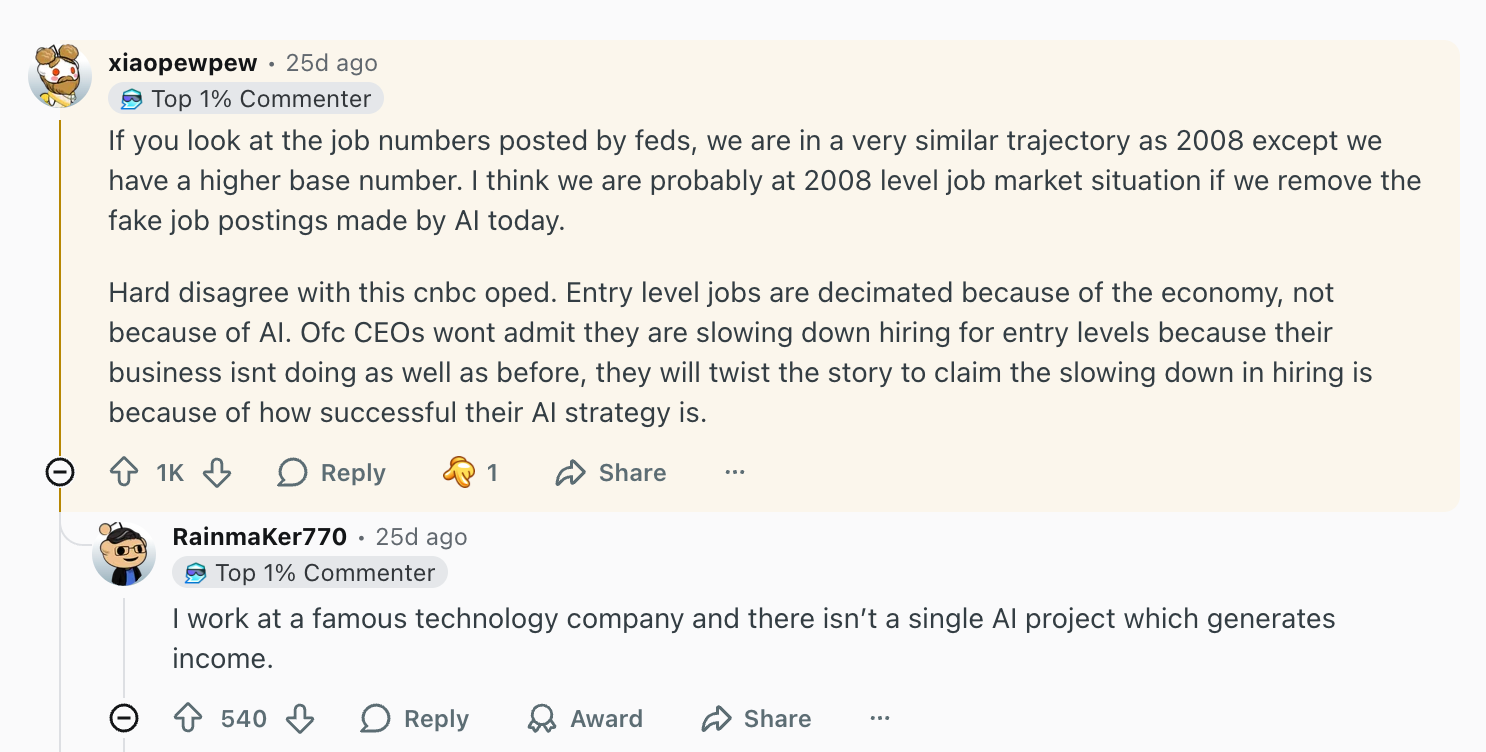
And as LinkedIn’s Aneesh Raman told the BBC, new grads are facing a “perfect storm”: economic uncertainty plus AI disruption. It’s not that opportunities are gone; it’s that the entry ramps are narrowing fast.
That said, many people online disagree that AI is the culprit.
Struggling to enter the market? Use AI to your advantage: How to Use Rezi for Student and Graduate Job Applications
Further reading:
- Why Is the Job Market So Bad
- The Gen Z Job Market
- Why Finding a Job Feels So Hard
- I Can’t Get a Job, What Now?
Tech workers
Ironically, the tech world, the driver of innovation, is now one of the first to feel AI’s bite. Companies are using automation to streamline costs, and that often means reducing teams in data, software, and analytics.
Here are just a few of the alarm bells in the tech industry:
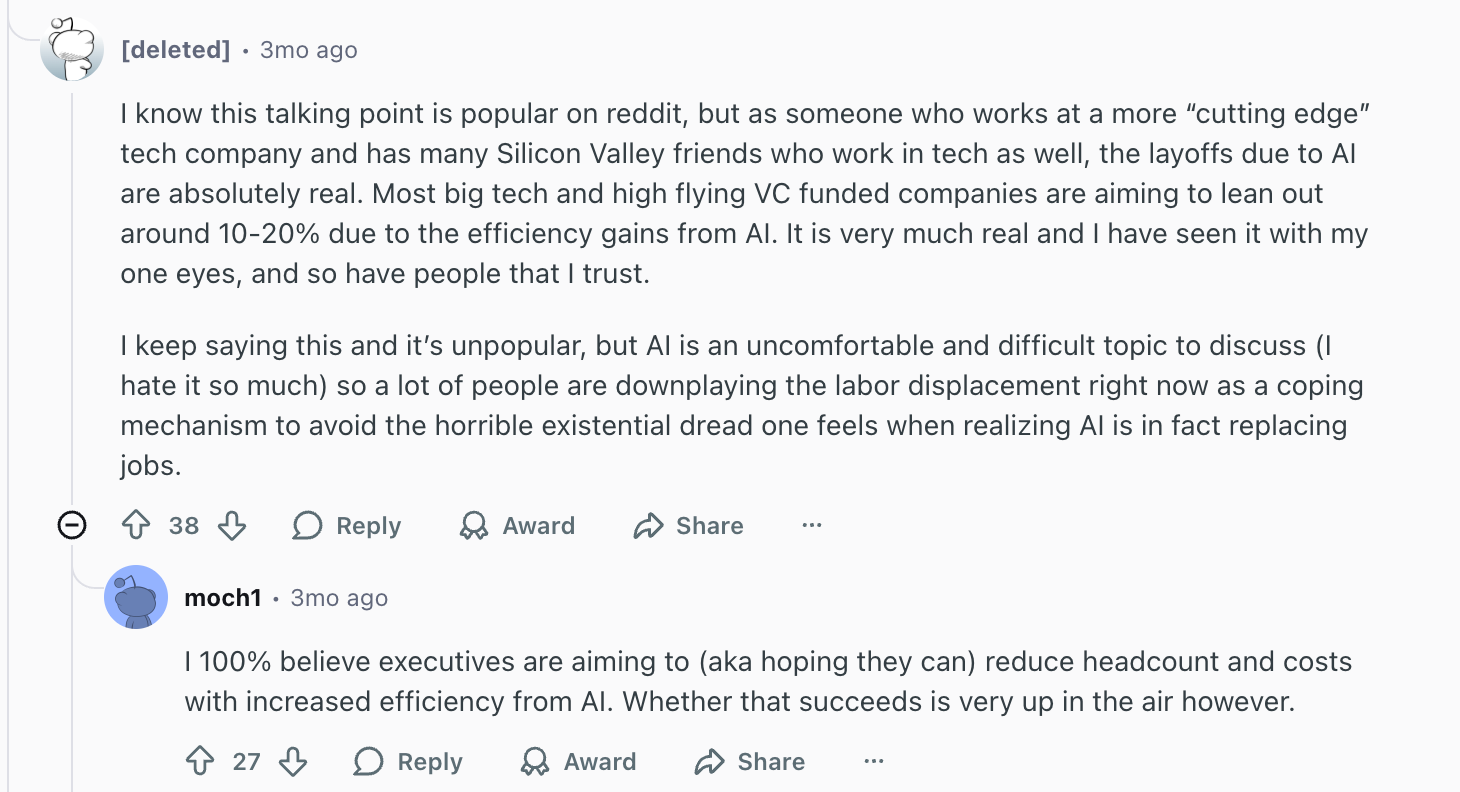
- Mark Zuckerberg said in a recent interview that AI could replace many mid-level engineers by handling the repetitive coding tasks humans used to do.
- Tools like GitHub Copilot are already writing full functions and debugging code automatically. In fact, three-quarters of developers now use AI assistants in their workflow.
- A Udacity survey of 2,500 tech professionals found that 61% believe AI could replace their current role within the next three to five years, no matter their level or industry.
- McKinsey’s data backs it up: 78% of organizations are already using AI in at least one function, particularly in IT, marketing, and sales.
Here’s what someone with connections to Silicon Valley said about AI replacing tech roles:
Explore the other factors disrupting the tech industry: When Will Tech Layoffs Stop?
Office clerks and administrative roles
Traditional office jobs are vanishing. When an AI system can process invoices, schedule meetings, and generate reports faster and cheaper, why would employers need good old-fashioned human workers?
Yes, it sounds like something from a dystopian movie, but it’s becoming the new reality.
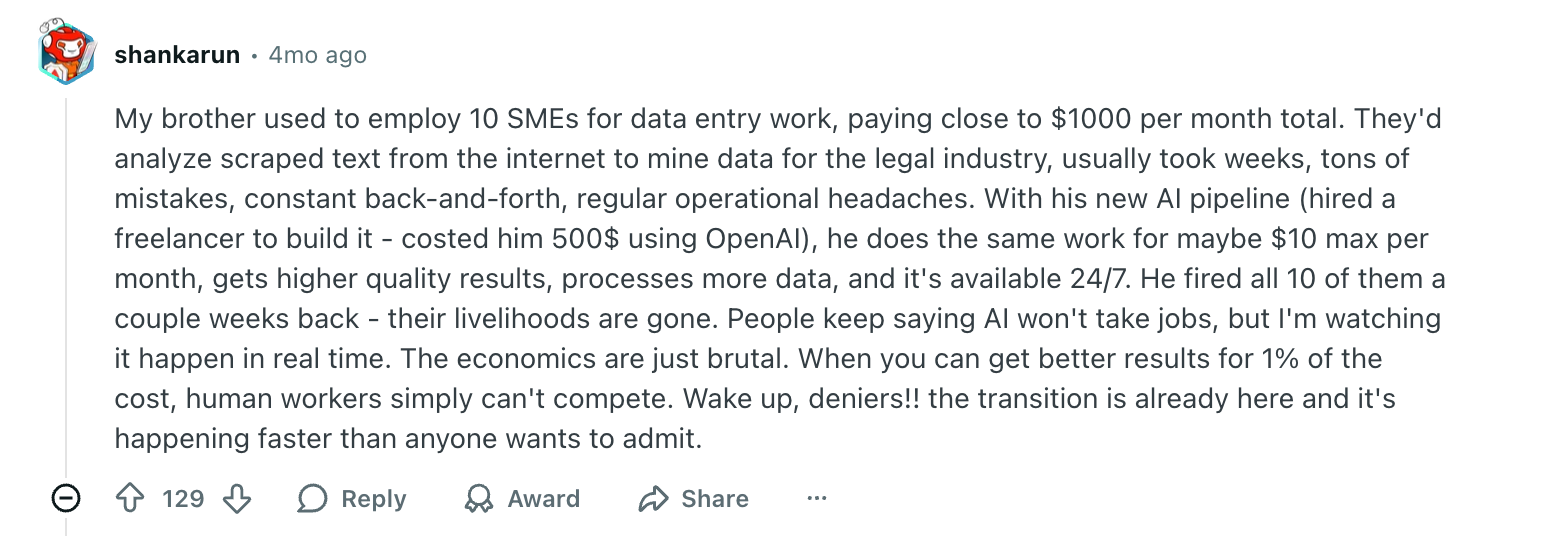
Administrative work, such as data processing, scheduling, expense reporting, and filing, is particularly vulnerable. McKinsey estimated a potential decline of 1.6 million office clerk jobs in the U.S. due to AI and automation. These roles are built around repetitive, rules-based tasks — the exact kind of work AI handles best.
And beyond the statistics, here’s how AI is affecting real people:
Legal sector
AI isn’t exactly taking over legal professions, but it’s definitely changing them.
AI-powered tools can now summarize contracts, analyze case law, and draft legal documents in seconds. This is speeding up work that used to take hours, even days, and it’s driving major efficiency gains in law firms and courts.
Legal copilots (similar to GitHub Copilot) are helping attorneys draft arguments or identify contract risks instantly. That’s great news for efficiency, but it also means clients will expect cheaper services. Routine legal work (like document review or due diligence) could become increasingly automated, and junior lawyers may find fewer entry points into the profession.
But there are ways to work with AI. According to the Wolters Kluwer Future Ready Lawyer Report, 73% of lawyers plan to integrate generative AI into their work within the next year. Many understand that it’s not replacing them; it’s just transforming what they do.
Finance professionals
If you work with spreadsheets, data entry, or reconciliations, I have some bad news: AI’s already doing your job.
Finance teams are now using machine learning to forecast and generate reports faster than ever. What used to take hours can happen in minutes with AI automation. Bookkeepers, accounts payable or receivable clerks, and junior accountants are the first roles being affected.
This is what a finance professional said when asked if AI is replacing entry-level roles:

Gartner predicts that by 2030, 15% of all financial decisions will be made through agentic AI (systems that make decisions on their own). But it’s not all doom and gloom.
Nobody wants to completely depend on AI to make financial decisions (most of us can’t even rely on ourselves). Professionals will likely move from doing the work to overseeing AI agents, checking for accuracy, explaining insights, and applying judgment when things go wrong.
Creative fields
You’d think creativity would be the last thing machines could replicate, but judging by all the fake images and videos of talking cats across social media, it seems AI is making moves in this department, too.
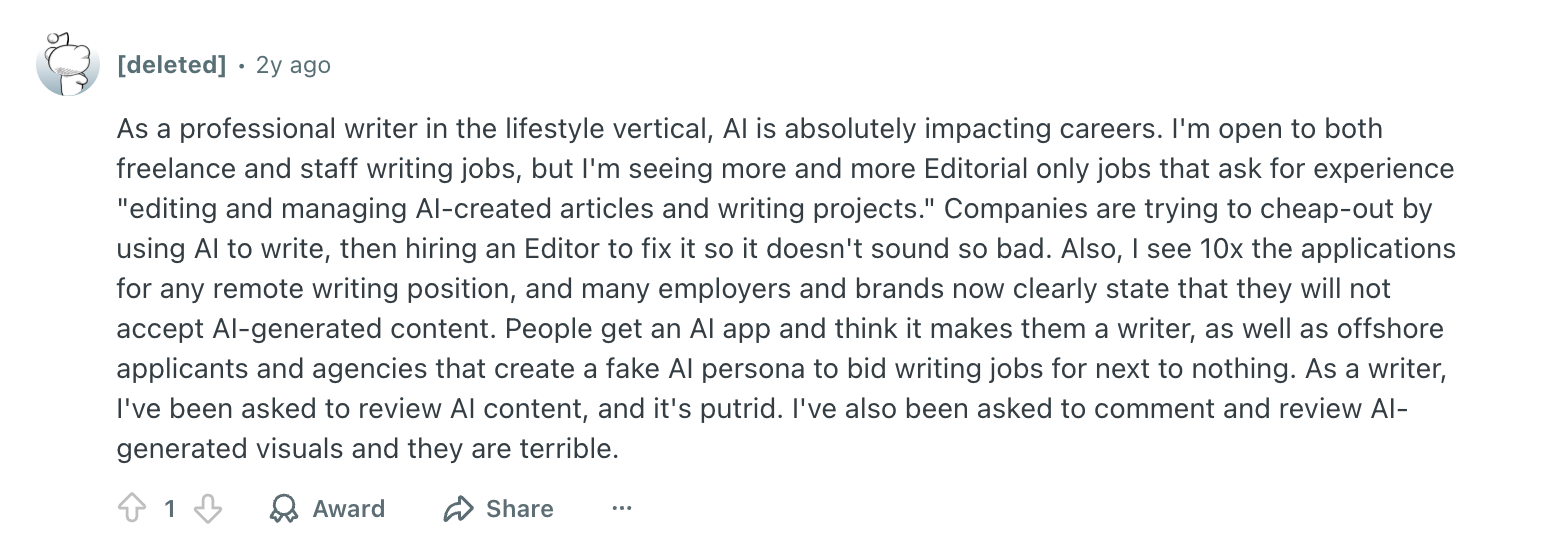
Microsoft’s Working with AI report listed writers and authors among the top five professions most likely to be replaced. Tools like ChatGPT, Midjourney, and Synthesia can already handle everything from ad copy to visuals to full marketing campaigns. And one in three businesses already say they plan to use ChatGPT for website content.
One content writer shared how they’ve gone from writing to editing bad AI copy:
And yes, I’m a content writer, so let’s address the elephant in the room.
Am I worried?
Let’s just say I’m quietly cautious.
Ninety percent of content marketers say they’ll use AI in 2025. But not to replace themselves; to scale their output. Nearly half already use AI for writing, and about a quarter for design.
The future of creative work will be about offering more than AI (that personal touch) or working alongside it. The real skill will lie in using AI to refine and amplify your own voice — curating its ideas and ensuring the final product still feels personal, authentic, and unmistakably human.
The ”Layoff Boomerang”: Why Half Will Be Re-hired
The final, and perhaps most ironic, insight from the 2026 labor market data is the ”Layoff Boomerang.” Forrester Research predicts that 50% of AI-attributed layoffs will be ”quietly reversed” as companies realize they have overshot their automation goals. Approximately 55% of employers already report regret over laying off workers for AI capabilities that do not yet exist.
However, this ”re-hiring” does not always mean a return to the status quo. Forrester notes that these workers will likely be re-hired offshore or at significantly lower salaries rather than at their previous pay scales. The ”Pivot Penalty” thus serves as a dual-edged sword: it allows companies to shed high-cost, experienced domestic labor under the guise of AI innovation, only to bring back the necessary human element at a lower cost once the ”AI mirage” fails to deliver on its promise of total automation.
Is AI Really That Bad for White-Collar Workers?
Honestly, it depends on perspective.
For those whose jobs are being disrupted or replaced, AI can understandably feel like a threat. But for those who adapt early and learn to work alongside it, AI can be an opportunity. While automation may eliminate certain tasks or roles, it’s also creating new jobs, improving efficiency, and making work easier and more productive.
And in many cases, AI is empowering people to start new ventures, increase output, and focus on more meaningful or creative work rather than routine tasks.
Here are some of the ways AI will positively impact white-collar work.
More time, less stress
AI gives people back their time. Mundane tasks that used to make you question your life choices, like analyzing spreadsheets, generating reports, and organizing files, now happen in seconds.
And that’s more than just convenience. According to Udacity, seven in ten workers say AI has helped them boost productivity and creativity, while four in ten report better work-life balance, less stress, and smarter decision-making.
The 2024 Work Trend Index Annual Report shows the ways AI has helped users:
- Save time (90%)
- Focus on their most important work (85%)
- Be more creative (84%)
- Enjoy work more (83%)
If used wisely, AI is giving workers the opportunity to spend their days solving meaningful problems instead of dealing with mind-numbing data entry or formatting reports.
Productivity and business growth
Beyond individual benefits, AI is reshaping business operations. In the U.S., generative AI could raise labor productivity by 0.5 to 0.9 percentage points annually through 2030, according to research on AI and the future of work.
Companies are already seeing the impact, and 90% of business owners believe tools like ChatGPT will positively influence operations within the next year. Organizations that use AI to cut down on repetitive work, improve collaboration, and deliver faster insights are the ones likely to get in competitive markets.
New roles and industries
AI doesn’t just take jobs, it creates them.
The McKinsey Global Institute projects that AI could generate 20–50 million new jobs globally by 2030. And these aren’t only tech roles.
According to Goldman Sachs Research, AI could put about 6–7% of US jobs at risk in the short term, but new opportunities are likely to outweigh those losses. By 2030, an estimated 92 million jobs may be phased out, yet around 170 million new roles could be created in AI, data ethics, and machine oversight (Future of Jobs Report).
What New Jobs Is AI Creating?
In short: roles like AI product managers, machine learning engineers, and prompt engineers bridge the gap between humans and technology. Others, like AI ethicists, data curators, and human–machine teaming managers, focus on making AI safer, smarter, and more collaborative.
Many of the new jobs being created would have been unimaginable just a decade ago. After all, 60% of today’s jobs didn’t exist in 1940 (Goldman Sachs). Imagine explaining some of these titles to a Victorian child:
- AI product manager or program lead. The translator between business goals and AI systems, ensuring technology delivers actual results.
- MLOps or AI platform engineer. Keeps the AI machinery running; deploying, monitoring, and maintaining models behind the scenes.
- Machine learning engineer or AI programmer. Builds and fine-tunes algorithms that help AI learn, predict, and improve.
- AI security specialist. Protects models and data from tampering or misuse.
- AI ethics, governance, and risk officer. Ensures AI is used fairly and responsibly, auditing systems for bias and managing compliance.
- Prompt engineer or AI trainer. Crafts the prompts and language that teach AI how to respond effectively — basically, AI’s personal tutor.
- Data labeling or curation specialist. Organizes and labels data so AI can learn accurately from it.
- AI operations and support staff. Keeps AI systems healthy, troubleshooting and optimizing as they run.
- Human–machine teaming manager. Helps people and AI work better together; part tech expert, part workplace diplomat.
- AI-powered creative professional. Combines human imagination with AI tools to design, write, market, and produce content faster than ever.
While AI specialists, machine learning engineers, and data scientists are seeing a surge in demand, opportunities are spreading across healthcare, finance, education, and other sectors where human judgment and creativity complement machine capabilities.
Other key stats paint an optimistic picture:
- The IBM Institute for Business Value found that 54% of CEOs are actively hiring for roles related to AI that didn’t exist a year ago.
- The Future of Jobs Report 2025 highlights technology-related roles as the fastest-growing in percentage terms, including Big Data Specialists, Fintech Engineers, AI and Machine Learning Specialists, and Software Developers.
- McKinsey research estimates AI could add $4.4 trillion in productivity growth potential through corporate use cases, showing that the economic upside is massive.
AI is opening entirely new career paths. The skills of tomorrow will involve translating between human needs and AI capabilities, designing prompts, interpreting machine-generated insights, and solving complex problems in ways only humans can.
The ”Ghost Worker” Economy and the Illusion of Automation
A critical but often ignored aspect of the ”Pivot Penalty” is that much of the ”AI” marketed as autonomous actually relies on a massive, low-wage human infrastructure. This is what labor organizations call the ”Ghost Worker” economy. The failure of Amazon’s ”Just Walk Out” technology serves as the ultimate indictment of this trend. While marketed as fully automated, the system reportedly required approximately 1,000 workers in India to manually review transactions due to technical difficulties in tracking customers.
This ”illusion of automation” is widespread. Research from the CWA-Union found that U.S.-based data workers, who act as the ”first line of defense” for AI systems, face conditions remarkably similar to those in the Global South. These workers report a median hourly wage of $15 and spend an average of three to eight hours per week sitting at their computers waiting for tasks to become available, often without pay. About 52% of these workers believe they are training AI to replace other people’s jobs, while 36% believe they are training it to replace their own. This ”race to the bottom” suggests that the ”Pivot Penalty” is not just about cutting jobs, but about shifting them into an invisible, gig-based underclass with no benefits or security.
The Inevitable Rebound
This fundamental misunderstanding of how AI interacts with human labor is leading to a massive corporate course correction. As previously noted, Gartner and Forrester predict that by 2027, up to 50% of companies that slashed their customer service, marketing, and support staff under the guise of "AI efficiencies" will be forced to rehire for those exact functions.
When AI is used as a blanket explanation for layoffs, but workloads do not actually change, the remaining employees burn out, institutional memory is destroyed, and customer satisfaction plummets. The organizations that engaged in the most aggressive AI-washing to justify their cuts will soon be back in the labor market, quietly posting traditional jobs under new titles to rebuild the human infrastructure they prematurely dismantled.
How to Adapt to the AI Era
Here’s a quick summary of how you thrive alongside AI as a white-collar worker:
- Explore AI-safe roles. Focus on industries where human judgment and unpredictability still matter. Look for hybrid roles that blend people skills with AI tools.
- Invest in upskilling. Keep learning to stay relevant. Build skills in AI through online courses, apply AI in your current work, and align your learning with where you want your career to go.
- Make yourself irreplaceable. Strengthen uniquely human abilities, pursue roles that bridge technology and human insight, and show how your soft skills complement AI.
Now, let’s explore these steps further below.
1. Explore AI-safe roles
Not all jobs are vulnerable to AI. Roles in healthcare, education, and construction are more resistant to automation because they rely on human judgment, unpredictability, and interpersonal skills.
McKinsey predicts a 23% increase in demand for STEM jobs by 2030, highlighting that long-term demand for skilled talent remains strong. And of course, physical work will still account for nearly a third of work hours in the economy, simply because these tasks are harder for AI to standardize.
What can you do?
- Stay informed about industry trends and demand forecasts to focus on resilient career paths.
- Seek hybrid roles that combine human insight with AI tools, such as AI-assisted healthcare specialists or edtech coordinators.
- Target industries that are less dependent on repetitive digital tasks, like healthcare, education, and skilled trades.
Want to switch out of the white-collar space entirely? Find out more: Best Blue-Collar Jobs
2. Invest in upskilling
The AI era rewards those who continuously learn. McKinsey notes that jobs requiring higher education and advanced skills will grow, while roles with minimal cognitive demands decline. Skills in AI, big data, cybersecurity, and technology literacy will be especially popular.
In fact, 71% of employers would rather hire a less experienced candidate with AI skills than a more experienced one without, and 66% of leaders say they won’t hire candidates who lack AI capabilities.
What can you do?
- You don’t necessarily need to return to college. Take online courses in AI, machine learning, big data, or cybersecurity via platforms like Coursera or Udemy.
- Apply AI tools in your current role to increase efficiency, improve insights, and prove you can adapt to new technology.
- Align your learning path to where you want to be in the next few years, then focus on skills that future-proof your career.
According to PwC’s 2025 Global AI Jobs Barometer, the wage premium for AI skills has exploded.
- 2024: 25% premium.
- 2025: 56% premium.
- Dollar Value: This represents an average of $18,000 more per year at median salary levels.
- Productivity: Industries with high AI exposure are seeing 4.8x higher productivity growth.
As technical tasks become automated, the value of uniquely human traits is skyrocketing. The EPOCH framework (Empathy, Presence, Opinion, Creativity, Hope) identifies skills with high "AI resistance" (82-95% resistance to automation). 92% of hiring managers now value soft skills equally or more than hard skills.
3. Make yourself irreplaceable
AI can handle repetitive, predictable tasks, but it can’t replicate human creativity, judgment, or empathy. Roles that combine technical know-how with business strategy or client-facing skills will be hard to replace.
A World Economic Forum survey found that analytical thinking is the top in-demand skill, followed closely by resilience, adaptability, creativity, self-awareness, and leadership. Similarly, a Workday survey showed 83% of workers believe creativity and adaptability will become more important as AI grows (and that AI can actually enhance human creativity).
What can you do?
- Develop skills that are difficult to automate, such as complex decision-making, leadership, and emotional intelligence.
- Seek roles that require bridging AI and human insights, like AI translators, data storytellers, or product managers with technical expertise.
- When looking for jobs, give concrete examples that show off your soft skills and how they can complement new technologies.
Final Thoughts: Will AI Actually Replace White-Collar Jobs?
AI will almost certainly replace tasks before it replaces roles.
Jobs that involve repetitive and basic duties will feel the impact first. But it will also create new jobs that don’t even exist yet. Think about the rise of the internet again: it wiped out traditional travel agents and bank tellers but gave us web designers, data analysts, and digital marketers.
The difference this time is speed and scope. AI is less about replacement and more about evolution. Those who embrace it, learn to work alongside it, and develop complementary skills are the ones who will thrive.
FAQ
Will AI cause mass unemployment?
It’s easy to imagine a future where AI takes everyone’s job, but that’s not how change usually works. Historically, new technologies have always disrupted work, but they have also created new industries, new roles, and new skills that didn’t exist before. AI is following the same pattern.
What’s more likely is a reshuffling of the workforce. Certain tasks will disappear, but people will move into new kinds of work that focus on oversight, creativity, problem-solving, and human connection. The challenge will be making sure people have the skills to transition into the ones that are emerging.
Learn more about what’s causing unemployment across industry heavyweights: Big Company Layoffs in 2025
When will AI take over jobs?
AI isn’t going to take over all jobs overnight, but we’re already seeing automation reshape the way people work, especially in areas that rely on routine or predictable tasks. Duties like data entry, report generation, or scheduling are being handled more efficiently by AI tools.
This shift will speed up as companies learn how to weave AI deeper into their operations. Over the next several years, we’ll see more jobs evolve rather than vanish. The key difference will be how quickly workers adapt; those who learn to use AI as an assistant rather than fear it as competition will find themselves in a much stronger position.
Will AI replace tech jobs?
Some technical tasks, like writing basic code or testing software, can now be done faster and cheaper by AI tools. That’s already changing what it means to be a developer or engineer. However, that doesn’t mean tech jobs will vanish. Instead, they’ll evolve into roles where humans manage, guide, and refine what AI creates.
The future of tech work is likely to be more collaborative, with developers using AI to handle the heavy lifting while they focus on creativity, architecture, and problem-solving. The people who thrive will be those who stay curious, learn continuously, and see AI as a co-worker rather than a threat.
What jobs will AI not replace?
The safest jobs are the ones that rely on what makes us human, such as empathy, judgment, creativity, and connection. These roles cover therapists, teachers, nurses, and leaders who motivate teams. AI can assist in these areas, but it can’t replicate genuine understanding, emotional intelligence, or moral reasoning. Jobs that blend technical skill with human interaction, like design, strategy, and communication, will also continue to thrive.
And then there’s skilled labor, such as plumbers, electricians, mechanics, builders, welders, and technicians. These jobs are among the hardest for AI to automate because they require dexterity, problem-solving in unpredictable environments, and physical presence. You can’t send a chatbot to fix a broken water heater or install solar panels.

Upload or drop your resume to get started
Upload your resume to get started
Score my resume

Lauren Bedford is a seasoned writer with a track record of helping thousands of readers find practical solutions over the past five years. She's tackled a range of topics, always striving to simplify complex jargon. At Rezi, Lauren crafts genuine and actionable content that guides readers in creating standout resumes to land their dream jobs.