Other
Career Story from Teacher to Content Writer & Lessons Learned
Learn how to transition from teaching to content writing with real-world advice, a personal career change story, and 15 actionable tips for landing a writing job.

Published on
July 10, 2025
Updated on
January 9, 2026
*Record scratch* *Freeze frame*
Yep, that’s me. You’re probably wondering who the heck I am, speaking to you in the first person. Maybe you’ve noticed my little head at the bottom of a few Rezi articles.
Well, today I’m pulling back the curtain. I’m here to explain how an Irish former English teacher somehow ended up writing career and resume advice for thousands of job seekers. Crazy stuff, right?
Here’s what I’ll share:
- How I transitioned from teaching to content writing.
- What I did during my job search.
- What I’d do differently now, after everything I’ve learned at Rezi.
If you’re changing your resume to rewrite your career story, try the Free AI Resume Builder. And check out these guides for extra help:
- How to Update Your Resume for 2025 & Make It 2x Better
- How to Tailor a Resume to a Job Posting Quickly and Efficiently
- 20+ Common Resume Mistakes in 2025
- I Hate My Job: What to Do, and When Is It Time to Quit?
From Classroom to Content Writing
Before I even graduated, I’d already started laying the groundwork. I studied English and New Media at university, and during that time, I wrote articles for I Love Limerick about the people, events, and news of the city. It was a small, collaborative team, and I got to be creative — pitching ideas, interviewing local business owners and charity founders, helping my teammates, training our replacements, and even tweaking the website in WordPress. I loved it.
I also did social media for a small jewelry brand for about a year. Extremely part-time, but it gave me a glimpse into brand voice and content planning (and a much deeper respect for high-quality product photography).
Then came seven years of teaching English in Madrid, Ho Chi Minh City, and Barcelona. Over that time, I worked in about 11 different schools and taught a handful of private students on the side, across various full-time and part-time roles. Teaching wasn’t my passion, but it was my gateway to living abroad. I liked chatting with adults, being silly with kids, and mostly tolerating the teenagers. But the part I genuinely loved was editing their longer writing assignments.
Give me an essay full of mistakes and I’m in my element. I enjoyed guiding students to improve their structure, tone, and clarity. That kind of problem-solving made me quietly giddy (and okay, I got a little kick out of being ruthlessly thorough with edits). That’s how I knew it was time to stop dipping my toes in and actually go for it.
Writing had always been the dream. As a kid, I wrote stories and entered competitions. Later, I found myself editing friends’ dissertations, blogs, and essays just for fun. It never felt like work.
I wrapped up my last teaching job in June 2024. Telling my boss I wouldn’t be coming back after the summer was tough, but it made the decision real. I’ve learned that saying something out loud to someone holds me accountable, mostly because I hate looking like someone who’s all talk.
That spring and summer, I applied for over 100 jobs. Some interviews went well, but I kept stumbling at the “you need more experience” stage. I was even offered a full-time unpaid internship (no, thanks).
At one point, I almost pivoted to coding. I did two bootcamps and gave myself until the end of August to land something in writing or fully commit to tech. That deadline both terrified and motivated me.
Then my friend Lauren (thank you Lauren, my hero) referred me to Rezi, who were looking for a content writer. They weren’t worried about my lack of experience; they just wanted strong writers. They gave me a writing task (love when companies do that): write a resume guide for a phlebotomist.
First, I googled what a phlebotomist was. Then I wrote the piece. Michael, the head of content, came back with a lot of edits and suggestions, but he liked it (phew).
I started freelancing with Rezi at the end of July, and by October, I was full-time.
Will the impostor syndrome ever go away? Probably not. But I love my job.
What I Did During My Job Search
Here’s a summary of what I did during my job search:
- Rewrote my resume (with help from a friend).
- Emphasized transferable skills from teaching and content work.
- Applied to writing-related jobs, including some long shots.
- Avoided video applications but always did the writing tasks.
- Reached out to friends and former classmates for referrals.
- Tracked applications in a phone note.
- Built a portfolio with MuckRack and older writing samples.
- Researched every company before interviews.
- Practiced common and behavioral interview questions.
- Sent thoughtful follow-up emails after every interview.
I ended up getting my job through a referral, but there were a few things I did along the way that definitely helped, and might help you too.
Here’s what worked for me during the job hunt:
Refreshed my resume
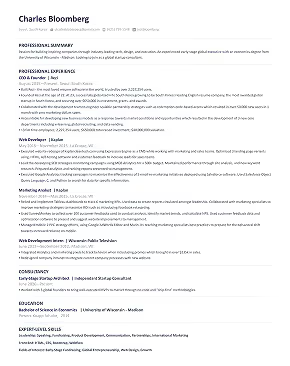
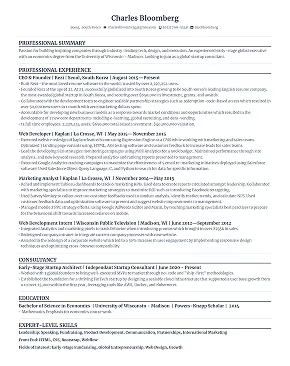
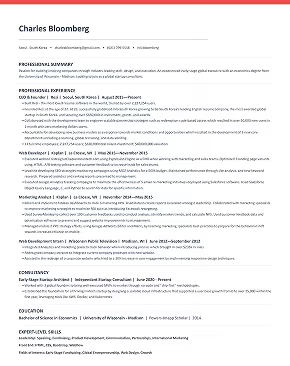
I can’t even look at the resume I used at the start without cringing. It still listed my high school exam results. Aislin — a college friend turned content manager — kindly offered to share it with her boss, then took one look and rewrote the whole thing herself. Total lifesaver.
If you don’t have an Aislin in your life, upload your resume to the free Rezi AI Resume Builder. It’s a great way to clean things up fast.
Highlighted transferable skills
I leaned into the experience I did have — social media, journalism, and copywriting — and also turned my teaching background into an asset. Communication, time management, adaptability, and leadership were all real skills I used daily. I also made a point of mentioning how my writing and editing skills developed.
Read more about How to Write a Career Change Resume.
Applied broadly (and often)
If the job had “content,” “writing,” or “copy” in the title, I was in. I applied to long shots too — maybe someone out there was desperate for a technical writer with zero experience but excellent piano skills. (Shockingly, no one was.)
If there was a writing task, I jumped on it — that’s usually where I made it furthest. But if it involved a video application, it was a hard pass. I’d almost rather stay unemployed.
Tapped into my network
I didn’t do anything formal like networking events, but I did reach out to college friends and people in related fields. Eventually, that’s what got me the referral to Rezi. Moral of the story: don’t job hunt in silence. Tell your people. Post on LinkedIn, Instagram, wherever your connections are. Ask around. Referrals really do work — according to ERIN, 9–15% of hires come from them.
Tracked every application
I kept a running note on my phone of every job I applied for. If I got rejected, I crossed it out. If the post disappeared without a word, I added “NR” (no response). I also tracked the dates, so I had a rough idea of when to follow up or let it go. My loose goal was five applications every other day, sometimes more.
Built a writing portfolio
I used MuckRack to pull together my old articles from I Love Limerick and a piece I wrote for an Irish newspaper during lockdown. Some of them weren’t great (or recent), but they were something. I also pitched to High On Films, a site for TV/film essays. I got one article in before I started at Rezi, but it’s a great way to build up your portfolio, even if the pay is modest.
Prepped before interviews
For every interview, I gave myself at least an hour to research the company. Website, blog, socials, Glassdoor — anything I could find. I also tried to reference something specific in the interview, like a recent accomplishment or something about their mission. Interviewers notice when you’ve done your homework.
Practiced common questions
After fumbling a few interviews in the past, I learned to prep real answers. I kept a document of common interview questions and a few go-to ones to ask the interviewer. Having that to hand made me feel slightly less nervous going in.
Some classic questions you’ll probably hear:
- Do you enjoy working alone or as part of a team?
- What can you bring to the company?
- How do you handle tight deadlines?
For any “tell me about a time when…” questions, try the STAR method: Situation, Task, Action, Result — it keeps your answer clear and structured, and prevents you from rambling.
And when it’s your turn to ask questions, try something like:
- What’s your favorite part about working here?
- What would a typical day look like in this role?
- How does the team communicate and collaborate?
Sent post-interview follow-ups
My dad once told me about a hiring manager who couldn’t choose between candidates — until only one followed up to say thanks. That one gesture sealed the deal. Ever since, I’ve made it a rule to send a follow-up email after every interview. I thank the interviewer, mention something specific I enjoyed from the chat, and make it clear I’m genuinely excited about the role.
15 Tips for Getting Your Dream Job
Here’s what you should do to land the job:
- Tailor your resume and summary/objective to each job.
- Use keywords from the job description.
- Cut irrelevant info and add measurable results.
- Start bullet points with action verbs.
- Make your resume ATS-friendly.
- Back up your skills with real examples.
- Write a personalized cover letter.
- Watch out for ghost job listings.
- Contact hiring managers.
- Take on freelance projects.
- Look beyond job boards.
- Upskill with short online courses.
- Show what makes you unique beyond AI.
After nearly a year at Rezi (wild), I’ve learned a lot about job searching from training sessions, research, writing, and hearing firsthand what actually works. I also realized just how many things I got wrong during my own search. (Like applying to an AI resume builder with a resume not made using their software. Bold move.)
If I were starting over, here’s exactly what I’d do — and what I tell every friend who’s job hunting:
1. Tailor your resume for each job
It sounds tedious, but it doesn’t mean rewriting your whole resume every time. Look at the job description, then highlight the parts of your experience that match. If the job calls for writing skills and you’ve written newsletters or blog posts, mention that. Adjust the wording and reorder bullet points so it’s obvious you’re a great fit.
2. Customize your objective or summary
If you’re writing a resume objective (for no experience) or a summary (some experience), make the hiring manager feel like it’s written just for them. Mention the company name, the specific job title, and throw in a quick achievement that relates to the role.
3. Use keywords from the job description
Scan the job posting and pull out key skills and tools. Then, work them naturally into your resume. If they say “proficient in Excel,” use that exact phrasing. It shows you speak their language and gets you noticed by hiring managers and the ATS.
Use the AI Keyword Targeting tool to get a list of keywords to include in your resume.
4. Leave out the irrelevant details
Cut out your full address (just city and state or country is fine), headshot, or random hobbies on your resume unless they’re directly related to the job and you’re light on experience.
5. Include measurable achievements
Numbers instantly make your experience more convincing. Instead of saying what you did, highlight how well you did it, like “wrote 3+ blog posts weekly,” “increased Instagram engagement by 20%,” “reduced onboarding time by 20%,” or “trained 5+ new hires.”
For more on this, read How to Show Achievements on a Resume (100+ Examples).
6. Start your bullet points with action verbs
Skip the paragraphs — bullets are easier to scan. No more “responsible for,” start each bullet with a strong action verb like “led,” “launched,” “created,” or “improved.” Keep each job to 3–8 bullet points, and focus on what you accomplished, not just what you were told to do.
7. Make your resume ATS-friendly
No Canva, no multiple columns, no icons. Just a straightforward, one-column layout with standard fonts (like Arial or Calibri). Fancy designs can make your resume hard to read. Rezi’s resume templates are a safe bet if you’re not sure.
8. Back up your skills with examples
Listing “project management” means little without proof. Show it: “Managed a team of 4 on a two-week content sprint.” Same with soft skills — instead of saying you’re a great communicator, describe how you collaborated with teams, led meetings, or resolved customer issues.
9. Write a tailored cover letter
Find the hiring manager’s name, address them directly, and write like a human. Why do you want the role? Why this company? Share one specific thing you admire about them, and connect it to your background. One personalized paragraph is better than a full page of fluff.
Check out these examples for inspo: 52 Skillful Cover Letter Examples.
10. Watch out for ghost jobs
If a job listing is months old, vague, or has zero activity after you apply, it might not be real. Some companies leave jobs up even after hiring, just to collect resumes or to appear like they’re expanding. It’s not you, it’s them.
11. Reach out to the hiring manager
After applying, reach out to the hiring manager via LinkedIn or email. Something simple like: “Hey, I just applied for [job title] and I’m really interested. I’d love to hear more about the team.” Even if they don’t reply, it shows initiative and helps confirm the job is real.
12. Take on freelance work
Pitch articles to niche blogs like High on Films, or reach out to websites in your area of interest and offer to write for free on topics like travel, sports, or tech. Sites like Fiverr or Upwork can help you find paid projects too — even one or two can boost your resume.
13. Look beyond job boards
Some of the best roles aren’t on major job boards. The Rezi AI Job Search pulls listings straight from company websites and includes the original posting date. Try Googling local businesses (“marketing agency near me”), check their careers pages, or send a cold email to get on their radar for the next time they’re hiring.
14. Upskill while you search
Short online courses (on Coursera, Udemy, or edX) are a quick way to fill skill gaps. Even listing a course as “in progress” on your resume proves you’re committed to learning. I did an SEO course while I was applying — just a few hours a week makes a difference over time.
Learn about the best certifications to put on your resume.
15. Know what sets you apart
AI is changing things, especially in writing jobs. Lean into what makes you human. Share how you can provide personal insights, firsthand experience, or community stories. Stay on top of trends and show you bring something AI can’t.
Final Thoughts
I don’t know if I’ve shared anything wildly profound — most of what I’ve learned comes from writing for job seekers and fumbling through my own career change before that.
But if I had to leave you with one thing, it’s this: never underestimate your network. A referral will always go further than a faceless application. Keep doors open. Stay in touch with classmates, coworkers, or old managers. Even a quick message can make a difference down the line.
And if there’s a job or career that’s been sitting at the back of your mind? At the risk of sounding cliché, it’s never too late to give it a shot. You might fail, or you might end up somewhere better than you imagined. Either way, you’ll know you tried. And that’s something.
Just be realistic: the job market’s tough right now. Stay curious, be kind to yourself, and keep going. You don’t need all the answers, just momentum.
FAQ
What is a red flag when looking for a job?
Watch out for job posts that sound flashy but say little about the actual role. If they don’t mention your responsibilities or what tools you’d use, that’s a red flag. Also, if they expect senior-level skills for entry-level pay, they might be trying to overwork one person.
How to survive job hunting?
Job hunting can feel like a full-time job in itself, so pace yourself. Focus on a few well-tailored applications a day instead of applying to dozens. Take breaks, track your progress, and stay connected with others. Talking to people helps more than you’d think. And celebrate the small wins, like getting a reply or finishing a resume tweak.
Read more about What to Do When Unemployed: 20 Practical Tips for the Break.
What is SEO writing?
SEO writing is about creating helpful content that ranks well on search engines. It means using the right keywords naturally, structuring content clearly, and matching what people are searching for, so your page shows up where it matters.
What is the ATS?
An ATS (Applicant Tracking System) is software that companies use to sort and filter job applications. It scans your resume for keywords from the job description and ranks candidates based on how closely they match. That’s why clear formatting and using job-specific phrases are so important — the better your match, the more likely your resume will make it to the top of the hiring manager’s list.
How to write a content writer resume with no experience?
Focus on any writing you’ve done, like blog posts, LinkedIn articles, personal projects, or freelance gigs. Show off your ability to research, communicate clearly, and adapt your tone for different audiences. Write a strong objective, list tools like WordPress or Grammarly, and mention any SEO or writing courses you’ve taken.
What not to include on a content writer resume?
Skip unrelated jobs unless you can spin them to show transferable skills. Avoid vague soft skills like “team player” without any examples in your work history or education. Leave out personal hobbies unless they’re relevant, and any fancy fonts, headshots, or graphics.

Sarah Coghlan is a writer and editor passionate about making resume and career advice clear and accessible to all. Based in Barcelona, her goal is to help job seekers create standout resumes and navigate the job search process with confidence and ease.