CVs
Best Skills for a CV to Get the Job in 2026
Discover the top skills to put on your CV and learn how to emphasise them in your summary, skills section, and work experience for maximum impact.

Published on
September 9, 2025
Updated on
February 25, 2026
The best skills to put on your CV are the ones listed in the job description and the ones most relevant to the role. Start by reviewing the posting carefully, noting repeated or essential skills. Highlight your top skills in your summary, create a dedicated skills section organised by type, and weave them throughout your work experience with real examples. Include both hard skills, which prove you can do the job, and soft skills, which show how you do it. Tailor your CV to the role, back up each skill with measurable results, and use volunteering, projects, or education to fill gaps. Popular skills in 2025 include project management, data analysis, communication, collaboration, inventory management, team leadership, and customer service.
Jenny’s stuck. She’s not sure which skills actually belong on her CV. (Quick fix: start with the ones in the job description, then add a few extras that match the role.)
Lewis has a strong work experience section, but he’s wondering if he really needs a separate skills section. (Short answer: yes. It’s standard, helps with ATS keywords, and gives hiring managers a quick snapshot of your strengths.)
Becky’s debating whether soft skills deserve a spot. (If space is tight, just weave them into your work history. But if you have room, adding a few in your skills section won’t hurt.)
The skills section is one of the most second-guessed parts of a CV. People either overthink it or skip it altogether.
This guide will clear things up. You’ll learn:
- The top skills to include on a CV in 2025.
- The best way to list your skills.
- CV examples highlighting skills.
Create a skills-focused CV in minutes with our free AI Resume Builder. Or check out these guides:
- How to Write Teamwork Skills on a CV
- 40+ Interpersonal Skills for Your CV
- Best Technical Skills for a CV
- Tips on Listing CV Language Skills
- 20+ Computer Skills for a CV
- Nursing Skills to Add to a CV
Key Skills to Put on a CV
In short: the most impactful skills to put on your CV are the ones directly tied to the job description, but some stand out across industries. Based on thousands of CVs in 2025, the top skills include project management, data analysis, communication, customer service, collaboration, and leadership. Other valuable skills range from technical strengths like troubleshooting and inventory management to people-focused ones such as stakeholder engagement, client relationship management, and problem-solving.
The best skills to put on your CV are the ones the job is actually asking for. If the posting mentions collaboration, make sure it’s highlighted on your CV. If it’s a technical role, show off your expertise with the right tools or software.
To give you a head start, we’ve analysed thousands of Rezi CVs and pulled together the most commonly listed skills of 2025 so far.
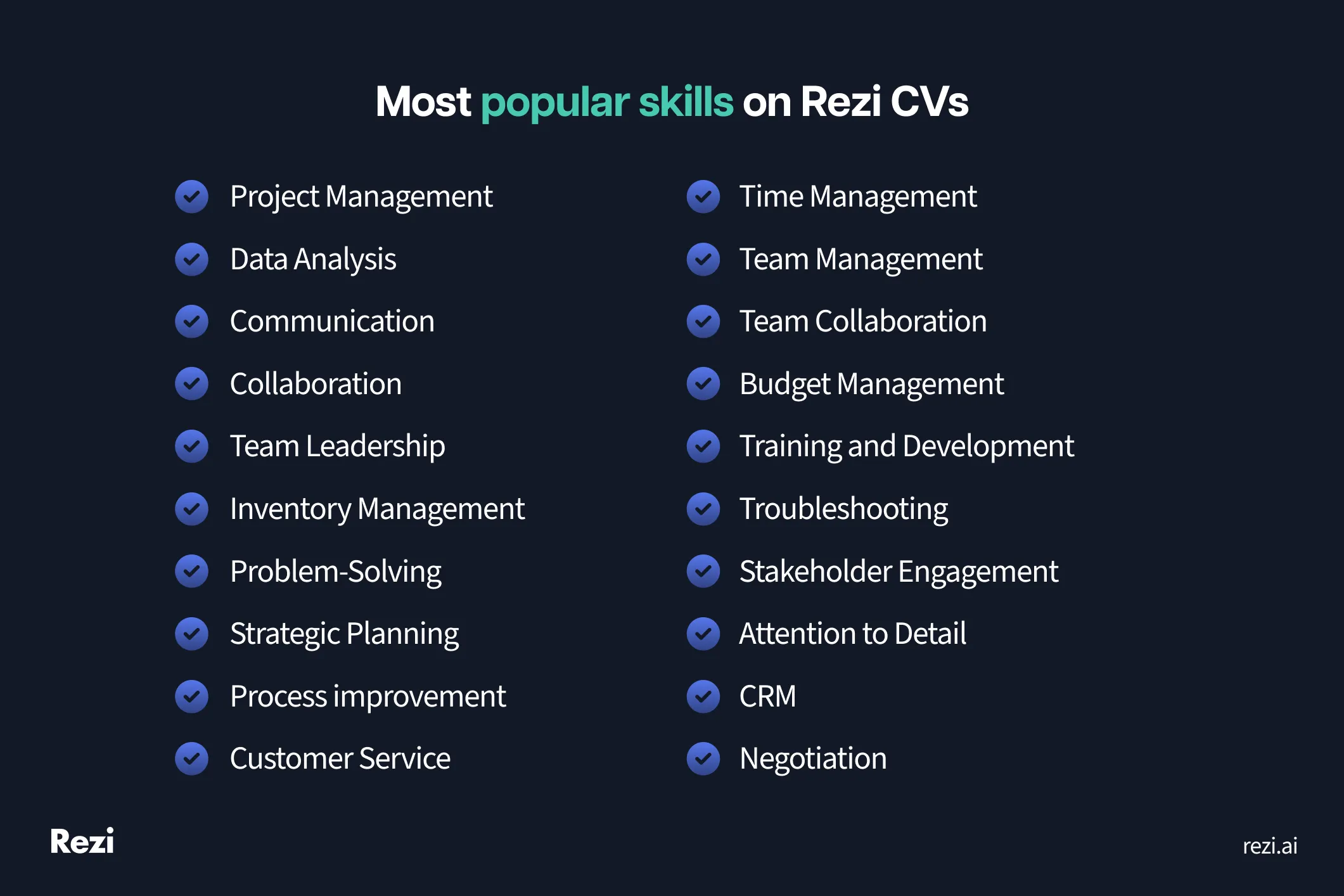
1. Project management
This is the most listed skill, appearing in over 14,000 CVs. It’s no surprise — project management shows up in careers like project managers (of course), operations coordinators, marketing leads, and even IT specialists who oversee rollouts.
Examples of project management on a CV:
- “Led a cross-functional team of 12 to deliver a product launch three weeks ahead of schedule.”
- “Oversaw multiple client projects worth over $2M annually, ensuring on-time and on-budget delivery.”
- “Used agile project management methods to coordinate workflows between design, engineering, and QA.”
2. Data analysis
Data analysis shows up in finance, marketing, supply chain, and IT; anywhere decisions rely on interpreting numbers.
Examples of data analysis on a CV:
- “Analysed customer behaviour data to identify trends, leading to a 15% increase in retention.”
- “Conducted weekly data analysis in Excel and Power BI, creating dashboards to track KPIs across five regions.”
- “Applied data analysis to A/B testing results, reducing marketing spend by 20% while improving conversions.”
3. Communication
Over 13,000 job seekers put communication skills on CVs, and with good reason. It’s essential for teachers, managers, sales reps, healthcare workers, and pretty much any role where you’re dealing with people.
Examples of communication on a CV:
- “Demonstrated strong communication skills by presenting complex technical updates in clear, actionable terms for non-technical stakeholders.”
- “Applied written communication skills to craft client proposals that secured $500K+ in new business.”
- “Used verbal communication to mentor and train five new team members, ensuring smooth onboarding.”
4. Customer service
Customer service skills aren’t just for retail; they’re key in hospitality, call centres, healthcare, and even tech support roles. Anywhere you’re working directly with people, this skill matters.
Examples of customer service on a CV:
- “Delivered excellent customer service by resolving 30+ client issues daily while maintaining a 95% satisfaction rating.”
- “Provided personalised customer service support that increased repeat business by 20%.”
- “Assisted customers with billing and technical questions, showing strong customer service and communication skills.”
5. Collaboration
Collaboration shows up everywhere, from designers working with developers to nurses coordinating with doctors. It’s a soft skill employers value across industries.
Examples of collaboration on a CV:
- “Demonstrated strong collaboration by working with cross-functional teams to launch three new marketing campaigns.”
- “Partnered with engineering and product teams, showcasing effective collaboration to meet tight deadlines.”
- “Worked closely with peers to share knowledge and improve team performance, highlighting strong collaborative skills.”
6. Team leadership
Team leadership applies in management, retail, construction, education, healthcare — anywhere you’re guiding others.
Examples of team leadership on a CV:
- “Exercised team leadership by supervising 10 employees and improving productivity by 18%.”
- “Provided day-to-day leadership in a fast-paced restaurant, ensuring smooth service and staff coordination.”
- “Trained and coached 12 new hires, showing strong leadership and mentoring skills.”
Check out how to highlight leadership skills on your CV and get a better understanding of your own leadership style.
7. Inventory management
Inventory management is common in retail, warehousing, logistics, and even restaurants, where stock tracking is critical.
Examples of inventory management on a CV:
- “Applied inventory management processes to reduce stock shortages by 25%.”
- “Oversaw daily inventory management of 5,000+ SKUs, maintaining accuracy above 98%.”
- “Used Excel and ERP software for efficient stock control and inventory tracking.”
8. Problem-solving
Problem-solving is one of those universal skills. Whether you’re an engineer, customer support agent, teacher, or manager, you’re constantly facing challenges that need solutions.
Examples of problem-solving on a CV:
- “Applied strong problem-solving skills to resolve technical issues that reduced system downtime by 30%.”
- “Handled customer complaints with effective problem-solving, improving satisfaction ratings.”
- “Identified workflow inefficiencies and suggested fixes, showing proactive problem-solving abilities.”
9. Strategic planning
Strategic planning comes up in leadership roles, business development, operations, marketing, and even HR when setting long-term goals.
Examples of strategic planning on a CV:
- “Led strategic planning initiatives that aligned company goals with new market opportunities.”
- “Conducted research and contributed to strategic planning sessions, helping shape annual budgets.”
- “Developed long-term growth strategies, showing strong strategic and analytical thinking.”
10. Process improvement
Process improvement is valuable in operations, manufacturing, healthcare, IT, and any role where efficiency and workflows matter.
Examples of process improvement on a CV:
- “Implemented process improvement initiatives that cut order processing time by 20%.”
- “Identified bottlenecks in workflows and suggested changes, showing strong problem-solving and process improvement skills.”
- “Used Lean Six Sigma methods to support process improvement projects across multiple departments.”
11. Time management
Time management is critical in roles with tight deadlines. Think project managers, teachers, healthcare workers, developers, and admin staff.
Examples of time management on a CV:
- “Demonstrated excellent time management by juggling multiple client projects and consistently meeting deadlines.”
- “Prioritised competing tasks effectively, showing strong time management skills in a fast-paced environment.”
- “Used digital tools like Trello and Asana to support efficient scheduling and time management.”
12. Team management
Team management applies in leadership roles across industries, from retail supervisors to department heads, call centre leads, or construction foremen.
Examples of team management on a CV:
- “Applied strong team management skills to oversee 15 staff members, improving productivity by 10%.”
- “Managed scheduling, training, and performance reviews as part of day-to-day team management responsibilities.”
- “Supported team management by mentoring junior staff and encouraging collaboration across departments.”
13. Team collaboration
Team collaboration is relevant across the board, in marketing, engineering, healthcare, hospitality, and anywhere people need to work well together.
Examples of team collaboration on a CV:
- “Demonstrated strong team collaboration during cross-departmental projects, ensuring smooth delivery of outcomes.”
- “Partnered with designers and developers, showing effective team collaboration to launch new product features.”
- “Contributed ideas in weekly meetings, highlighting proactive collaborative skills within the team.”
14. Budget management
Budget management is a key skill for finance professionals, project managers, business leaders, and anyone responsible for allocating resources.
Examples of budget management on a CV:
- “Applied budget management to control costs on projects worth $1M+, keeping spend within 5% of forecasts.”
- “Reduced expenses by 12% through careful budget management and vendor negotiations.”
- “Assisted with quarterly forecasting, showcasing strong financial acumen and budget management skills.”
15. Training and development
Training and development are essential in HR, management, healthcare, education, and any role that involves coaching or onboarding new staff.
Examples of training and development on a CV:
- “Designed and delivered training and development sessions that improved employee performance scores by 15%.”
- “Mentored junior staff, providing ongoing training and professional development opportunities.”
- “Created onboarding programs to support training and development for new hires, reducing turnover.”
16. Troubleshooting
Troubleshooting is big in IT support, engineering, manufacturing, and even healthcare; anywhere you need to quickly find and fix problems.
Examples of troubleshooting on a CV:
- “Applied strong troubleshooting skills to resolve 95% of technical support tickets on first contact.”
- “Diagnosed and repaired hardware issues, showing effective technical troubleshooting in a fast-paced environment.”
- “Supported clients with software errors, highlighting proactive problem-solving and troubleshooting abilities.”
17. Stakeholder engagement
Stakeholder engagement is common in project management, business analysis, consulting, and nonprofit roles where you’re balancing the needs of different groups.
Examples of stakeholder engagement on a CV:
- “Led stakeholder engagement sessions to align business requirements with IT project goals.”
- “Built strong relationships with clients and internal teams through effective stakeholder engagement.”
- “Facilitated workshops with diverse stakeholders, showing excellent communication and engagement skills.”
18. Attention to detail
Attention to detail is valued across careers, from accountants and editors to software testers, data analysts, and healthcare workers.
Examples of attention to detail on a CV:
- “Demonstrated strong attention to detail by reviewing contracts with 100% accuracy.”
- “Ensured quality control in manufacturing processes, highlighting excellent detail-oriented work.”
- “Conducted data entry with a focus on accuracy and attention to detail, reducing errors by 25%.”
19. Client relationship management
Client relationship management is crucial in sales, consulting, account management, and professional services; anywhere you’re building long-term trust with clients.
Examples of client relationship management on a CV:
- “Strengthened client relationship management by maintaining regular contact with 20+ key accounts.”
- “Applied strong relationship management skills to increase client retention by 15%.”
- “Partnered with clients to identify new opportunities, demonstrating proactive CRM abilities.”
20. Negotiation
Negotiation skills show up in sales, procurement, law, management, and any role where agreements and compromises are part of the job.
Examples of negotiation on a CV:
- “Used strong negotiation skills to secure vendor contracts that cut costs by 12%.”
- “Applied effective negotiation techniques in sales, increasing revenue by $500K annually.”
- “Mediated team conflicts, showing excellent negotiation and conflict resolution abilities.”
How to List Skills on a CV
Here’s how to list skills on a CV:
- Look at the job description and note which skills are emphasised. Only include ones you actually have and think about the company’s culture and values.
- Save time with AI tools: Keyword Targeting highlights missing skills and can draft bullet points, while Skills Explorer suggests related skills if you get stuck.
- Consider where you’ve used each skill, which ones you excel at, and any that are in progress (include certifications if relevant).
- Emphasise your top skills in your CV summary, showing how you’ve applied them and the results you’ve achieved.
- Add a skills section organised by type (hard, soft, technical, languages), with simple formatting and optional proficiency levels.
- Show skills in context through your work experience, and don’t forget volunteering, projects, or education if you lack formal roles.
Your skills are the main character of your CV; they pop up everywhere. They should appear in your summary, your work experience, even your education if it makes sense, and of course, they get their own dedicated section too.
This Reddit user sums up how to highlight skills on a CV:
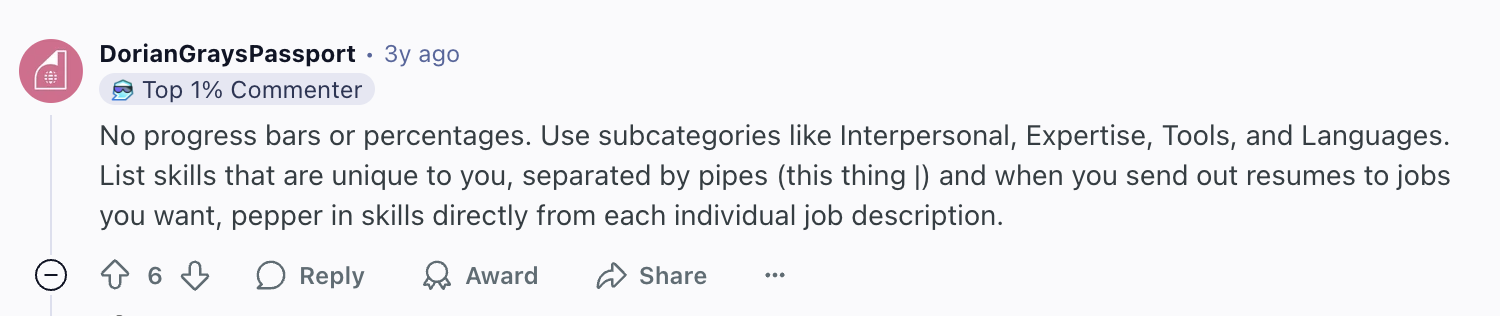
1. Review the job description
The job description is your best guide for which skills to include, as it shows exactly what the employer wants. Highlight all the required skills and abilities, and pay attention to the company’s culture or values. Skills mentioned multiple times are especially important. Only list what you genuinely have, and focus on relevance.
To make this easier, use our AI Keyword Targeting tool. Paste in the job description, and it’ll point out which skills you already have on your CV and which ones are missing. It can even write bullet points for skills you want to highlight.
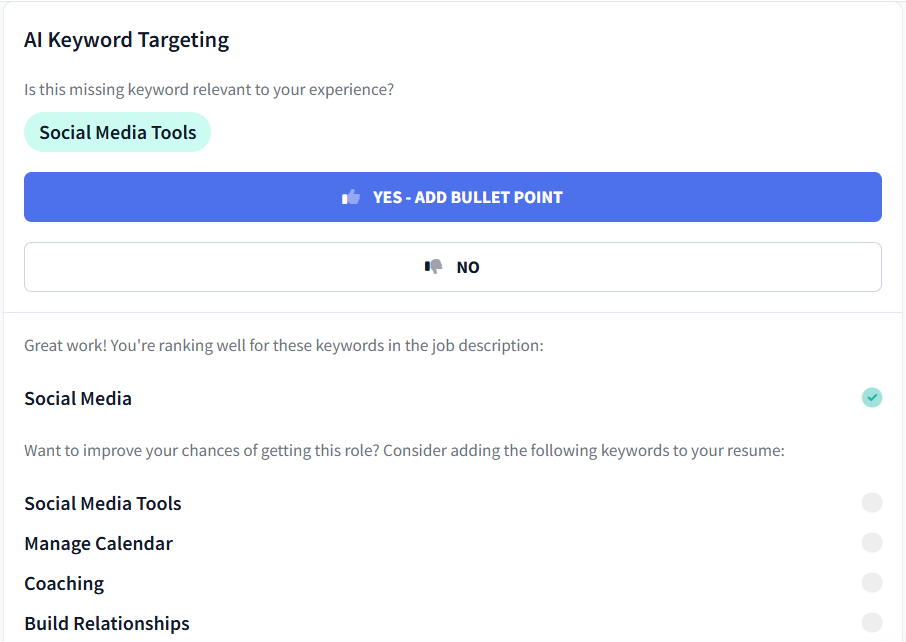
If you want to add extra skills not explicitly listed but relevant to the role or industry, try our AI Skills Explorer. Enter a category and example skill, and it suggests related skills you can include — perfect for when your mind goes blank.

Once you have your skill list, ask yourself:
- Where have I applied this skill in work, school, or side projects?
- Which skills do I genuinely excel at?
- Am I still learning any of them? If so, pop in the certification that’s “in progress” and explain what skills you’re developing.
- Can I back up each skill with accomplishments or measurable results?
2. Mention your skills in your CV summary
Your CV summary (or professional profile) sits right under your contact info and is usually two or three sentences. Show why you’re a great fit for the role by highlighting your key skills and the results you’ve achieved (numbers help here too).
Here’s a sample summary:
Passionate elementary school teacher with 5 years of experience fostering student learning and engagement. Skilled in curriculum development, classroom management, and differentiated instruction, with a track record of improving student test scores by 15%. Excited to bring these skills to Lincoln Elementary School, collaborating with colleagues and parents to create a supportive and effective learning environment.
If this feels tricky, try our AI Resume Summary Generator. Pick a previous role and the skills you want to emphasise, and it will create a summary tailored to the job description.
Here’s a sample summary from our AI Summary Generator:

3. Include a skills section
Your skills section matters — ATS scans these keywords to see if you match the job.
Group skills by type (technical, languages, soft, hard) and add proficiency levels if useful. Keep it simple with commas or dividers (|), and skip progress bars because ATS can’t read them.
This Reddit user agrees:

Here’s a sample skills section:

4. Sprinkle skills in your work experience
Your work experience section is where you show how you used your skills. Try to work each key skill into your bullets at least once, with real examples that bring them to life.
Here’s a sample work experience section:
Customer Support Specialist | Red Panda Inc. | London | August 2024–February 2025
- Delivered excellent customer service by resolving 40+ support tickets daily with a 95% satisfaction rating.
- Applied strong communication and problem-solving skills to de-escalate client issues and retain key accounts.
- Partnered with product and engineering teams, showing teamwork and stakeholder engagement, and flagged recurring bugs that reduced complaints by 20%.
- Balanced a heavy workload through strong time management, consistently meeting daily response targets.
And if you don’t have much formal experience, don’t stress. You can still showcase skills through volunteering, education, or projects.
Here’s an example from volunteering work experience:
Volunteer Event Coordinator | Community Food Bank | London | February 2023–August 2025
- Guided a team of 15 volunteers, demonstrating leadership and collaboration to run weekly food drives.
- Improved process efficiency by creating a digital sign-up system, cutting registration time by 30%.
- Built strong client relationships with local families, ensuring support was delivered with care and respect.
Hard Skills vs. Soft Skills
In short: hard skills are concrete, teachable, and measurable abilities, like project management, languages, or carpentry. Soft skills are personal strengths that guide how you work with others, like communication, problem-solving, and teamwork. Focus on showcasing hard skills prominently in your skills section, then display both hard and soft skills through your work experience to show you can get the job done and work well with others.
Employers want both — hard skills prove you can do the job, soft skills show how you do it.
Hard skills are specific, teachable, and measurable. You pick them up through training, school, or experience. For example, bookkeeping, curriculum design, or forklift driving. Technical skills like coding or robotics fall under this, but not all hard skills are technical, like foreign languages, public speaking, and copywriting.
Soft skills are personal qualities that shape how you work with others. They’re harder to measure but just as important; communication, problem-solving, leadership, time management, and teamwork all fall here.
Both matter, but hiring managers usually look at hard skills first. Put those front and centre in your skills section, then use your work experience to show off both hard and soft skills in action.
Take it from these guys:
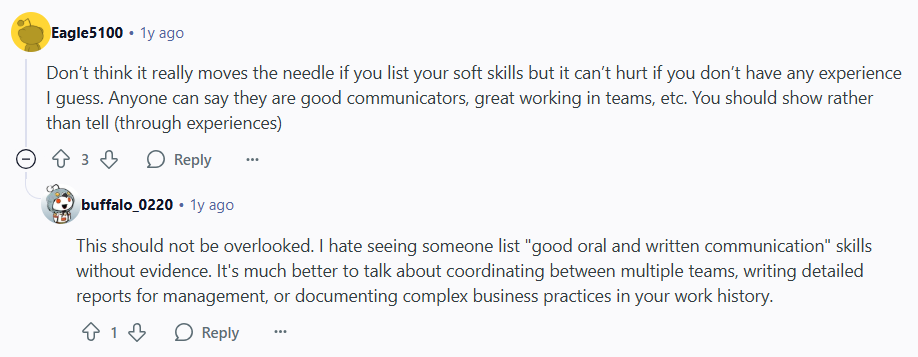
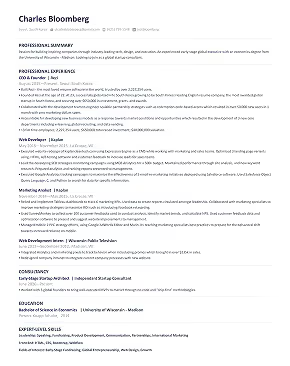
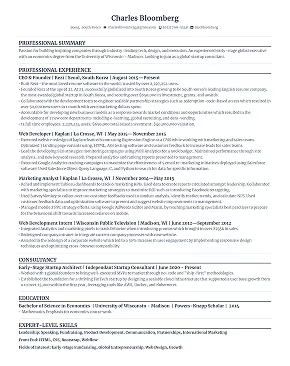
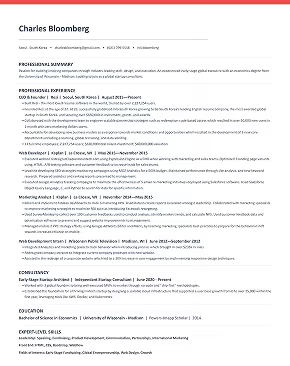
Examples of Skills on a CV
In short: there are three CV formats you can use. Reverse chronological is the most common and recruiter-friendly, emphasising your work experience. Skills-based CVs focus on transferable skills, making them ideal for employment gaps. Combination CVs blend both, leading with skills then listing experience, best suited for senior professionals.
Let’s look at three different types of CVs and three different ways of showing off your skills on these CVs. Personally, I recommend just going with the reverse chronological format. It’s the easiest, the most widely accepted, and all hiring managers are familiar with that structure, but each style has its uses depending on your situation.
Reverse chronological CV
You can’t go wrong with this one. Your work experience takes centre stage, right after your summary, listed from your most recent backwards. It’s straightforward and what most recruiters expect, so it rarely raises questions.

Skills-based CV
Also called a functional CV, this format puts your skills on top. It’s useful if you have gaps in employment or want to highlight transferable skills. You start with a skills summary, showing how you’ve applied each one, then list your work experience. Be aware, though: some recruiters might think you’re trying to hide something if you skip the usual chronological order.
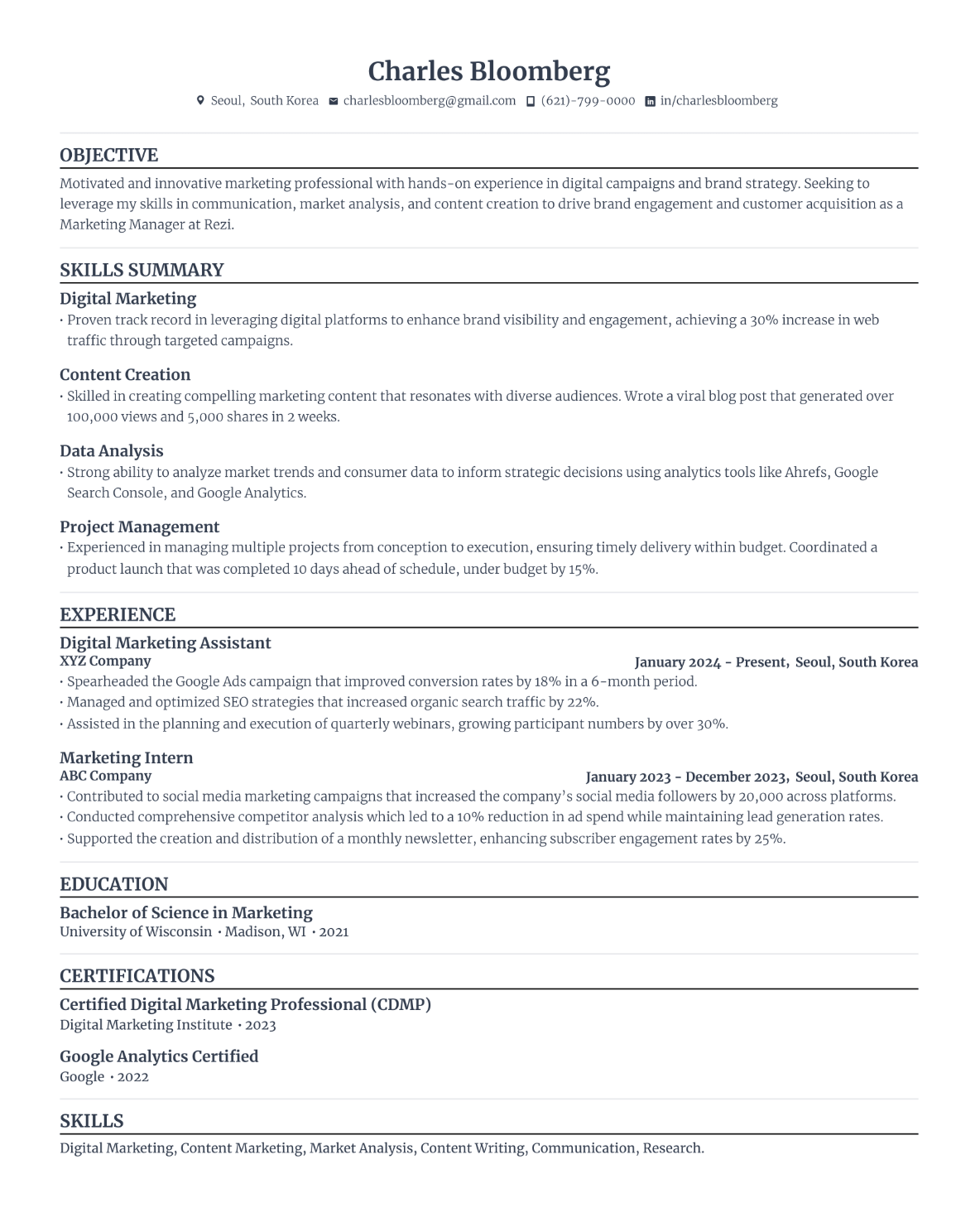
Combination CV
This hybrid leads with a detailed skills summary, then follows with reverse chronological work experience. It’s great for senior professionals with lots of expertise, but it can be tricky to pull off without repeating yourself too much.

Summary
Here’s a recap on adding skills to your CV:
- Focus on the skills mentioned in the job description and tailor your CV to what the employer values most.
- Top skills of 2025 include project management, data analysis, communication, customer service, collaboration, leadership, inventory management, and problem-solving.
- Work skills naturally into your summary, experience, education (if relevant), and a dedicated skills section.
- Use your summary to spotlight key skills, backed by measurable results that show your impact.
- Create a skills section organised by type (hard, soft, technical, languages), with simple formatting, and skip progress bars.
- Support each skill with examples or achievements from work, volunteering, or projects.
- Employers look for both hard and soft skills. List hard skills clearly in your skills section and show both in action through your experience.
FAQ
What skills can I put in my CV?
Include skills that actually match the job you’re applying for. Read the job description carefully and pull out the keywords they use. If they want communication, project management, or data analysis, make sure those show up in your CV. The key is to be selective and focus on what’s relevant, not just everything you can think of.
What are basic resume skills for jobs?
Basic resume skills are the ones that almost every workplace values, like communication, teamwork, time management, problem-solving, and adaptability. Employers want to know you can work well with others, handle your tasks on time, and figure things out when challenges pop up.
What are 5 hard skills and soft skills for a resume?
Five hard skills are data analysis, programming, cybersecurity, project management, and languages. They’re measurable and teachable. Soft skills are more about your personality and how you work with others, like leadership, teamwork, communication, problem-solving, and adaptability.
What to write for skills and achievements on a CV?
For skills, highlight the ones that are most relevant to the job, ideally pulled from the job description. And don’t just list them, think about where you can show them in action. For achievements, use real examples with numbers where possible. Instead of saying “good at sales,” you might write “increased monthly sales by 20% through new customer outreach.”
What skills to put on a CV for retail?
Retail jobs value both customer-facing and behind-the-scenes skills. Some strong ones to include are customer service, communication, teamwork, cash handling, sales, inventory management, and problem-solving. If you’ve had experience with point-of-sale systems, that’s worth adding too.
How to write a CV for someone with no skills?
You probably have more skills than you think. Look at school projects, volunteering, part-time jobs or unpaid work, and even hobbies — anything that shows responsibility or teamwork. Maybe you organised an event, helped others, or picked up a new tool. Highlight transferable skills like communication, reliability, and adaptability. If you’re still learning, include training or certifications in progress to show initiative and a willingness to grow.

Upload or drop your resume to get started
Upload your resume to get started
Score my resume

Sarah Coghlan is a writer and editor passionate about making resume and career advice clear and accessible to all. Based in Barcelona, her goal is to help job seekers create standout resumes and navigate the job search process with confidence and ease.