Resume
Combination Resume for Skills & Experience (With Examples & Template)
Learn how to create a combination resume that highlights both your skills and work experience. This guide covers who should use it, formatting tips, and examples.


Published on
July 17, 2025
Updated on
October 17, 2025
A combination resume, or hybrid resume, blends a skills-based format with a reverse-chronological work history. It’s ideal for career changers, recent graduates, job hoppers, those with employment gaps, and experienced professionals who want to showcase their skills while maintaining a clear career timeline. This format emphasizes key abilities at the top while detailing work experience below, making it easier to connect transferable skills to new roles.
Whether you’re juggling experience from multiple industries, switching careers, coming back after a break (thanks to sickness, school, or that lovely thing we call a recession), or just want to highlight your best skills, a combination resume can work wonders. It lets you showcase your abilities while framing your work history — and those gaps or less relevant jobs — in the best possible light.
The problem is people sometimes cram in every skill they’ve ever learned, hoping to seem versatile, or get stuck figuring out what’s actually worth including.
Maybe you’re wondering how to highlight skills from different jobs without overcrowding the page — or if your resume summary should focus on where you’re going next or where you’ve already been. And how do you keep it all neat, relevant, and easy to read?
This guide will answer all your questions and more. We’ll cover:
- What a combination resume is and who it’s best for.
- A step-by-step breakdown of how to write a combination resume.
- An example and template to get you started.
If you want to make it even easier, try our AI Resume Builder. And for more tips, check out these guides:
- How to Write a Resume With No Work Experience
- Tips for Tailoring Your Resume to A Job
- The Best Skills to Put on a Resume
- 13 Best Technical Skills for a Resume
- Computer Skills for a Resume
What is a Combination Resume
A combination resume, also known as a hybrid resume, blends the best features of two formats — the popular reverse chronological format and the skills-based resume. It emphasizes your key skills at the top while outlining your work experience in reverse chronological order. This format is perfect for highlighting both your expertise and career progression.
Who Should Use a Combination Resume
In short: it’s ideal for career changers, recent graduates, job hoppers, those with employment gaps, and seasoned professionals who want to highlight their skills while still showcasing their work history.
The reverse-chronological resume is the most commonly recommended format, but it’s not always the best choice. If listing your work history first doesn’t highlight your strengths, a combination resume may be a better fit.
Here are some job seekers who can benefit from using a combination resume:
Career changers
A combination resume is ideal if you’re switching fields, as it emphasizes transferable skills — like communication or project management — while still outlining your work history. Whether you’re moving from retail to marketing or hospitality to healthcare, this format helps connect your past experience to your new career path.
Recent graduates
If you’re new to the workforce, a combination resume highlights the skills you’ve gained through internships, volunteer work, or extracurriculars while still listing your job history. This format helps employers see your potential, even if you lack extensive professional experience.
Job hoppers
A combination resume is useful if you’ve held multiple jobs in a short time. It showcases the skills and expertise you’ve developed across roles while downplaying the frequent job changes. This approach shifts the focus to your adaptability and diverse knowledge rather than your employment timeline.
People with employment gaps
Whether you took time off for family, health, or other reasons, a combination resume highlights your skills and achievements rather than career breaks. It allows you to showcase your strengths while still including your work history, proving you’re ready to re-enter the workforce.
Seasoned professionals
If you have an extensive or varied career, a combination resume emphasizes your top skills and achievements while outlining your work history. This format makes your expertise clear and helps employers quickly understand your value, without having to sift through every job title.
How to Write a Combination Resume Format
In short: use professional fonts, clear headings, and a neat layout with single spacing and one-inch margins. Keep the resume to one page, using bullet points for skills and accomplishments. Include contact information in the header with your name in bold and links to LinkedIn or a portfolio. Write a concise resume summary or objective tailored to the job. Highlight relevant skills and work experience, quantifying results. Add sections for education, languages, awards, personal projects, and hobbies if applicable.
Format your resume
A clean, consistent resume format ensures your skills and experience are easy to read.
- Use professional fonts like Arial, Calibri, or Verdana in 10–12 pt, with headings in 14–16 pt.
- Label sections clearly with simple headings like “Skills,” “Experience,” and “Education.”
- Keep your layout neat with single or 1.15 spacing and one-inch margins.
- Limit your resume to one page and use bullet points to detail your skills and accomplishments.
List your contact information in your header
Place your contact info at the top in a resume header for easy visibility. Make it clear, accurate, and up-to-date.
- Use a bold, larger font (20–24 pt) for your name to make it stand out.
- Include your phone number, professional email, and location (city and state or country).
- Add a link to your LinkedIn profile or portfolio if available. If you don’t have a LinkedIn, create one to enhance your job applications (for help, check out How to Make a Good LinkedIn Profile).
Here’s an example of a resume header:

Write a resume summary or objective
Create a concise and impactful resume summary or objective in two or three sentences.
- Experienced professionals: write a resume summary highlighting key skills, accomplishments, and years in the field.
Here’s a sample resume summary:
Experienced software developer with 5+ years of expertise in Java and Python, specializing in web development and cloud-based applications. Successfully led projects that improved system performance and user experience for clients in the finance industry. Looking to leverage my technical skills at Pink Cloud to contribute to innovative software solutions.
- Newcomers: craft a resume objective that showcases transferable skills and eagerness to learn and contribute to the team.
Here’s a sample resume objective:
Recent computer science graduate with hands-on experience in coding, problem-solving, and agile development methodologies. Proficient in Java and C++, with a strong foundation in data structures and algorithms. Eager to apply my skills at RangeCard, where I can learn and grow while contributing to innovative software projects and expanding my expertise in collaborative environments.
- Customize your summary or objective by using keywords from the job posting. Focus on relevant skills and mention the job title and company to show your alignment with the role.
If you need help writing your summary, try the Rezi AI Resume Summary Generator.
Outline your skills summary
Your skills summary shows off the skills you can back up with experience. Tailor it to align with the employer’s needs.
- Focus on two or three key abilities that are relevant to the job, combining technical (hard) skills and interpersonal (soft) skills.
- For each skill, include bullet points that prove your expertise with real achievements. Quantify results when possible to highlight your impact.
- If you don’t have direct experience, talk about transferable skills and avoid including irrelevant accomplishments, no matter how proud you are of them.
Here’s an example of a skills summary:
Project Management
• Led a cross-functional team of 15, delivering projects 20% ahead of schedule.
• Implemented new workflows that increased productivity by 35%.
Customer Service
• Managed 50+ customer inquiries daily with a 98% satisfaction rate.
• Trained and mentored 10 new hires, reducing onboarding time by 25%.
If space is limited, list extra relevant skills under “Additional Skills.”
Here’s an example of how to include an additional skills section on a resume:
Additional Skills
• Microsoft Office Suite (Excel, Word, PowerPoint)
• Basic HTML/CSS
• Time management
• Conflict resolution
• Google Analytics
Describe your work experience
Highlight your most relevant roles in your work experience section and connect them to the skills you’re showcasing.
- List your relevant roles in reverse chronological order, beginning with your most recent position.
- For each job, include your title, company name, location, and dates worked.
- Use 3–8 bullet points per job, starting with action verbs like “led,” “created,” and “optimized.”
- Show your impact with numbers, like percentages or dollar amounts (e.g. “increased customer satisfaction by 30%” or “trained 4 new employees”).
- Tie your skills to job responsibilities, like “communicated effectively with a team of 10,” if communication is a key skill on the job posting.
Here’s a sample work experience section:
Project Manager | Cherry Tech Solutions
June 2020–Present, San Francisco, CA
•Led a team of 10 in managing software development projects, improving delivery time by 20%.
•Implemented Agile methodologies, resulting in a 30% increase in team productivity.
•Coordinated with clients to ensure project milestones were met, maintaining a 95% client satisfaction rate.
•Managed budgets exceeding $500,000, ensuring projects stayed within budget and on schedule.
Marketing Coordinator | Rooster Media
May 2017–May 2020, San Francisco, CA
•Developed and executed digital marketing campaigns that boosted website traffic by 40%.
•Managed social media accounts, increasing followers by 25% in one year.
•Collaborated with cross-functional teams to create marketing materials and presentations.
•Analyzed campaign performance, presenting results to senior leadership to inform future strategies.
Mention your education
Keep your education section brief and just highlight your degree and the key details, as your skills and work experience are the main focus.
- Start with your highest degree, including the degree or certification, institution, and graduation date (or expected date).
- Throw in your GPA if it’s above 3.5 and you’ve graduated within the last 10 years.
- Optionally, list relevant coursework if it adds value to the position.
Here’s an example of a combination resume’s education section:
Education
Bachelor of Science in Computer Science | University of California, Berkeley
May 2023 | GPA: 3.8
• Coursework: Data Structures, Algorithms, Web Development, Cloud Computing
Include extra sections
Add sections that show off valuable skills and experiences that don’t fit neatly into your work history or education.
- Languages. List any languages you speak on your resume and your proficiency level (e.g. native, fluent, intermediate, basic).
- Awards and honors. Include any recognitions you’ve received on your resume, like “Employee of the Month” or industry awards.
- Personal projects. Mention relevant projects on your resume like coding work, design projects, or extracurricular activities.
- Hobbies. Highlight hobbies on your resume that showcase valuable skills, like photography, blogging, or team sports.
Here’s a sample personal projects section for a combination resume:
Personal Projects
• Open-Source Contributor: Redesigned the UI for “UIEnhance” on GitHub, fixing 10+ bugs and improving overall functionality.
• Tech Blog Creator: Launched and manage “DevTrends,” a blog with 30+ posts on software development, including AI and machine learning.
• Volunteer Graphic Designer: Created promotional materials (flyers, posters, and social media graphics) for my local sports team to boost event attendance and visibility.
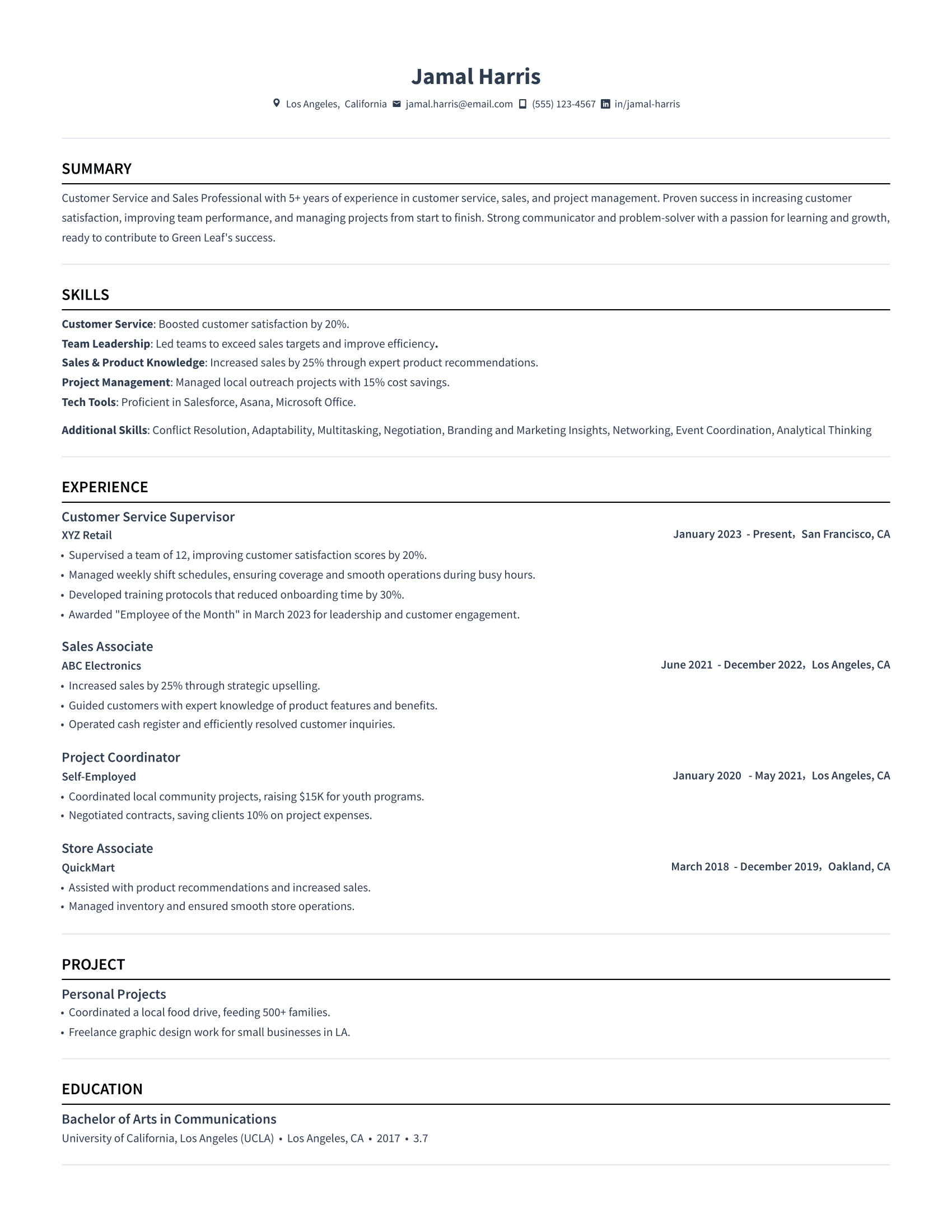
Combination Resume Example
This combination resume example highlights the candidate’s key skills and achievements, showcasing their value while demonstrating growth and measurable success in their work experience.
Combination Resume Template
Here’s a combination resume template with easy-to-follow instructions for each section. Just copy, paste, and customize it with your own details.
[Your Name]
[Your City, State] | [Your Email Address] | [Your Phone Number] | [Your LinkedIn Profile URL]
SUMMARY
[Write 2–3 sentences summarizing your experience, skills, and career goals, tailored to the job you’re applying for.]
SKILLS
• Customer Service: [Quantifiable achievement]
• Team Leadership: [Quantifiable achievement]
• Sales & Product Knowledge: [Quantifiable achievement]
• Project Management: [Quantifiable achievement]
• Tech Tools: [List software and tools]
• Additional Skills: [List soft skills]
EXPERIENCE
[Job Title]
[Company Name] | [City, State] | [Dates of Employment]
• [Achievement/Responsibility 1]
• [Achievement/Responsibility 2]
• [Achievement/Responsibility 3]
[Job Title]
[Company Name] | [City, State] | [Dates of Employment]
• [Achievement/Responsibility 1]
• [Achievement/Responsibility 2]
• [Achievement/Responsibility 3]
PROJECTS (Optional)
[Project Name]
[Description of the project]
[Your role and responsibilities]
[Key accomplishments or outcomes]
EDUCATION
[Degree Name] in [Major]
[University Name] | [City, State] | [Year of Graduation] | [GPA (Optional)]
Summary
Here’s a recap of what you need to know about combination resumes:
- A combination resume mixes the reverse-chronological format with a skills-based approach, allowing you to highlight both your key skills and career progression.
- A combination resume is ideal for career changers, recent graduates, job hoppers, people with employment gaps, and seasoned professionals who want to showcase skills while keeping a clear work history.
- Use professional fonts (Arial, Calibri) in 10–12 pt with simple headings, one-inch margins, and single or 1.15 spacing. Keep the resume to one page and use bullet points for clarity.
- Include your name (in bold, larger font), phone number, professional email, location, and links to a LinkedIn profile or portfolio if available.
- Write a 2–3 sentence summary highlighting your skills and achievements (for experienced candidates) or a focused objective emphasizing transferable skills (for newcomers).
- Focus on 2–3 key skills that align with the job. Use bullet points to provide evidence of your expertise, quantifying results when possible.
- In your work experience section, list jobs in reverse chronological order. For each role, include the job title, company, location, dates worked, and 3–8 bullet points emphasizing achievements with measurable results.
- In the education section, include your highest degree, institution, and graduation date. Add your GPA (if 3.5+) or relevant coursework if applicable.
- Enhance your resume with extra sections like languages, awards, personal projects, and hobbies — especially if they showcase job-relevant skills.
- Customize every section to match the job description. Use keywords from the posting, especially in your summary, skills, and work experience, to increase your chances of passing the Applicant Tracking System (ATS).
FAQ
What are the benefits of using a combination resume format?
A combination resume highlights your skills upfront while still showcasing your work history. It’s perfect for job seekers with diverse skills, career changers, or those with employment gaps, because it lets you focus on strengths without hiding your experience. Plus, it’s flexible, as you can easily tailor it to match the job.
What are the cons of a combination resume?
It can be harder to read if overloaded with details and may feel repetitive if you are repeating achievements in your skills summary and work experience section. Since it’s less common than a chronological resume, some hiring managers might be less familiar with it.
Why is the combination resume most commonly used by teenagers?
The combination resume shifts the focus away from their limited job history and puts more emphasis on their skills, volunteer work, and extracurricular activities. This format helps them show employers what they’re capable of, even if their actual work experience isn’t as extensive as other applicants.
What is the difference between chronological and combination resumes?
A chronological resume focuses on your work history the most. A combination resume, however, starts with a detailed skills summary, showing how you’ve used those skills to achieve results, followed by your work history and education.
What are common resume mistakes to avoid?
Keep your resume concise— one page is usually enough. Avoid listing irrelevant skills and focus on what matters for the job. Watch for typos, poor formatting, and don’t just list duties — highlight your achievements and the impact you made.
What are 5 important soft skills that employers look for?
- Communication: Clearly express ideas and listen actively.
- Teamwork: Collaborate with others and work towards shared goals.
- Problem-solving: Think critically and find solutions to challenges.
- Adaptability: Adjust to change and handle unexpected situations.
- Time Management: Prioritize tasks and efficiently meet deadlines.
What is the Applicant Tracking System?
An Applicant Tracking System (ATS) is software that many companies use to filter resumes before they ever reach a human. It scans resumes for keywords and phrases that match the job description. If your resume doesn’t include these keywords or is poorly formatted, it could get passed over. That’s why it’s so important to tailor your resume for each job you apply to, ensuring it aligns with the ATS requirements.

Upload or drop your resume to get started
Upload your resume to get started
Score my resume

Sarah Coghlan is a writer and editor passionate about making resume and career advice clear and accessible to all. Based in Barcelona, her goal is to help job seekers create standout resumes and navigate the job search process with confidence and ease.