
Career Advice
How AI Is Changing the Job Market: New Jobs & What’s at Risk
Discover how AI is transforming jobs worldwide; what roles are at risk, which ones are thriving, and how to stay relevant with the right skills and mindset.

Published on
December 3, 2025
Updated on
December 3, 2025
AI is reshaping the job market by automating repetitive roles, transforming existing ones, and creating entirely new careers in tech and innovation. While jobs in data entry, customer service, and logistics are at risk, opportunities are growing in fields like AI development, ethics, and human–machine collaboration. The key to staying competitive is adaptability: learn how AI works, build soft skills like creativity and empathy, and treat learning as a lifelong habit.
AI is showing up everywhere, from how we work and create to the bizarre corners of social media. You’ve seen those AI babies sprinting out of hospitals and the horse doing a perfect front flip off a diving board, right? No? Just me?
Beyond the memes, AI is changing the job market and the way we work: some roles are disappearing, others evolving, and entirely new ones are popping up faster than ever.
This guide covers:
- Jobs most at risk and those that are AI-proof.
- New roles emerging from AI adoption.
- How workers can stay ahead.
If you’re ready to beat the odds in the job market, try our AI Resume Builder or check out these guides:
- Why Is It So Hard to Find a Job (And What You Can Do About It)
- Why Is the Job Market So Bad in the US Right Now?
- 15 Best Job Search Engines in 2025
- Check Your Resume for ATS Compatibility
The Impact of AI on the Workforce
AI is already reshaping the job market. 13.7% of US workers say they’ve lost a job to automation, and around 40% of employers anticipate cutting staff if AI could take over certain tasks (National University).
You can see it happening everywhere:
- Amazon has let go of 14,000 employees, and previously announced the total could climb to 30,000 (BBC).
- UPS has cut 48,000 workers since last year, mostly among warehouse staff and drivers (New York Times).
- Salesforce, Google, and Microsoft have all downsized teams while investing heavily in AI (Fortune).
Still, it’s not all doom and gloom. About 77% of employers say that by 2030, they’d rather upskill workers than replace them (Future of Jobs Report 2025), helping employees learn to work with AI. (Whether they actually follow through is another story.)
And while AI gets most of the blame for layoffs, the broader economy isn’t exactly thriving either. Automation is just speeding up changes that were already underway.
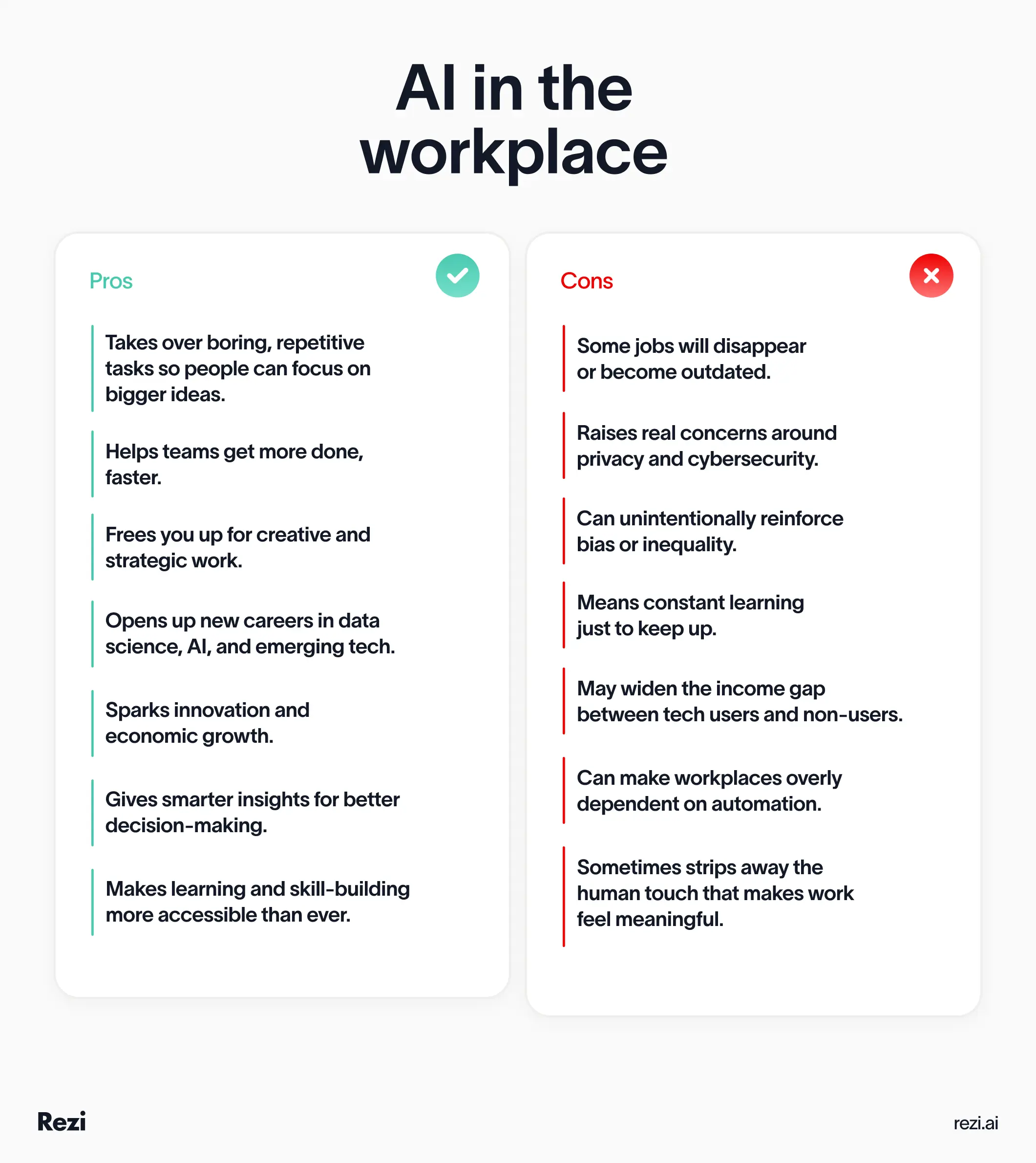
Here are some of the pros and cons of AI in the workplace:
Is AI Taking Our Jobs or Just Changing Them?
Yes, AI is both taking some jobs and massively transforming others. Every major tech revolution reshapes the workforce, from the steam engine to the internet. Some roles disappear, others emerge, and entirely new industries are born. AI is the latest wave.
According to Goldman Sachs Research, AI could put about 6–7% of US jobs at risk in the short term, but new opportunities are likely to outweigh those losses. By 2030, an estimated 92 million jobs may be phased out, yet around 170 million new roles could be created in AI, data ethics, and machine oversight (Future of Jobs Report).
What jobs will AI replace?
Roles built on repetition, rules, or data-heavy tasks are especially vulnerable; the kind of work algorithms are getting very good at.
- Clerical and admin work. Data entry clerks, bookkeepers, payroll assistants, and office administrators are among the first to go as AI takes over paperwork and record management.
- Customer service and telemarketing. Gartner predicts that by 2028, roughly 70% of customers will begin and resolve their service interactions through conversational AI assistants.
- Retail and cash handling. Self-checkout systems and digital payments are reducing roles for cashiers and bank tellers, with double-digit declines expected by 2033 (NU).
- Manufacturing and logistics. Robots can now assemble, pack, and inspect products.
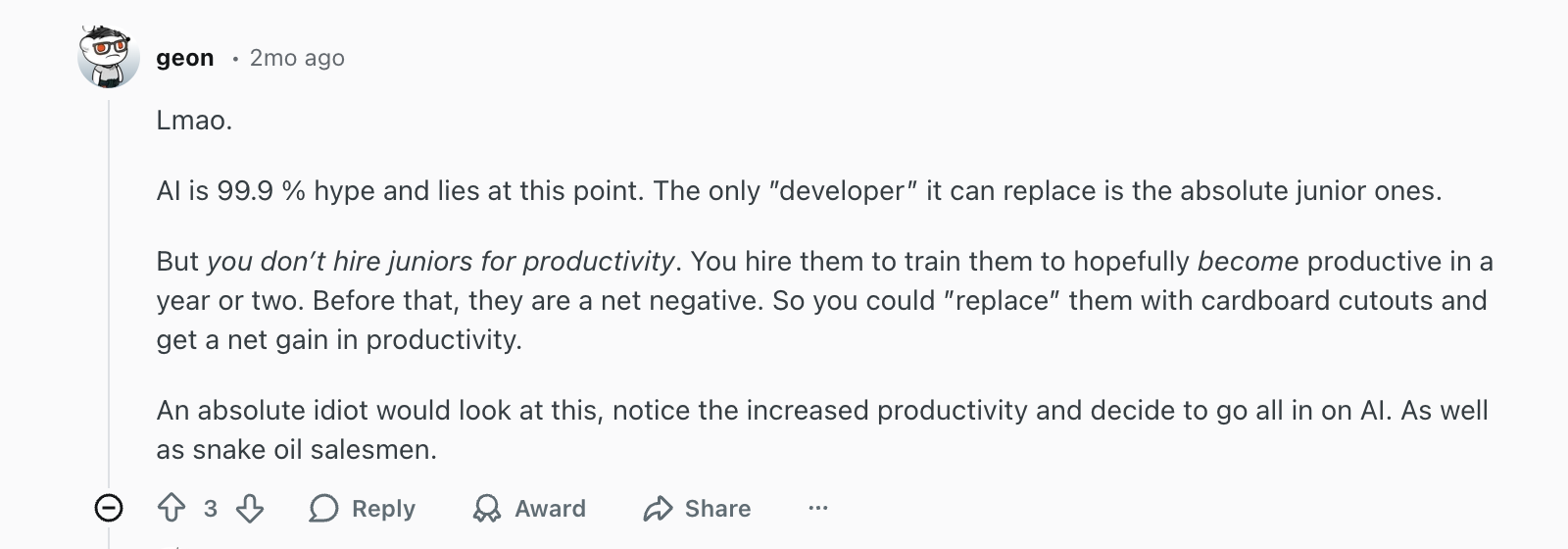
- Entry-level white-collar jobs. Paralegals, HR staff, and junior developers are increasingly at risk. Nearly half of all entry-level jobs in tech, law, and finance could be replaced, according to Anthropic CEO Dario Amodei.
While junior developers are struggling, senior roles seem safe for now. As this Reddit user pointed out, it would be foolish to think AI could fully replace experienced developers:
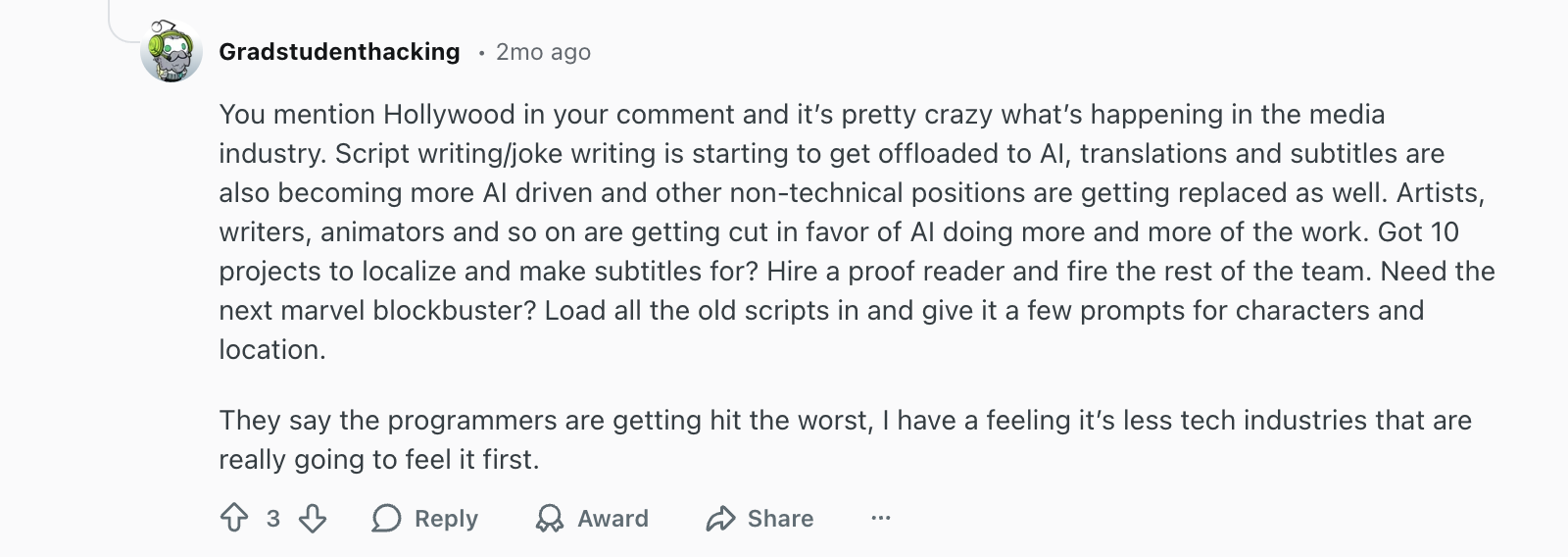
And it’s not just technical fields feeling the pressure. Creative industries are also starting to see AI’s influence:
Find out more about the AI Impact on White-Collar Jobs.
What jobs are AI-proof?
If your work depends on empathy, human judgment, creativity, adaptability, or simply showing up in person, you can relax (for now).
Some of the most AI-resistant fields include:
- Healthcare. Radiologists, pharmacists, and medical assistants rely on human expertise and ethical decision-making. Privacy laws also limit the data AI can access, which slows automation. Instead of replacing these roles, AI is helping them by handling routine tasks like image analysis and creating new tech-driven healthcare jobs.
- Construction and skilled trades. Builders, electricians, and repair techs work in unpredictable environments that AI can’t easily replicate. (Read more: Best Blue-Collar Jobs.)
- Education. Teaching requires emotional intelligence, adaptability, and trust — things no chatbot can fake.
- Personal services. Chefs, cleaners, stylists, and caregivers all depend on presence and personal connection.
- Creative and leadership roles. Executives and team leaders all rely on originality, intuition, and human insight.
The future belongs to professionals who combine tech skills with empathy, creativity, and problem-solving.
What New Jobs Is AI Creating?
In short: roles like AI product managers, machine learning engineers, and prompt engineers bridge the gap between humans and technology. Others, like AI ethicists, data curators, and human–machine teaming managers, focus on making AI safer, smarter, and more collaborative.
Many of the new jobs being created would have been unimaginable just a decade ago. After all, 60% of today’s jobs didn’t exist in 1940 (Goldman Sachs). Imagine explaining some of these titles to a Victorian child:
- AI product manager or program lead. The translator between business goals and AI systems, ensuring technology delivers actual results.
- MLOps or AI platform engineer. Keeps the AI machinery running; deploying, monitoring, and maintaining models behind the scenes.
- Machine learning engineer or AI programmer. Builds and fine-tunes algorithms that help AI learn, predict, and improve.
- AI security specialist. Protects models and data from tampering or misuse.
- AI ethics, governance, and risk officer. Ensures AI is used fairly and responsibly, auditing systems for bias and managing compliance.
- Prompt engineer or AI trainer. Crafts the prompts and language that teach AI how to respond effectively — basically, AI’s personal tutor.
- Data labeling or curation specialist. Organizes and labels data so AI can learn accurately from it.
- AI operations and support staff. Keeps AI systems healthy, troubleshooting and optimizing as they run.
- Human–machine teaming manager. Helps people and AI work better together; part tech expert, part workplace diplomat.
- AI-powered creative professional. Combines human imagination with AI tools to design, write, market, and produce content faster than ever.
How Can Workers Stay Competitive in an AI Landscape?
Here’s how workers can stay competitive:
- Keep learning, stay flexible, and focus on curiosity and adaptability, rather than one set of skills.
- Get comfortable with AI tools like ChatGPT or Copilot, and build basic data and cybersecurity skills.
- Strengthen human skills like creativity, empathy, and critical thinking; things AI can’t replace.
- Help bridge people and tech by improving workflows, training teams, and making AI work in real settings.
- Stay informed on how AI is changing your industry and experiment with new tools as they emerge.
Keeping up with AI means constantly learning. As the Fiverr CEO bluntly put it, workers who want to stay relevant will need to upskill, reskill, and outwork the machines. It’s not the most comforting message, but he’s right. By 2030, 59% of workers will need new skills, according to NU.
The key now is adaptability. It’s no longer enough to master one set of tools; what matters is how quickly you can learn new ones. Employers want people who can handle change, experiment with technology, and stay calm when things shift.
1. Build your tech fluency
You don’t need to become a programmer overnight, but understanding how AI works and how to use it effectively gives you a real edge. Explore tools like ChatGPT, GitHub Copilot, or other AI platforms relevant to your industry.
Basic skills in data literacy, cybersecurity, and machine learning are becoming essential across almost every field.
2. Strengthen your soft skills
Ironically, the smarter AI gets, the more valuable human qualities become.
Communication, critical thinking, empathy, and creativity show up in millions of job postings because no algorithm can truly replicate them. These soft skills help you do what AI can’t: connect, lead, and think beyond the data.
Related reading:
3. Lead the integration
Every company that adopts AI faces the same problem: making it actually work in real-world teams.
There’s a rising demand for people who can manage teams, train coworkers, and streamline workflows. You don’t need to be deeply technical; you just need to understand how people, processes, and tools fit together.
Find out What’s your Leadership Style & How to Choose the Best One for You.
4. Stay curious and flexible
Keep up with how AI is changing your industry. Follow industry news, attend workshops, talk to peers, and try out new tools when they come out. The people who treat learning as a lifelong habit (not a one-time task) will adapt the fastest and thrive the longest.
Check out AI is Reshaping Work: How Learning Platforms Can Help You Stay Relevant.
Final Thoughts: The Future of Work in an AI World
The future won’t be kind to those who resist change and stick their heads in the sand; it’ll favor those who adapt, learn fast, and treat AI as a partner, not a threat. It’s not going anywhere anytime soon.
Keep it out of your hobbies if you want, but the best career move now isn’t to outsmart the machines; it’s to do what they can’t: stay curious, stay human, and keep evolving.
FAQ
When is it time to change jobs?
It’s time to move on when you’ve stopped learning, growing, or feeling appreciated. If Sunday nights fill you with dread or your values no longer (or never did) match the company’s, take that as your cue. You deserve work that energizes you, not drains you.
Learn more: How to Switch Careers.
Why is AI bad for education?
AI isn’t necessarily bad, but relying on it too much can backfire. When students use AI to do the thinking for them, creativity and problem-solving suffer. There’s also the risk of biased or inaccurate information, and it’s made cheating a lot easier than before.
Will AI replace radiologists?
Despite early predictions, AI hasn’t replaced radiologists; it’s become their assistant. It helps process and analyze images faster, but the final diagnosis still needs human expertise. AI speeds up their work, but radiologists remain essential for accuracy and patient care.
How many jobs are available in technology?
“As of mid-2025, there were about 125,000 open AI-related job postings (CompTIA), and nearly a million new jobs in the tech sector were added globally this year (Second Talent). The biggest demand is in software development, cloud computing, cybersecurity, data analysis, and AI/machine learning roles.
Will finance jobs be replaced by AI?
Some finance roles will change, but most won’t disappear. AI is great at automating tasks like data crunching and fraud detection, but it can’t replace human judgment in strategy, ethics, or client relationships. Instead, it’s creating new finance roles in analytics, compliance, and AI oversight.

Upload or drop your resume to get started
Upload your resume to get started
Score my resume

Sarah Coghlan is a writer and editor passionate about making resume and career advice clear and accessible to all. Based in Barcelona, her goal is to help job seekers create standout resumes and navigate the job search process with confidence and ease.
%2520(1).webp)

.webp)