Career Advice
How to Become a Teacher: Education, Degrees, & Skills
Find out how to become a teacher, including degree options, certification paths, state licensure, timeline, and top skills to succeed in the classroom.
.webp)
Published on
January 27, 2026
Updated on
January 27, 2026
This guide shows you how to become a teacher step-by-step. First, decide what age group or subject you want to teach, as this determines your degree and license requirements. Most public school teachers earn a bachelor’s in education or their subject with a state-approved teacher preparation program and certification. Career changers can use fast-track programs. Private schools may not require a certification, but it helps. Licensure rules, exams, and reciprocity vary by state. Becoming a teacher typically takes 4–7 years, depending on several factors. Key skills include communication, classroom management, organization, empathy, tech and data literacy, and cultural competence.
You might dream of being the next Miss Honey (minus the whole adopting-a-student thing). Or maybe you’re more Jack Black in School of Rock. Personally, if a student had ever told me “you’re tacky and I hate you” during my teaching days, I probably would’ve reconsidered my life choices on the spot.
Whatever your teaching style, we’re here to help you become the teacher you want to be, so you can shape young minds, stay curious alongside your students, and actually make a difference where it counts.
If you’re ready to get started, make your resume in minutes with our free AI Resume Builder.
Or explore these guides:
- How to Write a Teacher Resume (With Examples)
- Tips for Listing a Teaching Certification on a Resume
- How to Improve Your Education Section
What Degree Do You Need to Be a Teacher?
In short: most public school teachers earn a bachelor’s degree with a state-approved preparation program and teaching license, though career changers can use alternative certification routes. Private schools may be more flexible, and advanced degrees can expand opportunities and pay.
First things first: what kind of teacher do you want to be? Preschool, elementary, middle, or high school? A general classroom teacher, or a subject specialist in math, science, or history? Your answer determines the degree and license you’ll need.
If you’re unsure, job shadowing or volunteering in a classroom is a great way to see what teaching is actually like before committing to a program.
Relevant articles:
.webp)
Bachelor’s degree and teacher preparation
Most public school teachers earn a bachelor’s degree in education, which typically bundles coursework, a Teacher Preparation Program (TPP), and supervised classroom experience. Common majors include early childhood, elementary, secondary, and special education.
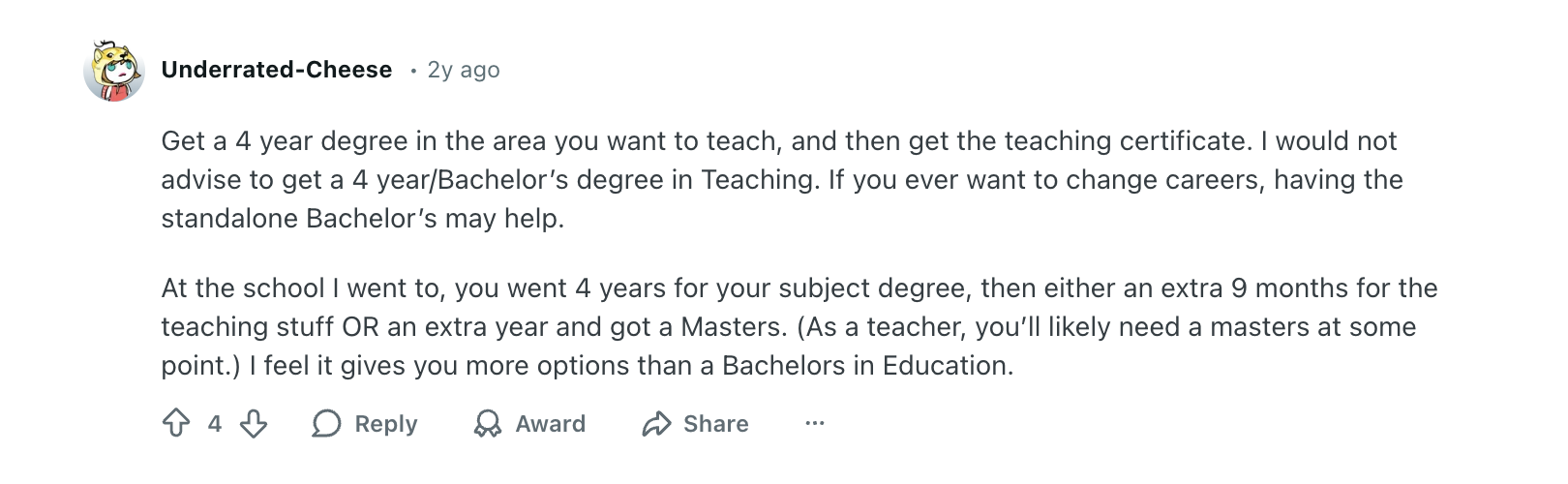
If you plan to teach middle or high school, you can major in the subject you want to teach (like math, English, science, or history) while completing your teaching coursework and training.
Some teachers on Reddit also recommend this route over earning a general education degree:
Accredited online programs are also an option if they meet state requirements.
Teacher certification
A teaching license or certification is required to teach in public schools. Most paths include:
- Completing a state-approved TPP
- Supervised student teaching or classroom internship
- Passing certification exams (often Praxis or state-specific)
- A background check (no surprise there)
Many education programs combine all of this, so you graduate ready to apply for your license.
Already have a bachelor’s in another field? Alternative or fast-track certification programs let career changers move into teaching in 1–2 years, sometimes while working in schools. Many offer online, evening, or weekend classes, and some districts even provide paid internships with mentor support.
Related guides:
- How to Write a Career Change Resume
- How to Change Careers
- Career Change at 40: How to Make it Happen
- How to Use Rezi for a Career Change Job Application
Teaching at private schools
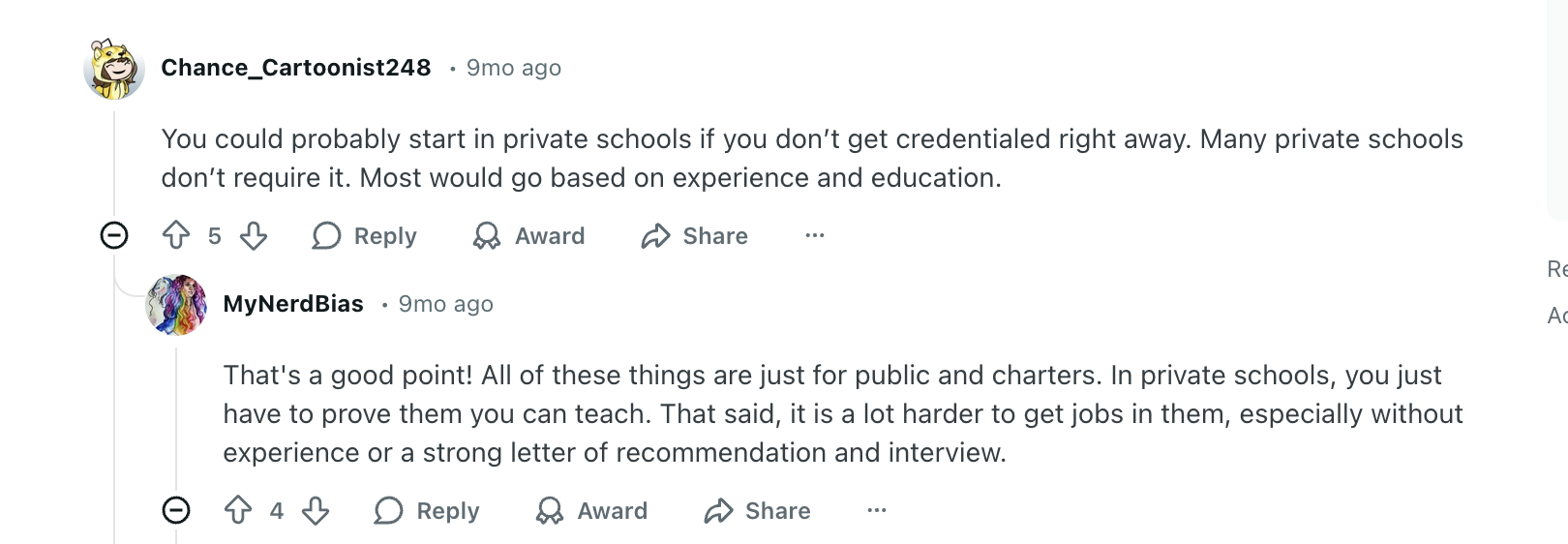
Private schools play by their own rules. Many don’t require a teaching license, and a bachelor’s in any subject may be enough. That said, earning a certification can broaden your options, especially if you later want to teach in public schools.
Some Reddit users recommend starting in private schools:
Advanced degrees: master’s and beyond
A master’s isn’t always required to start teaching, but it often helps. Programs like a Master of Arts in Teaching (MAT) or Master of Education (MEd) can lead to higher pay, leadership roles, or expand your teaching options.
If you’re aiming for higher education, the bar is higher: college instructors usually need at least a master’s, and tenure-track professors typically require a doctorate.
Degree paths by level and subject
While requirements vary by state, most public schools follow similar patterns:
- Early childhood teachers: Degree in early childhood education, focused on preschool and early learning.
- Elementary teachers: Bachelor’s plus license to teach multiple subjects.
- Middle & high school teachers: Major in your subject and earn certification for that subject/grade level.
- Special education teachers: Specialized coursework and hands-on training to support diverse learners.
- Subject-specific teachers (PE, art, music, science, history): Major in the field and complete subject-aligned teacher preparation.
How to Become a Teacher (According to Your State)
Here’s how becoming a teacher works, depending on your state:
- Apply for a teaching license through your state’s Department of Education.
- Pass required certification exams, usually Praxis or state-specific tests (like CBEST, EAS/CST, or TExES).
- Meet key educational requirements.
- Navigate reciprocity rules if you’re licensed in another state; some states add extra exams or coursework.
- Expect stricter processes in states like New York, California, Illinois, and Pennsylvania.
- Look for more flexibility in states such as Florida, Colorado, Iowa, and Kentucky.
To teach in a public school, apply for a license through your state’s Department of Education. That usually means passing certification exams, meeting any master’s degree expectations, and following the rules for transferring a license from another state.
States with strict licensure and limited reciprocity
These states often require state-specific exams and add extra steps for out-of-state teachers:
- New York. Requires EAS and CST exams; master’s degree within five years; limited reciprocity.
- California. CBEST and CSET exams; strict reciprocity.
- Illinois. Relies on Illinois Licensure Testing System (ILTS); out-of-state teachers often need extra coursework or exams.
- Pennsylvania. Praxis and/or state tests; graduate study or master’s needed to advance license; limited reciprocity.
- Michigan, Virginia, Missouri, Minnesota, North Carolina, Ohio, New Jersey. Mix of Praxis and state exams with limited reciprocity.
Praxis-based states with conditional reciprocity
These states primarily use Praxis exams, but may require additional steps for incoming teachers:
- Texas. TExES exams; accepts out-of-state teachers with conditions.
- Georgia. Praxis Core and content exams; conditional reciprocity.
- Alabama. Praxis Core and subject exams; limited reciprocity.
States with more flexible reciprocity
These states are generally more welcoming to licensed teachers from other states:
- Colorado. Praxis exams; flexible reciprocity.
- Iowa. Praxis-based; more flexible transfer options.
- Kentucky. Praxis exams; flexible reciprocity for standard licenses.
- Delaware. Praxis-based with flexible reciprocity.
- Louisiana. Praxis exams; more open reciprocity.
- Florida. FTCE exams; considered a full reciprocity state.
- Maryland. Praxis exams; master’s or graduate credits expected to move up; flexible reciprocity.
How Long Does It Take to Become a Teacher?
Most people can expect it to take about 4 to 7 years, depending on where you’re starting.
- Starting from scratch. A bachelor’s degree takes about four years. If certification is included, you can teach right after graduating; if not, add another year for a credential program.
- If you earn a master’s degree. Expect one to two additional years, depending on your program and state.
- With an existing bachelor’s degree. Alternative or fast-track certification programs can let you start teaching in under a year, often while completing training.
Skills Needed to Be a Teacher
According to Teachers of Tomorrow, here are some of the most in-demand skills for teachers:
- Communication and active listening
- Patience, empathy, and commitment
- Classroom management and conflict resolution
- Organization, time management, and adaptability
- Leadership, teamwork, and cross-disciplinary collaboration
- Creativity and cultural competence
- Data literacy and data-driven decision-making
- Technological proficiency, including AI and digital content creation
- Critical thinking and self-evaluation
- DEI-centered instructional design
- Mental health awareness and SEL facilitation
When listing skills on your resume, prioritize what each school specifically asks for. Teachers are expected to balance strong communication and classroom management with adaptability, collaboration, cultural awareness, and ease using data, technology, and digital tools.
Focus on the skills listed in the job description (assuming you actually have them). Many schools use Applicant Tracking Systems (ATS) to scan for keywords, so matching what the school is asking for matters more than listing every skill you’ve ever picked up.
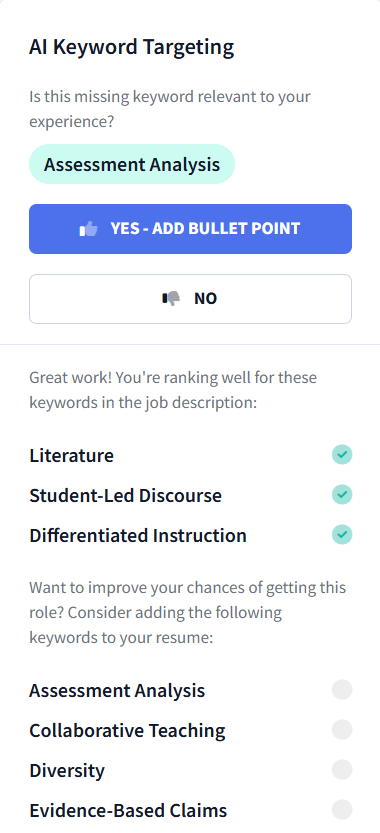
If combing through job posts for keywords feels tedious, our AI Keyword Targeting tool can help. Paste the job description and it’ll show you which skills you have, which ones to add, and even write resume bullets that include them.
Here’s what our AI Keyword Targeting tool looks like:
Still wondering what it actually takes to be a teacher, beyond what looks good on a resume? I asked my friend Sarah, an elementary school teacher in Minneapolis, and here’s what she had to say:
“You have to be super patient. It’s something you have to put your whole heart into; you can’t half-ass it. Teaching is truly a whole-soul profession — it’s hard and challenging, but also so rewarding, and I do love it.
Burnout is crazy, especially in the United States. It’s atypical to make it past your fifth year of teaching. I’m in my fifth year and starting to look at options outside the classroom while staying in education.
It’s so important to have boundaries. You can give your whole heart to teaching, but leave it there when you go home. That’s how I found success in being a good teacher and maintaining my mental and physical health; prioritize taking care of yourself, because otherwise your students suffer too.”
For deeper dives, check out these guides:
- Best Communication Skills for Your Resume
- Teamwork Skills on a Resume
- AI Skills for Your Resume
- Organizational Skills for a Resume
- Best Technical Skills on a Resume
Summary
Here’s a recap on how to become a teacher:
- Choose the type of teacher you want to be (preschool, elementary, middle, high school), which guides the degree and license required.
- Most public school teachers earn a bachelor’s degree in education or their subject area, often combined with a state-approved teacher preparation program and supervised classroom experience.
- A teaching license or certification is required for public schools, typically involving student teaching, passing exams (Praxis or state-specific), and a background check.
- Career changers with a bachelor’s in another field can use alternative or fast-track certification programs, often completed in 1–2 years with flexible formats and sometimes paid internships.
- Private schools may not require certification; a bachelor’s in any subject can be enough, though certification broadens future public school opportunities.
- Advanced degrees, like a master’s (MAT or MEd) or doctorate (EdD/PhD), can improve pay, career options, and leadership opportunities, and are required for higher education teaching.
- State licensure requirements vary, including exams, reciprocity rules for out-of-state teachers, and master’s degree expectations. Some states are strict, others more flexible.
- Becoming a teacher typically takes 4–7 years, depending on degree, certification, and any advanced education pursued.
- Essential teacher skills include communication, classroom management, leadership, collaboration, adaptability, empathy, tech and data literacy, creativity, and DEI-focused teaching.
FAQ
How to become an online teacher?
Becoming an online teacher usually starts with the right credentials for what you want to teach, like a TEFL certificate for English or a state license for K–12 subjects. Most platforms look for a bachelor’s degree, strong communication skills, and a reliable tech setup. From there, you create a profile, prep sample lessons, and apply to platforms that fit your subject and schedule.
How to become a teacher without a degree?
Teaching without a degree is possible, but options are limited. Private schools, tutoring centers, and some charter or online programs may hire based on experience rather than formal education. Some states also offer emergency or provisional licenses, letting you teach while working toward certification. Gaining classroom experience through volunteering also helps.
What is the starting teacher salary in New York State?
In New York State, starting pay depends on your education. As of September 2025, new teachers earned about $68,902 with a bachelor’s degree and $77,455 with a master’s, according to Teach NYC. Salaries increase over time with experience and additional credentials.
How much does it cost to become a teacher?
The cost depends on where and how you study. According to Research.com, most teaching degree programs fall between $25,000 and $90,000, factoring in tuition, fees, supplies, and living expenses. Public in-state programs tend to be on the lower end, while private or out-of-state options cost more.
What is the easiest state to become a teacher?
“Easiest” depends on your background, but states like Florida, Iowa, and Louisiana are often mentioned for having more flexible certification and reciprocity rules. They’re generally more open to out-of-state teachers and require fewer extra hoops. That said, easier licensing doesn’t always mean better pay or resources, so it’s worth looking at the full picture before deciding.

Upload or drop your resume to get started
Upload your resume to get started
Score my resume
Sarah Coghlan is a writer and editor passionate about making resume and career advice clear and accessible to all. Based in Barcelona, her goal is to help job seekers create standout resumes and navigate the job search process with confidence and ease.