
Career Advice
Top 15 AI Jobs: What’s in Demand and How to Get a Job in AI
Discover the best AI jobs, the top skills, and how to get started in artificial intelligence. Learn which roles AI will create and how to safeguard your career.
Published on
December 22, 2025
Updated on
December 22, 2025
The top AI jobs include machine learning engineer, artificial intelligence engineer, data scientist, natural language processing (NLP) engineer, robotics engineer, AI research scientist, AI consultant, and more. Here’s how to get an AI job: learn programming languages, experiment with tools, consider higher education or courses on AI, grow your network, and build a strong portfolio and resume.
AI gets a lot of bad press. Job losses, privacy concerns, replacing our brains, you name it.
And while some of those worries are valid, the other side of the story often gets buried under dramatic headlines.
Remember: every major leap has stirred panic before it created progress.
The Industrial Revolution reshaped entire workforces. The rise of the internet wiped out some jobs, but opened doors to careers we never even imagined.
AI is the next big shift. Yes, it’s moving quickly, and yes, some roles will change or disappear. But we’re also seeing new fields emerge, along with jobs for those who can learn and adapt.
So, let’s take a break from the negatives to focus on the opportunities. This article will cover:
- The best jobs in AI and the required skills.
- How to start a career in artificial intelligence.
- How to get a job in AI.
- What jobs AI will create and eliminate.
Start your journey into artificial intelligence using our AI Resume Builder. Simply enter your details and create a customized job application in minutes.
And learn more about what’s going on in the world of AI:
What Are Artificial Intelligence Jobs?
Artificial intelligence jobs are roles that involve building, using, or supporting AI technologies to solve real-world problems.
This can mean developing machine learning models, applying AI tools to business workflows, or ensuring AI systems are ethical, reliable, and easy for people to use. In other words, AI jobs span everything from creating the technology to applying it — and even making sure it works well for humans.
The headlines will tell you AI is taking over jobs (and possibly the world). While there is some truth to this, the reality is more nuanced.
Let’s not forget that some jobs naturally go obsolete over time — when was the last time you met an elevator operator or lamplighter? But AI is moving things at a much faster pace, and that change can be scary.
AI and big data are topping the list of the fastest-growing skills right now, according to the World Economic Forum — right up there with networks, cybersecurity, and technology literacy. Businesses want people who can use AI tools to get results faster and more efficiently.
What AI jobs look like
Here are the main types of AI jobs:
- Core AI roles, including machine learning engineers, data scientists, and AI researchers. These are the professionals building the algorithms and systems behind the scenes.
- Applied AI roles, such as AI product managers or prompt engineers, focus on making AI practical for real-world business problems.
- AI-adjacent roles, like ethicists, UX designers, and AI trainers, who make sure AI tools are fair, usable, and aligned with human values.
You don’t have to be Tony Stark to find your place here. Many companies need people who can bridge the gap; those who understand both human behavior and technology.
On the hunt for a new AI job? Use our AI Job Search to find over a million updated jobs straight from company websites.
15 AI Jobs: Career Paths & Roles That Are Resistant to AI
Here are the top AI jobs:
- Machine learning engineer
- Artificial intelligence engineer
- Data scientist
- Natural language processing (NLP) engineer
- Robotics engineer
- Computer vision engineer
- AI research scientist
- UX designer
- Big data specialist
- AI consultant
- Cloud security architect
- AI marketing specialist
- Business intelligence developer
- AI ethics specialist
- Software engineer
Artificial intelligence is already reshaping what we work on. According to the Future of Jobs Report 2025, AI and big data top the list of the most in-demand skills globally, followed by networks, cybersecurity, and tech literacy.
Here’s a breakdown of the top AI jobs, what they do, and the key skills you’d need to thrive in each one.
1. Machine Learning Engineer
Machine learning engineers are the builders behind the “brains” of AI systems. They design algorithms that help computers learn and make predictions, such as recommending your next Netflix binge trap or spotting fraud in financial data. They have the skills to turn data into something that adapts, improves, and automates processes over time.
Key skills:
- Python and SQL
- Deep learning frameworks (TensorFlow, PyTorch)
- Data modeling and statistics
- Algorithm optimization
- Time Series Forecasting
Learn how to create the perfect AI resume: How to Use Rezi for Engineering Job Applications
2. Artificial Intelligence Engineer
AI engineers use machine learning models and algorithms to build applications, such as chatbots and recommendation systems.
Unlike researchers, they focus on applying existing models rather than inventing new ones from scratch. Their work often involves integrating AI tools into real-world business systems and ensuring everything runs smoothly.
Key skills:
- Python, R, and Java
- Machine learning libraries (AWS, Azure)
- Continuous integration (CI)
- Big data analysis (Apache, Spark SQL, Google Cloud Platform)
- AI Security
Find out how to include these skills on your job application: AI Skills for Your Resume
3. Data Scientist
Data scientists uncover insights hidden in mountains of data. They take the information collected by data engineers, clean it up, analyze it, and use it to make predictions or solve business challenges. You’ll find them forecasting market trends, improving healthcare outcomes, or optimizing supply chains.
Key skills:
- Programming (Python, R, SQL)
- Statistical analysis and predictive modeling
- Data visualization (Tableau, Power BI, Matplotlib)
- Machine learning algorithms
- Communication and storytelling with data
Data science is also one of many high-income skills that are worth learning.
4. Natural Language Processing (NLP) Engineer
If you’ve ever asked Siri about life’s big mysteries, you’ve seen an NLP engineer’s work in action.
These professionals teach computers how to understand and respond to human language (a task that’s tricky with all the slang and context we use). NLP engineers blend computer science, linguistics, and AI to make technology more conversational and human-like.
Key skills:
- NLP libraries (spaCy, NLTK, Gensim)
- Deep learning and neural networks
- Linguistic knowledge
- Maths and statistics
- Python programming
5. Robotics Engineer
Robotics engineers combine mechanical, electrical, and computer engineering to design and build robots that can perform anything from surgery to warehouse logistics. They prototype, test, and refine systems that interact with the physical world.
With robotics booming in industries like manufacturing and healthcare, these engineers are in high demand.
Key skills:
- Machine learning and programming
- Mechanical and electrical design
- Software engineering
- Mathematics and physics
- Computer vision and sensors
6. Computer Vision Engineer
Computer vision engineers help machines see. Their algorithms interpret images and videos, powering technologies like facial recognition, self-driving cars, and medical imaging. They combine deep learning and image processing to translate visual data into actionable insights. It’s an interesting mix of coding, math, and creativity.
Key skills:
- Image processing and OpenCV
- Deep learning (CNNs, PyTorch, TensorFlow)
- Machine learning algorithms
- Programming (Python, C++, MATLAB)
- Strong math and linear algebra background
7. AI Research Scientist
AI research scientists are constantly pushing the limits of what AI can do. They’re using existing tools, creating new ones, and developing algorithms that redefine what’s possible. Most work in labs, universities, or R&D divisions, often collaborating with academic and industry experts. If you love experimentation, this is where innovation lives.
Key Skills:
- Advanced mathematics and statistics
- Machine learning theory
- Programming (Python, C++)
- Research and data analysis
- Deep learning frameworks
8. UX Designer
UX designers make digital products and software feel intuitive. They focus on how users interact with apps, chatbots, or systems, making complex features simple and human-friendly.
A great UX designer helps people trust and enjoy the technology they use. In the AI space, UX designers make AI products and features understandable.
Key skills:
- User interface (UI) design skills
- Wireframing and prototyping
- Design tools (Figma, Sketch, Illustrator)
- Information architecture (IA)
- Empathy and storytelling
9. Big Data Specialist
Big data specialists know how to store, organize, and make sense of massive datasets. They design systems that turn oceans of raw information into something usable. According to the Future of Jobs Report 2025, this is one of the fastest-growing jobs expected through 2030, because every AI system depends on clean, well-structured data.
Key skills:
- Frameworks (Hadoop, Spark, or Kafka)
- Predictive analytics
- Programming (Java, Python, C++, Ruby)
- Cloud computing
- Data visualization and modeling
10. AI Consultant
AI consultants help businesses figure out how to use AI effectively.
They translate complex tech concepts into actionable plans, helping companies implement AI tools without getting lost in the jargon. In general, they help to connect the business world and the tech world.
Key skills:
- Business analysis and strategy
- Data preparation and modeling
- Stakeholder communication and presentation
- Project management
- Understanding of AI and machine learning
11. Cloud Security Architect
Cloud security architects design and oversee the security framework for cloud environments, protecting platforms, tools, and infrastructure. They analyze cyber threats and build defenses that keep data, systems, and operations secure in complex cloud ecosystems.
And as these threats grow, so does the industry. According to the Future of Jobs Report 2025, cybersecurity is right behind AI and big data in skill growth.
Key skills:
- Advanced network and system security
- Fluency in key cloud platforms (GCP, AWS, Microsoft Azure)
- Proficiency in at least one programming language
- Understanding of the CI/CD pipeline
- Knowledge of encryption technologies and DLP.
12. AI Marketing Specialist
AI marketing specialists combine creativity with data science. They use AI tools to analyze consumer behavior, personalize campaigns, and optimize marketing performance in real time. These professionals know how to make tech-driven insights feel human and enhance a company’s marketing strategy.
Key skills:
- Data analytics and predictive modeling
- Marketing automation platforms
- Machine learning basics
- SEO and digital strategy
- Customer psychology
Looking for a marketing job? Find out more: How to Use Rezi for Marketing Job Applications
13. Business Intelligence Developer
BI developers are the storytellers of data. They design dashboards, reports, and analytics tools that turn complex information into business insights. Essentially, they make sure decision-makers can see what’s happening in the business and why. They play a key role in keeping strategy data-driven.
Key skills:
- Data preparation and mining
- BI tools (Power BI, Tableau, Qlik)
- Knowledge of data warehousing
- Programming languages
- Knowledge of data warehousing
14. AI Ethics Specialist
AI ethics specialists are the conscience of the AI world. They ensure that AI systems are fair, transparent, and aligned with ethical values.
As large language models and automation tools grow more powerful, these specialists help companies stay accountable and prevent bias or misuse. This field is becoming crucial as AI impacts more of daily life.
Key skills:
- Knowledge of AI systems and bias detection
- Ethics and policy analysis
- Risk assessment and compliance
- Communication and stakeholder management
- Research and critical thinking
15. Software Engineer
Software engineers design, develop, and maintain the software infrastructure that powers everything from chatbots to machine learning pipelines. And yes, even though AI tools can now write code, human engineers are still important for designing architecture, ensuring quality, and solving complex problems.
Key skills:
- Coding and programming (Python, Java, C++)
- Software architecture and testing
- DevOps and CI/CD pipelines
- Knowledge of data engineering
- Collaboration and agile development
How to Get a Job in AI
Here’s a quick overview of how to start a career in artificial intelligence:
- Understand the AI job market by checking out different fields, staying updated through articles and experts, and exploring the fastest-growing AI skills.
- Learn programming languages and coding to get the technical foundation to understand models rather than relying solely on AI-generated code.
- Experiment with tools and technologies by building small, hands-on projects, allowing you to practice real skills and gain portfolio-ready experience.
- Consider higher education or take online courses through degrees, certificates, bootcamps, or accessible online platforms.
- Network and join online AI communities by participating in groups, forums, meetups, or hackathons, focusing on building relationships and learning from others.
- Build a strong portfolio and resume by showing practical projects and emphasizing your problem-solving mindset, adaptability, and curiosity; all qualities employers value as much as technical credentials.
Now, let’s break down how to work in AI step-by-step using my top tips and firsthand advice from people who’ve been in your shoes.
1. Understand the AI job market
Artificial intelligence isn’t just typing in prompts to ChatGPT or futuristic cyborgs. It’s a collection of fast-moving fields like machine learning, natural language processing, robotics, and computer vision. Each has its own challenges and job paths.
Start simple. Read articles, watch explainer videos, and learn basic concepts like programming or supervised vs. unsupervised learning. Follow AI leaders on LinkedIn or X, read research papers, and listen to podcasts like High Energy or Eye on AI.
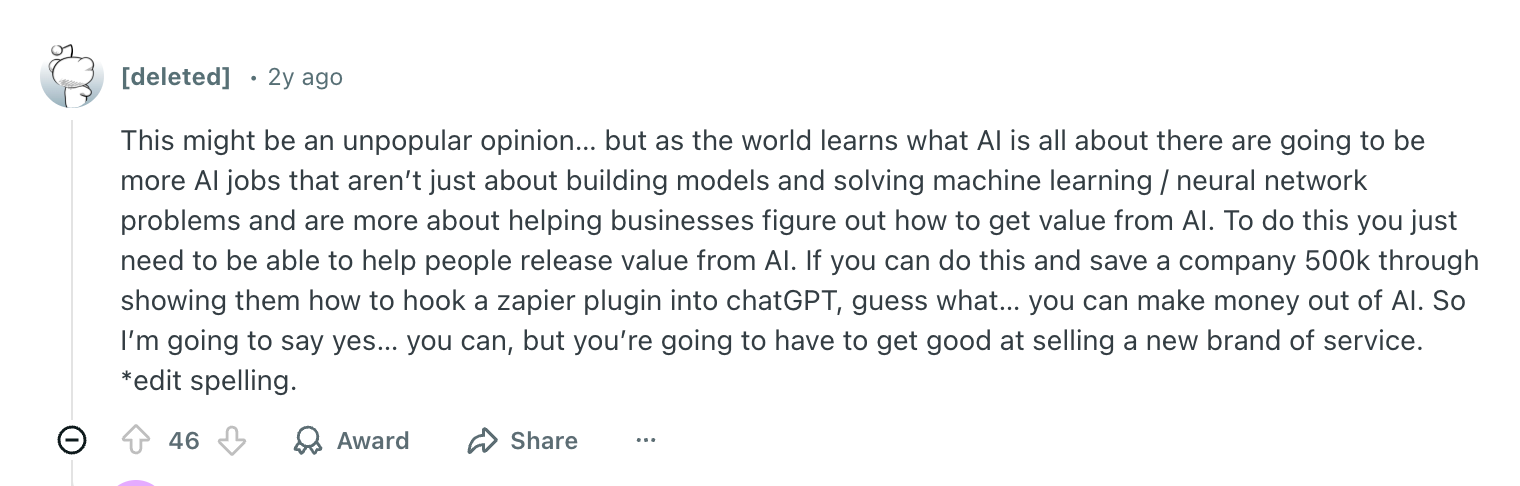
That said, you don’t need to be an expert coder or engineer to break into the world of AI. Here’s some useful insight from a Redditor advising someone with no AI experience:
Learn more about the current job market: What Does Fiverr’s CEO Say About the Job Market?
2. Learn programming languages and coding
Even though tools like ChatGPT or GitHub Copilot can write snippets of code for you, you still need to understand what’s going on under the hood. Start with Python; it’s beginner-friendly, widely used in AI, and has tons of libraries designed for machine learning and data analysis.
Once you have the basics, branch out to other languages, depending on your goals. For example:
- R. Great for statistics and data visualization.
- Java or C++. Useful for large-scale or performance-heavy applications.
- SQL. A must for handling big data efficiently.
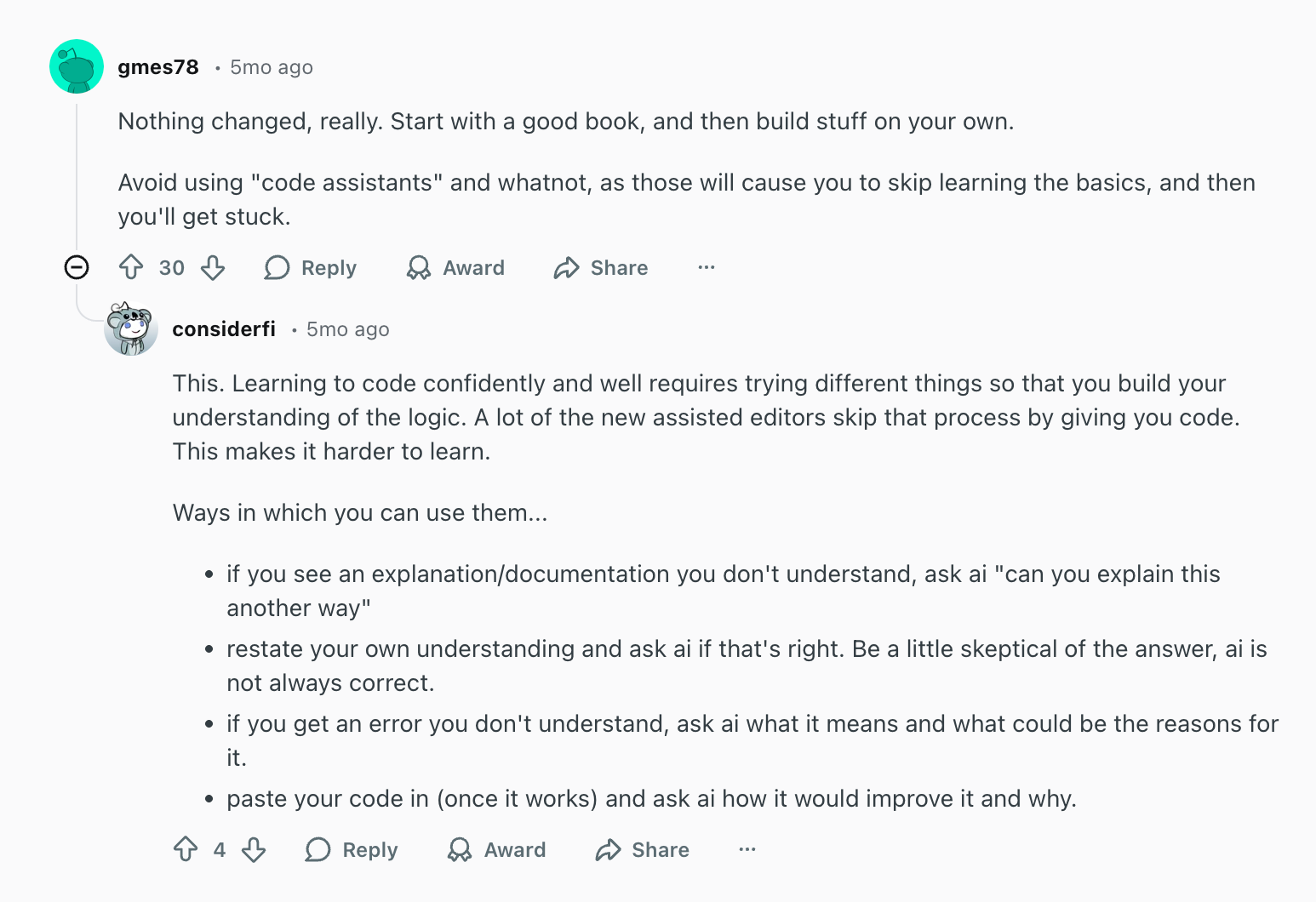
Here’s some advice from Reddit on learning these coding languages using AI:
You can also pick up coding skills through affordable online platforms like Coursera, Udemy, or DataCamp. And no, I don’t recommend trying to master everything at once. Break it into manageable steps by practicing a little every day to understand how your code works with the model or system you’re building.
Find out more: Best Programming Skills to Put on a Resume
3. Experiment with tools and technologies
Once you have a basic grasp of AI and programming, start experimenting with real-world tools.
There are plenty of AI platforms that let you build models without a Ph.D. in computer science. Try out ChatGPT, Kaggle, ProjectPro, Google AI Studio, and GitHub to get hands-on practice without drowning in code.
Build small projects to test your skills. For example:
- Build a multiplayer trivia app.
- Create a chatbot that answers FAQs.
- Design a movie recommendation system using public datasets.
- Set up a tutorial that guides the user through various steps and tools.
Each project gives you experience and something real to show in your portfolio. The more you experiment, the more confident you’ll feel discussing your skills in interviews or on your job application.
Want to prepare for future interviews? Check out our AI Interview tool for job-specific questions and feedback.
4. Consider higher education or take online courses
You don’t have to earn a master’s or Ph.D. to work in AI, but having a solid academic foundation is always helpful.
Degrees in computer science, data science, mathematics, or engineering can give you a structured understanding of algorithms and systems. Many universities also offer AI-specific programs or certificates that can boost your credibility.
But you don’t necessarily need a tech degree to get into AI. Here’s some advice from a Reddit user who got into machine learning without a computer science degree:
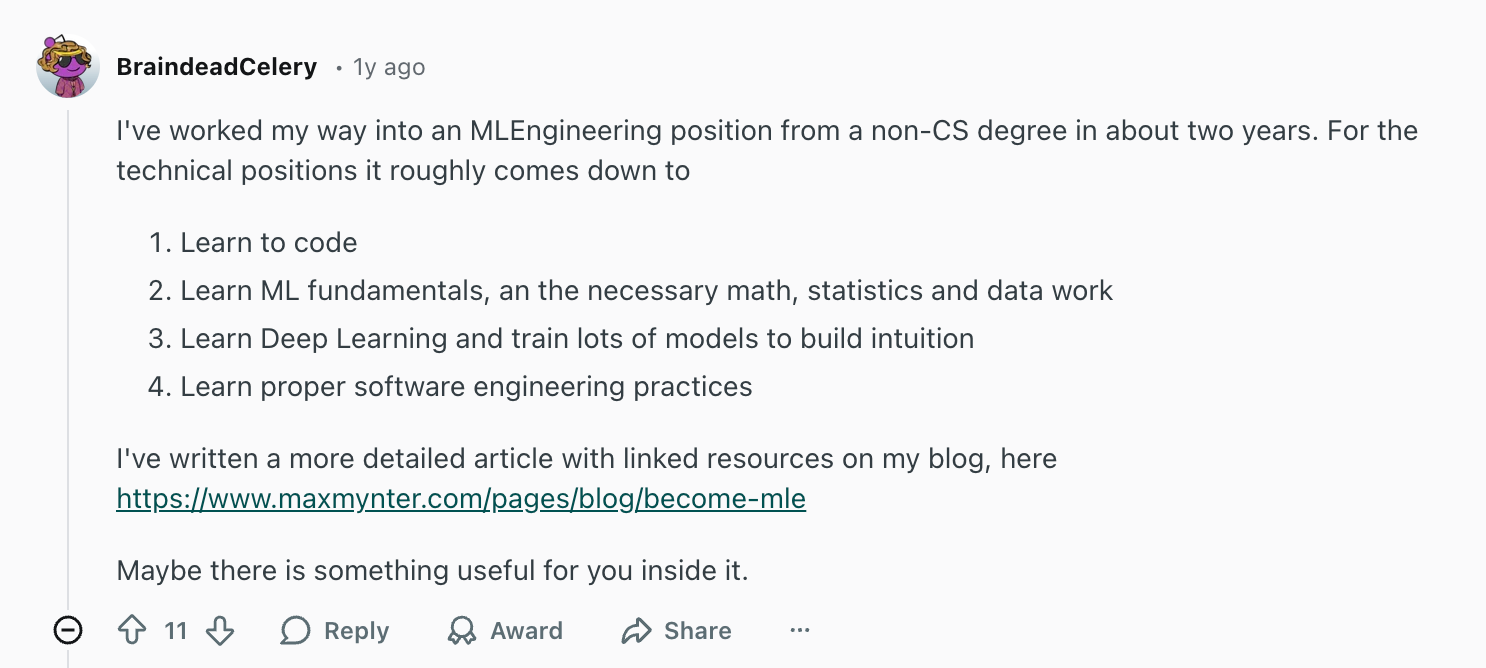
If formal education isn’t an option, try online learning. Platforms like DataCamp, Coursera, Codecademy, and Google AI offer courses taught by industry experts — and many of them are free or low-cost. Bootcamps can also give you a more focused route if you prefer a project-based learning style.
5. Network and join online AI communities
You can build up all the skills in the world, but sometimes it just takes one connection to get you through the door. I’m not saying you can’t do it alone, but as someone whose last three jobs came through referrals, I’d never underestimate the power of building a strong network.
Even if you’re in the introvert club, there are still ways to get out there. Start by joining online communities.
Here are some popular groups and resources:
You can also attend local AI meetups, webinars, or hackathons to connect with professionals who can share their experiences and advice.
When you network, don’t just collect contacts: build relationships. Ask thoughtful questions, get advice, and share your own learning journey. Showing curiosity and a willingness to learn often opens more doors than having a perfect resume.
6. Build a strong portfolio and resume
It’s so easy to sit behind a degree and claim you’re the right fit for a role. But what’s even more impressive? Using your passion and initiative to build and create in your own time. Employers love seeing what you’ve actually built in your portfolio and resume.
Aim for projects that solve real-world problems. Even something simple like predicting house prices or creating a chatbot can show resourcefulness and skill.
Once you’ve got a few projects, here’s how you can present them:
- Upload your code and notebooks to GitHub.
- Create a personal website to display your work.
- Share results, visuals, or even write-ups on LinkedIn or Medium.
And when it comes to your resume, focus on how you learn and solve problems. Give examples of adaptability, curiosity, and your ability to integrate new tools. Employers are increasingly valuing candidates who can deal with change, so your mindset matters just as much as your technical skill set.
Learn more about building a professional resume:
- How to Write a Resume That Gets Interviews
- How to Write a Career Change Resume
- How to Use ChatGPT to Write a Resume
- How to Use AI to Write a Resume
- How to Put Freelance Work on a Resume
The Future of AI Jobs
As companies weave AI deeper into their operations, we’re seeing a mix of optimism and disruption. What’s encouraging is that, historically, technological leaps eventually lead to growth, not decline. And right now, skills in AI, cybersecurity, and tech literacy are climbing to the top of the “most wanted” list across industries.
Here’s an idea of the jobs we can expect to get popular over the next decade.
AI Trainers
AI trainers are the brains behind smarter, safer AI systems. They use technical expertise and industry knowledge to build and refine the LLM that powers tools like ChatGPT.
But their work goes far beyond coding. They curate data, test model behavior, and ensure everything aligns with ethical guidelines. As AI expands into fields like healthcare, finance, and law, trainers who understand both the tech and the context will be in high demand.
Prompt Engineers
Prompt engineering is perfect if you love problem-solving through language. These specialists write the instructions that guide AI models toward accurate, useful responses (like typing in the perfect query for Google, but more nuanced).
Because different industries rely on precise outputs, companies in tech, law, education, and marketing are already hiring people who excel at shaping how AI “thinks.” It’s a role where creativity, logic, and communication all carry equal weight.
AI Data Curators
As AI systems grow more powerful, the quality of the data feeding them becomes more important. Their job is to sift through massive information sources, evaluate accuracy, and ensure datasets are diverse and responsibly collected.
Since many models are trained on internet text, maintaining integrity and reducing bias is a growing challenge. This need is giving rise to a specialized workforce dedicated to building stronger, safer datasets that help AI perform better across industries.
AI-Assisted Healthcare Technicians
Healthcare is one of the fields where AI is making the biggest leap, creating a need for technicians who can connect technology with patient care. These professionals will operate AI-driven imaging tools, support robotic-assisted procedures, and help translate algorithmic insights into decisions.
Their work ensures doctors can use advanced systems effectively while patients still receive the human support they need. As diagnostics and treatment planning become increasingly data-driven, these hybrid tech–medical roles will become essential to modern healthcare.
AI Urban Planners
Cities are getting smarter, and AI urban planners will help shape how they grow. Using AI-enhanced GIS tools, drones, and intelligent modeling systems, these professionals can analyze data faster and design more efficient, sustainable communities.
Routine tasks like drafting reports or running simulations can be automated, freeing planners to focus on strategy and long-term impact. As urban areas face challenges like climate adaptation and population growth, planners who can combine traditional expertise with AI-enabled insights will play a key role in building the cities of the future.
What Are the Most AI-Safe Careers?
Here are some jobs that aren’t going anywhere just yet:
- Farm workers: Agricultural work is one of the fastest-growing job categories, with an estimated 35 million more roles by 2030. This is largely because of the global push toward sustainability. As countries invest in greener practices and climate adaptation, agriculture becomes even more essential.
- Healthcare professionals: Nurses, aides, and other care workers are growing due to aging populations and expanding healthcare needs. The Bureau of Labor Statistics estimates 12.6% growth from 2021 to 2031, translating to 2 million new jobs, more than any other occupational group.
- Construction trades: Construction is famously resistant to automation; many projects are simply too unique and unpredictable to leave in the hands of AI. Many firms still rely on low-tech workflows that can adapt to constantly changing job sites. And the same applies to many other skilled trades, such as mechanics and plumbers. (Read more: The Best Blue-Collar Jobs.)
- Teachers: Great teaching is emotional, relational, and personal. Sure, AI might help with grading or lesson planning, but inspiring students, guiding young people through challenges, and dealing with a class of rowdy teenagers? That’s human territory.
- Therapists and social workers: These roles depend on trust, emotional intelligence, and the subtle art of human connection. Even advanced AI can’t replicate genuine empathy or build the therapeutic relationships needed for healing. Technology may support the work, but it can’t replace the people doing it.
Many roles still lean heavily on human judgment, empathy, and hands-on skill, while others are built around tasks AI can easily automate. Understanding the difference can help you make smarter career decisions for the future instead of feeling like you’re scrambling to keep up.
What makes a job safe from AI?
When people ask which jobs are “AI-safe,” what they’re really asking is: Where should I put myself, so I don’t get replaced by a robot next year? Which is totally fair, and I’d be lying if I said this never crossed my mind (especially as a content writer).
AI-safe jobs usually have one thing in common: they rely on skills that are deeply human or physical. Think teaching, healthcare, skilled trades, and roles that require emotional intelligence or working with your hands. Even when AI steps in to support these roles, it tends to act as an assistant rather than a replacement, helping people work smarter, not disappear.
Careers At Risk of Being Replaced By AI
Here are the top careers set to be affected by AI:
- Bookkeepers and bank tellers: Forecasts show these roles are the fastest-declining jobs between 2025 and 2030. Automation is already handling bookkeeping with cloud-based systems that run around the clock. And Gartner predicts AI will make 15% of all financial decisions by 2030. But it’s not all doom: we still need humans for oversight, interpretation, and complex financial planning.
- Customer service representatives: Chatbots now handle many simple, repetitive inquiries. The challenge is anything emotional or nuanced; bots still fumble there. So while frontline FAQ-style service is shrinking, customer-facing roles requiring empathy, conflict resolution, and deeper problem-solving remain valuable.
- Office clerks: Tasks like filing, scheduling, updating databases, or processing expenses are tailor-made for automation. McKinsey estimates a decline of 1.6 million office clerk jobs in the U.S. as AI streamlines these workflows. The more routine the task, the faster AI can take it over.
- Translators and interpreters: Machine translation has already made text translation faster, but the big shift is coming from real-time voice translation. As simultaneous interpretation tools get better, they’ll compete more directly with human interpreters, especially for routine or high-volume work.
- Creative roles: Surprisingly, creative work may be more exposed than many expected. Tools that generate art, copy, and designs from simple prompts are transforming workflows. Microsoft’s Working with AI report even listed writers and authors among the top five professions most likely to be replaced.
Jobs that are repetitive, rules-based, or dependent on data processing are more at risk. That doesn’t mean every job in these categories will vanish, but they will change. People who adapt and learn to work with AI will have a much smoother ride than those who try to hang on to the old ways.
Final Thoughts: Is AI a Good Career?
What makes AI an exciting field isn’t just the technology, but the variety of directions you can grow in. You could get into research, build AI systems, focus on ethics, apply AI in healthcare, or explore creative applications. And with AI, big data, and technological literacy leading the fastest-growing skill areas, the demand isn’t slowing down.
That said, choosing AI as a career means signing up for constant learning. The field moves faster than almost any other industry; the people who thrive are those who stay curious, adaptable, and willing to experiment. If you enjoy solving problems and exploring new tools, AI can be incredibly rewarding. But if you prefer stability and predictability, the pace of change might feel overwhelming.
AI is a new frontier that’s still being built in real time. And if the idea of shaping the future rather than just watching it unfold excites you, then it might be the right place for you.
FAQ
What is the highest-paying AI job?
The highest-paying AI job is an AI Research Scientist, earning an average of $199,007 per year.
Here are all the top-paying AI and AI-related roles from the same dataset:
1. AI Research Scientist: $199,007
2. Software Engineer: $139,060
3. Robotics Engineer: $133,136
4. Natural Language Processing Engineer: $126,831
5. Data Scientist: $118,399
6. Computer Vision Engineer: $118,319
7. Cybersecurity Analyst: $118,073
8. Artificial Intelligence Engineer: $113,371
9. UX Designer: $114,049
10. Machine Learning Engineer: $109,939
This information comes from Salary.com, one of the most trusted compensation resources. Their data is pulled from an ongoing national research study covering 1,200+ unique jobs and 4,000 job titles, reflecting pay practices across companies of all sizes and industries in the U.S.
Check out more top-paying career paths: Highest Paying Jobs in the US
How to get a remote AI job?
Remote AI jobs are increasingly common, but they still require preparation. Here are some steps you can take to get an online AI job:
1. Build strong technical skills. Knowledge of Python, ML frameworks like TensorFlow or PyTorch, and data handling are all in demand.
2. Show what you can do. Personal projects, online competitions, hackathons, and portfolio sites can demonstrate your abilities.
3. Target remote-friendly companies. Startups, AI consulting firms, and cloud service providers often have distributed teams.
4. Network online. Join AI communities like Hugging Face, OpenAI Community, or r/MachineLearning. Referrals can land remote roles faster.
5. Highlight remote-readiness. Emphasize time management, communication, and experience with collaboration tools. Remote AI work is flexible, but employers want proof you can deliver without direct supervision.
Related article: How to Describe Remote Work On a Resume
What does C3.AI do?
C3.ai is a company that builds enterprise AI software for large organizations. They focus on providing scalable AI solutions that help companies optimize operations, predict maintenance, improve supply chains, and detect fraud. Essentially, C3.ai acts as a platform that lets businesses deploy AI without building it entirely in-house, offering tools to clean data, train models, and integrate AI predictions into real-world decision-making.
What AI skills are in demand?
The AI job market is evolving fast, but some skills consistently top the list:
- Machine learning & deep learning: Building models, neural networks, and understanding algorithms.
- Programming languages: Python, R, Java, SQL, and C++ are all valuable.
- Data skills: Data wrangling, cleaning, visualization, and cloud database handling.
- Natural Language Processing (NLP): Especially for roles involving chatbots, translation, and text analysis.
- AI tools & platforms: TensorFlow, PyTorch, Keras, AWS SageMaker, Azure ML, or Google AI tools.
- Soft skills: Problem-solving, domain expertise, and the ability to translate technical insights into business outcomes.
Check out the most in-demand soft skills: Best Soft Skills on a Resume
Can you get into AI without a degree?
Yes, you can break into AI without a formal degree, but having one can definitely give you a significant advantage. While self-taught skills, online courses, bootcamps, and hands-on projects can demonstrate your abilities, a degree in computer science, data science, engineering, or a related field provides a solid foundation.
Having a degree also signals to employers that you’ve mastered structured learning and complex technical concepts. For competitive roles, like machine learning engineer, AI research scientist, or AI architect, a degree can open doors more quickly, make it easier to understand advanced concepts, and help you build credibility in a field where both technical depth and domain knowledge matter.

Upload or drop your resume to get started
Upload your resume to get started
Score my resume

Lauren Bedford is a seasoned writer with a track record of helping thousands of readers find practical solutions over the past five years. She's tackled a range of topics, always striving to simplify complex jargon. At Rezi, Lauren crafts genuine and actionable content that guides readers in creating standout resumes to land their dream jobs.