Career Advice
How to Become a Software Engineer (Step-by-Step Guide)
Learn how to become a software engineer step-by-step. Discover education options, skills, and the steps to start your software engineering career.
Published on
January 20, 2026
Updated on
March 26, 2026
You don’t need a degree to break into software engineering. To become a software engineer, start by picking a programming language and learning the fundamentals. Next, build projects that prove your skills, set up your GitHub and portfolio, and get comfortable with AI development tools. Once you have the essential skills and a few projects that demonstrate what you can do, start applying for roles strategically.
Software engineering is a technical field, yet you can break into it without a traditional college or university degree. The job outlook for software engineers is still projected to grow, according to BLS.
Regardless of what you might have seen online about how AI is affecting jobs across all industries including fields like software engineering, it’s still in demand.
However, landing an entry-level software engineer job is brutal. It looks a lot different than it did a few years ago. Many job openings have tightened and companies expect new hires to contribute more than what you’d normally expect (partly thanks to AI tools). You might have even noticed job descriptions for entry-level or junior positions asking for 3–5 years of experience, which is quite ridiculous.
Simply "learning to code" alone isn't the career cheat code it was in 2018. Still, it doesn’t mean it’s impossible to pursue software engineering. It means you need a clearer plan.
This guide covers what software engineers actually do, the skills and education you'll need, tips for your portfolio, and what you can expect in terms of salary and timeline.
If you want to jump ahead and create a professional resume for software engineering job applications, you can get started with Rezi AI Resume Builder for free.
What Does a Software Engineer Do?
In short: software engineers solve problems through code.
They design, build, and maintain software, from mobile apps and web platforms to complex systems like operating software, databases, or embedded devices. As a software engineer, it’ll be your job to think logically and create efficient solutions to real-world issues.
Here’s what your day-to-day tasks could look like:
- Writing and testing code in languages like Python, Java, or JavaScript.
- Collaborating with designers, product managers, and QA testers.
- Debugging (which is fancy talk for “finding out why your program broke five minutes before demo”).
- Reviewing code from teammates and learning better approaches.
- Planning new features or improvements for the next software release.
There are many specialties too: web developers, mobile engineers, data engineers, DevOps engineers, and machine learning specialists. These roles fall under the software engineering umbrella.
These are the main types of developers:
- Front-end developers focus on what users see (the website, the app interface).
- Back-end developers handle what happens behind the scenes (databases, servers, APIs).
- Full-stack developers do both front-end and back-end development.
Need career tools to help you break into a certain industry? You might find these guides helpful:
- Rezi for Jobs in Tech
- Rezi for Engineering Job Applications
- Rezi for Marketing Job Applications
- Rezi for Project Management Job Applications
- Rezi for a Career Change
How to Become a Software Engineer
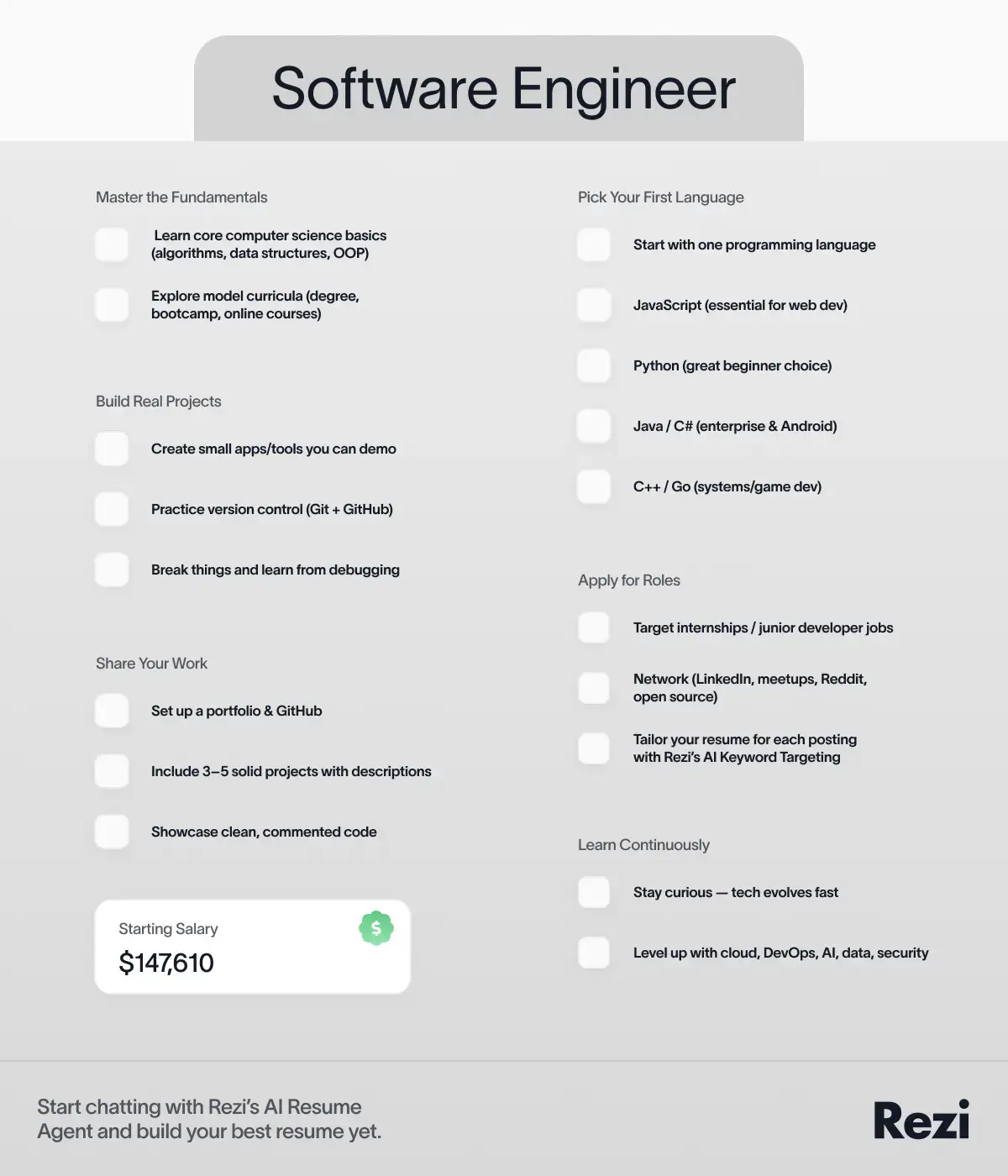
Here’s how to become a software engineer:
- Learn the fundamentals of computer science.
- Pick your first programming language.
- Build real projects (and break things often).
- Create a portfolio and GitHub profile.
- Apply for internships or junior developer jobs.
- Keep learning because tech never sits still.
My biggest advice is to learn the essentials and then get right into building stuff. It doesn’t have to be absolutely mind-blowing, even a simple app or game can help you break into the field. This also aligns with a Redditor’s advice for someone looking to transition into programming, as shown below.
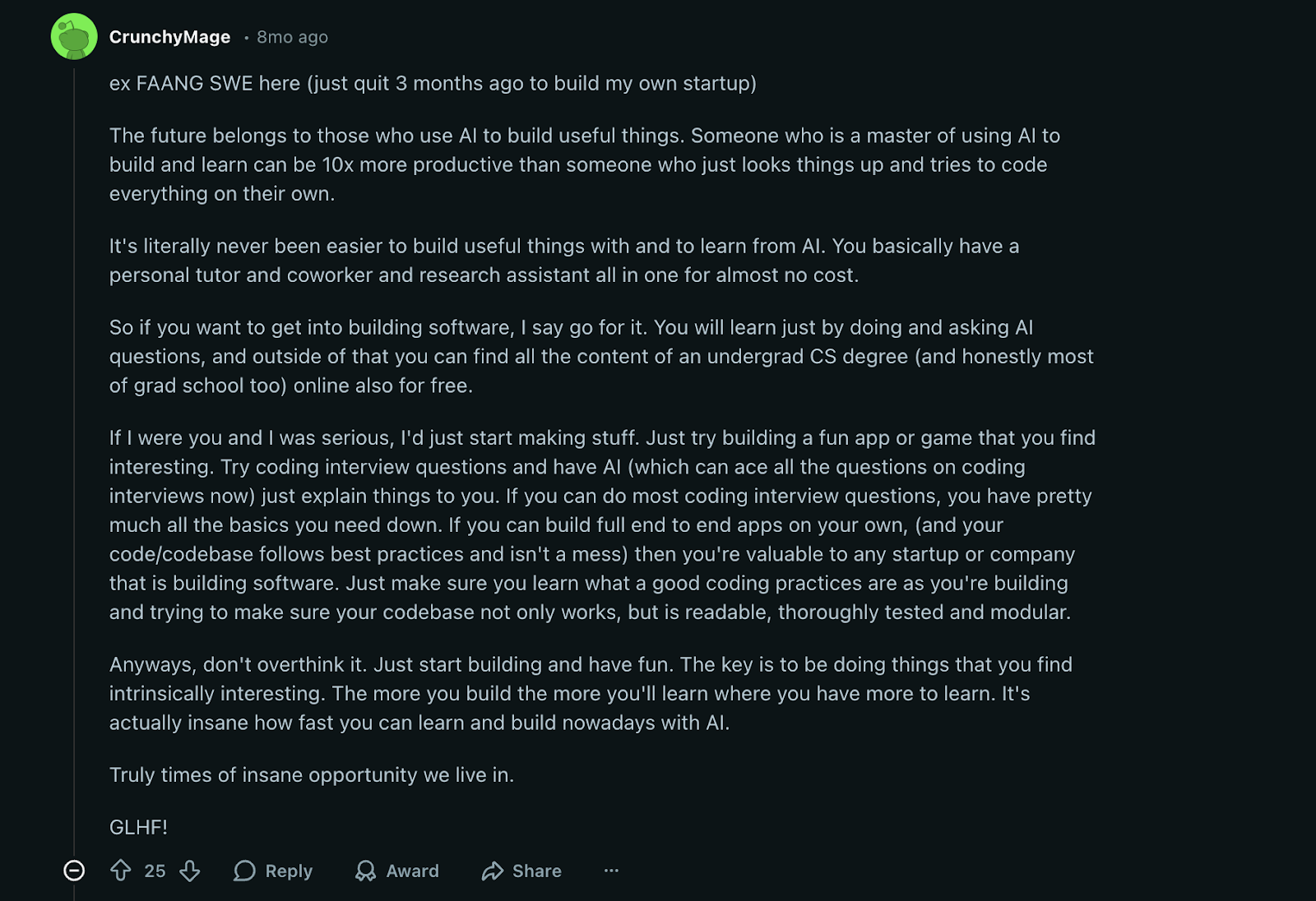
Sure, AI might not create the most original or polished code on its own, but it’s still a powerful tool to help you build projects and strengthen your understanding as you learn to program.
Let’s unpack each of the steps in more detail below.
1. Learn the fundamentals of computer science
You can go the traditional route (earning a degree in computer science, IT, or software engineering) or teach yourself online. Both paths are valid. Employers usually care more about your skills and problem-solving ability than a qualification that’s stuck on your wall.
If you prefer structure, look for:
- Bachelor’s in Computer Science or Software Engineering – classic four-year route.
- Coding bootcamps like Flatiron, General Assembly, or App Academy – fast-paced and practical.
- Online platforms like Coursera and Udemy – flexible and affordable options.
Focus on the core building blocks: algorithms, data structures, databases, and basic programming concepts like loops, functions, and object-oriented design.
Related guides:
- Computer Skills to Put on Your Resume
- Programming Skills for a Resume
- Technical Skills to Include on a Resume
- AI Skills to Add to Your Resume
2. Pick your first programming language
Choose one language to start. Don’t try to learn five at once. Here are the main ones to consider:
- Python: great for beginners, data science, and automation.
- JavaScript: essential for web development (front and back end).
- Java or C#: common in enterprise and Android development.
- C++ or Go: for performance-heavy systems or game development.
Once you’re fluent in one, learning others becomes much easier. Don’t just memorize the syntax, but try to understand the logic behind it.
Here are a few common paths to consider doubling down on:
- Web Developer – Build websites and web apps (HTML, CSS, React, Node.js).
- Mobile Developer – Create apps for iOS or Android (Swift, Kotlin, React Native).
- Game Developer – Build games using Unity or Unreal Engine (C#, C++).
- Data Engineer or Machine Learning Developer – Work with data pipelines and AI (Python, TensorFlow).
You don’t have to pick one right away. Explore different areas to see what excites you and which area you want to focus more on.
3. Build real projects (and break things often)
Reading tutorials is fine, but real learning happens when you start creating. In other words, start building apps, websites, or tools that interest you, even small ones. Adding these projects to your resume, especially as someone with no formal experience, will help you stand out.
Here are a few examples of projects to start:
- To-do list app (this is quite a common place to start)
- Portfolio website
- Personal finance tracker
- Weather app
- Game or chatbot
Each project helps you practice problem-solving, version control (Git/GitHub), and deployment. You’ll also have tangible work to show employers later.
Git and GitHub are must-know tools. They let you track changes to your code, collaborate with others, and show employers that you understand real-world workflows.
Learn how to:
- Commit and push code.
- Branch and merge changes.
- Write clear commit messages.
4. Create a portfolio and GitHub profile
A solid portfolio and GitHub profile are your golden tickets to breaking into the software engineering industry.
Include:
- Links to 3–5 of your best projects.
- Clean, well-commented code.
- Short project descriptions (what it does, tools used, challenges solved).
- A personal bio that feels human (employers love seeing personality behind the code).
When you have a portfolio, you can add it to the header section of your resume.
5. Apply for internships or junior developer jobs
Look for internships, apprenticeships, or junior developer roles. Freelance projects are also a great way to start gaining experience.
The first job is typically the hardest to land, so start small and be strategic by doing the following:
- Network through LinkedIn, GitHub, Reddit, or local meetups.
- Contribute to open-source projects (it shows initiative and teamwork).
- Tailor each resume to the job description (highlight relevant projects and tech stacks).
Not sure where to start? Look for inspiration based on proven software engineer resume examples.
If you're applying for different types of software engineering roles (front-end vs. back-end vs. full-stack), maintain separate resume versions for each. More often than not, our users keep a master resume that they can easily tailor depending on the target description. Our resume builder makes this easy since you can duplicate and adjust without starting from scratch each time.
Alternatively, you can search for jobs using Rezi Job Search. Enter the location and job title you’re applying for, and hit “target resume” to get your resume tailored.

Relevant articles:
- How to Write a Resume That Gets Interviews
- How to Write a Resume With No Professional Experience
- How to Find a New Job Fast
- How to Write a Resume for a Career Change
- Freelance Experience on a Resume
6. Keep learning because tech never sits still
Technology evolves faster than coffee brews. Once you land that first role, you’ll keep learning through experience, mentorship, and curiosity.
Explore areas like:
- Cloud computing (AWS, Azure, GCP).
- DevOps and CI/CD.
- AI and machine learning.
- Cybersecurity.
- Data engineering or product management.
Certifications can also boost your knowledge and resume, especially early on. Examples of some popular ones include:
- Google Professional Cloud Developer
- AWS Certified Developer – Associate
- Microsoft Certified: Azure Developer Associate
- Meta Front-End Developer (Coursera)
Although these certifications aren’t always required, they can still signal credibility and initiative.
Continuous learning is part of the gig, and that’s also what makes software engineering both challenging and rewarding.
Curious about what other skills look like on a resume? Check out:
- The Best Resume Skills to Include
- Best Soft Skills for a Resume
- How to Write About Communication Skills on a Resume
- Leadership Skills to Put on a Resume
How Long Does It Take to Become a Software Engineer?
It depends on your path and how much time you can commit. That said, here are example timelines:
- Degree route: 3–4 years (plus a few months of job hunting).
- Bootcamp: 3–9 months, usually followed by 3–6 months of job searching.
- Self-taught: 1–2 years of consistent learning and projects.
No matter which route you take, consistency beats speed. Even 5–10 hours a week adds up quickly if you stick with it.
Software Engineer Salaries
Software engineering is generally considered a high-paying career. According to Glassdoor, the average pay for a software engineer in the US is $147,610 per year. However, there are other factors to consider such as experience level and location.
The median pay for software developers was $131,450 per year in 2024, according to the U.S. Bureau of Labor Statistics (BLS). However, salaries can also vary depending on your experience, location, and specialization.
Summary
Here’s your step-by-step roadmap to becoming a software engineer:
- Learn the basics of computer science and programming.
- Pick one language and build small projects.
- Start working on real projects.
- Create a portfolio and GitHub to showcase your work.
- Apply for internships or entry-level roles.
- Keep improving your skills through courses and real-world practice.
Regardless of switching careers or starting from scratch, software engineering is one of the most flexible, future-proof paths out there. You don’t have to know everything. Just start building.
FAQs
Do you need a degree to become a software engineer?
Not necessarily. Many engineers are completely self-taught. What matters most is your ability to solve problems and demonstrate real projects.
What are the best programming languages for beginners?
Start with Python or JavaScript — both are versatile and beginner-friendly.
Is software engineering hard?
It can be, especially at first. But it’s learnable — think of it like learning a new language. The first few weeks are confusing, but soon things click.
How do I know if software engineering is right for me?
If you love solving puzzles, working on creative problems, and don’t mind debugging at 2 a.m. (occasionally), it’s probably a great fit.

Upload or drop your resume to get started
Upload your resume to get started
Score my resume

Astley Cervania is a career writer and editor who has been sharing resume and job search insights for 5+ years. He shapes the direction of the Rezi blog, providing practical answers for important career-related questions and helping hundreds of thousands of people navigate the job market and build resumes that land interviews.