Resume
How to Write a Skills Section of a Resume (50+ Examples)
Learn how to write a resume skills section with practical tips, examples, and industry-specific guidance to highlight your abilities and match job postings.

Published on
December 19, 2024
Updated on
April 3, 2026
The skills section of a resume is a quick summary of what you can bring to your new role. It highlights your most relevant abilities so hiring managers can immediately see your value without digging through your experience. The goal is to keep it focused, tailored to the job, and easy to scan. Instead of listing everything, choose skills that match the role and use the same language as the job description. Then, back them up in your work experience section with real examples. When done right, your skills section can reinforce your entire resume and help you stand out.
A lot of people treat the skills section like an afterthought; something they throw together before hitting submit. It ends up as a random list of everything they’ve ever picked up, or a place to get too fancy with pointless progress charts. I don’t recommend either approach.
Skim-reading recruiters use your skills section to see if you’re a match, and digital systems take those all-important keywords to move your application toward the top of the pile. With the right strategy, you can use this section to align yourself with the role and impress hiring managers.
Let’s find out how to do it. This guide will cover:
- The definition of a resume skills section.
- My rundown of the most popular industry skills.
- How to build a strong skills section.
And if you’re struggling to find ways to communicate your skills, try our free AI Resume Builder. Use our AI features to write entire sections and bullet points in minutes.
You can also check out more popular skill examples for your resume:
- Interpersonal Skills for Your Resume
- High-Income Skills to Make More Money
- Best Organizational Skills to Put on a Resume
- Top Customer Service Skills to Put on a Resume
What Is the Skills Section of a Resume?
Your resume skills section is a bulleted list of 8 to 15 relevant abilities to show a hiring manager what you’re capable of at a glance, without making them dig through your entire work history.
That said, it’s fine if this section overlaps with your work experience. In fact, it should. Your skills section is just an overview of your abilities, while your work history section provides more detail.
Your skills section needs to ensure nothing gets missed by a busy recruiter skimming your resume in ten seconds (because yes, that happens). Here’s what you should communicate:
- What tools do you know?
- What strengths do you bring?
- What can you contribute right away?
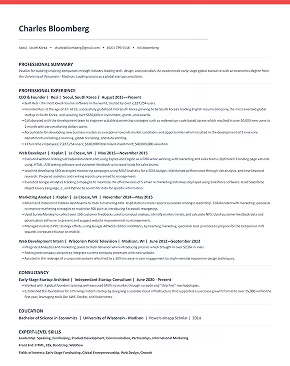
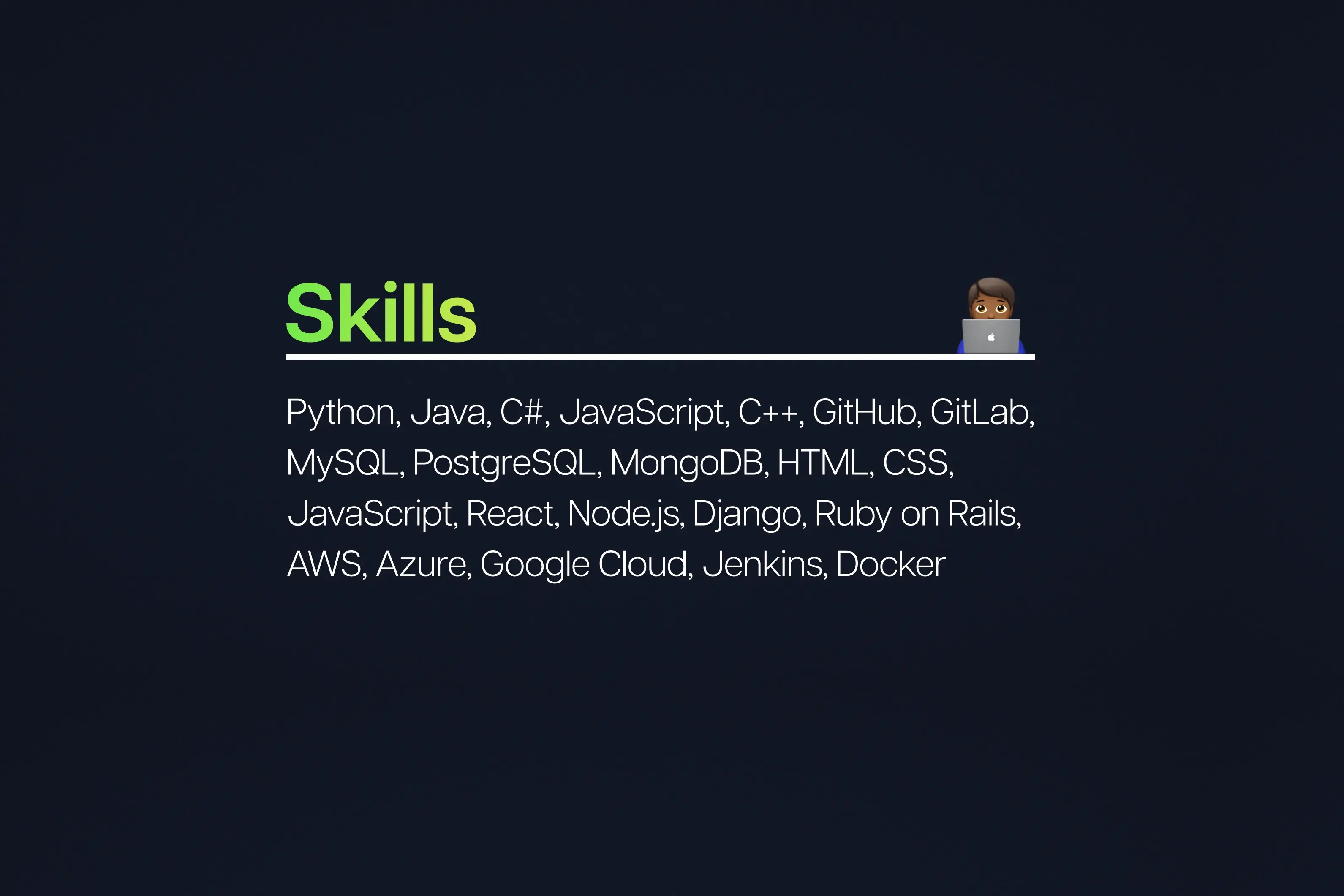
Here’s what a skills section can look like on your resume:

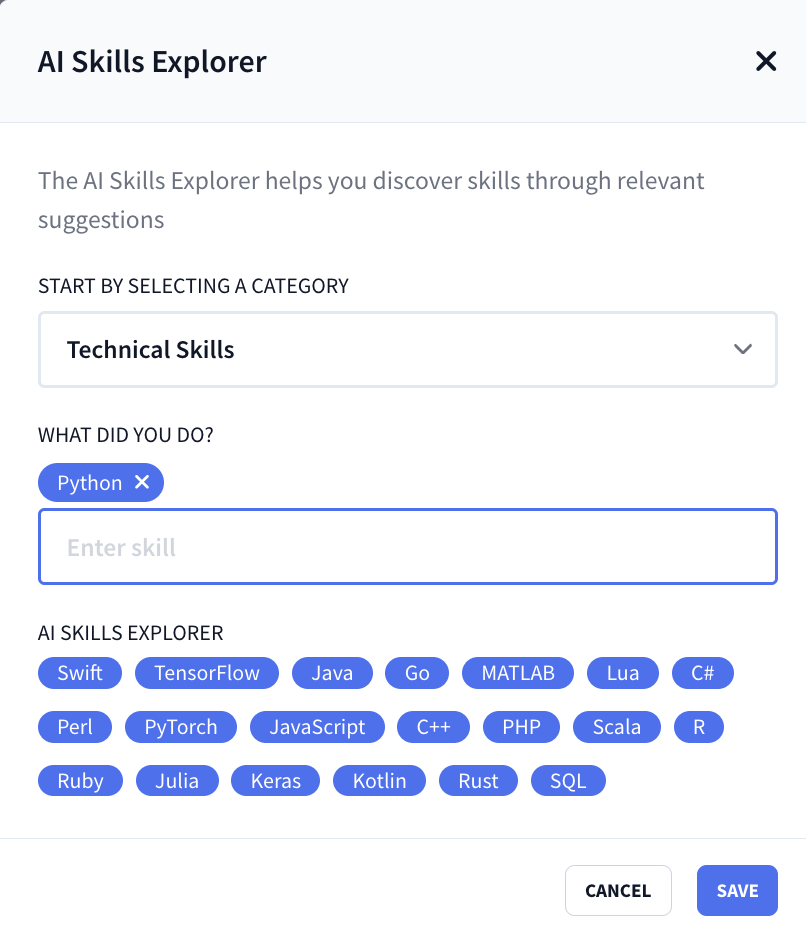
Need some inspiration? Try our AI Skills Explorer. Just enter an existing ability to get a tailored list of specific and in-demand skills for your application. Here’s a peek into how the feature works:
Types of Skills for Your Resume
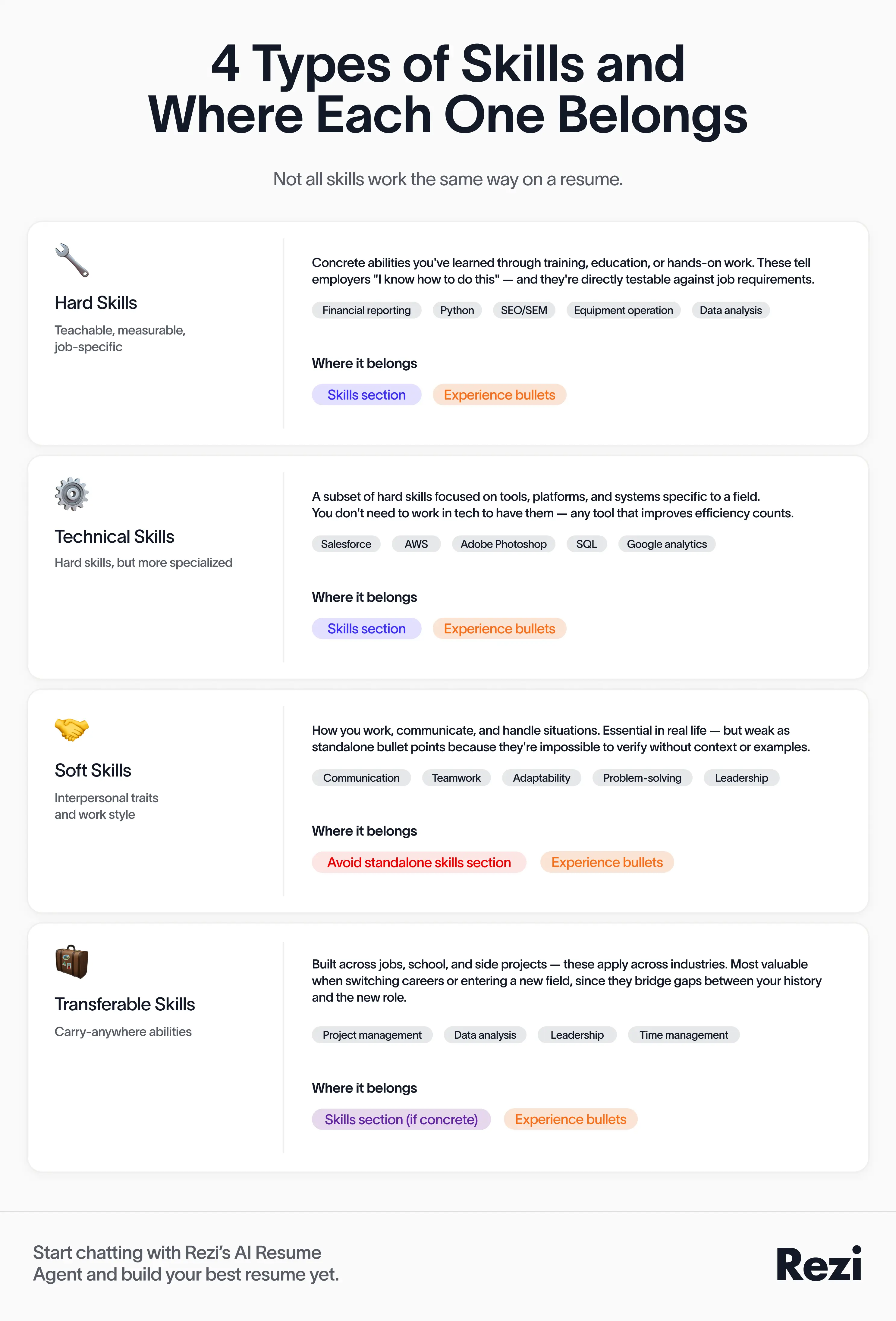
You should have a mix of skills on your resume, but your skills section itself should focus on hard skills that prove you can do the job. Soft skills work if you don’t have many technical abilities, but since they’re harder to prove, it’s better to give concrete examples of these in your work experience section.
So, what exactly is the difference between the different types of skills? Let’s break it down so you know how each one plays its role:
Soft Skills
Your resume soft skills are your interpersonal traits: the way you work, communicate, and handle situations on the job. They shape your work style and how you interact with others.
Here are some examples:
- Communication
- Teamwork
- Adaptability
- Problem-solving
These skills are important in real life, but they’re weak as standalone resume bullet points. Why? Because everyone lists them. Saying “great communicator” doesn’t prove anything — it could mean anything from giving a great presentation to dishing out office gossip.
Instead, show them through your experience. For example:
- “Led weekly team meetings” (shows communication)
- “Collaborated across departments” (shows teamwork)
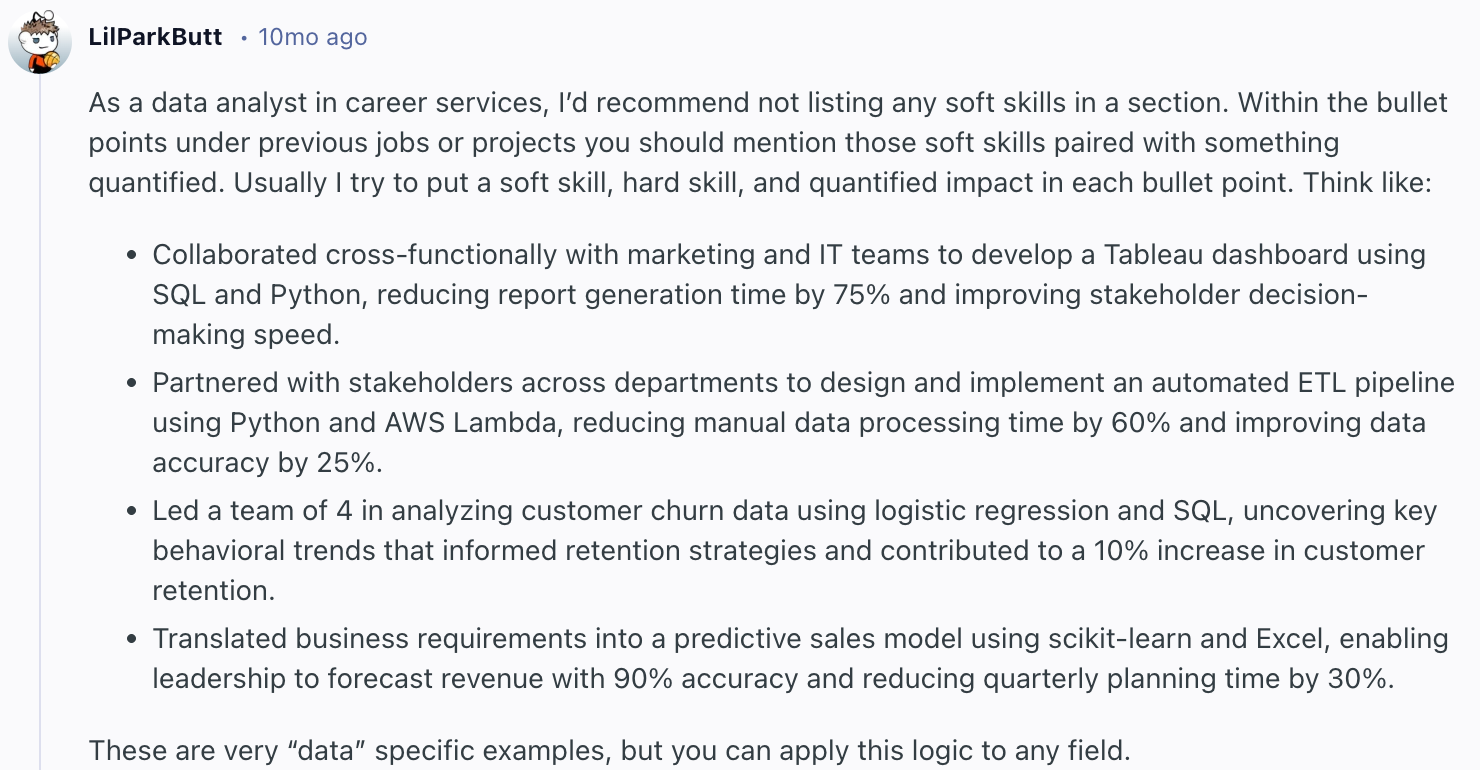
Here’s some more handy advice and examples for including soft skills in your resume:
Hard Skills
Hard skills are teachable, measurable abilities you’ve picked up through training, school, or hands-on work. You can include them in your skills section to show that you meet the requirements and can do the job.
Check out these examples:
- Programming languages
- Marketing tools
- Financial reporting
- Equipment operation
These resume hard skills tell employers, “I know how to do this.” That’s why they belong front and center in your skills section. They’re concrete, testable, and directly tied to job performance.
Technical Skills
Technical skills fall under the hard skills umbrella, but they’re more specialized. They focus on tools, systems, and methods used in a specific field.
For example:
- Software (Excel, Photoshop, CRM systems)
- Industry tools or platforms
- Technical processes or workflows
And just a heads up: you don’t have to work in tech to have technical skills on your resume. If you use tools to solve problems or improve efficiency, you’ve got something to work with and tie to the role.
Transferable Skills
These are your “carry them anywhere” skills. You build them through all kinds of experiences, such as jobs, school, side projects, hobbies, and they apply across industries.
Here’s what that looks like:
- Time management
- Leadership
- Data analysis
- Adaptability
These transferable skills are especially valuable if you’re switching careers or stepping into something new, since they are less specific to a particular job.
Resume Skills by Seniority Level
As you progress through your career, the skills you emphasize on your resume evolve.
- Entry-level: focus on foundational skills like communication and technical literacy, and demonstrate adaptability and teamwork through specific examples.
- Mid-level: detail advanced technical capabilities, analytical skills, and leadership experiences to show your capability in managing more complex roles.
- Senior: emphasize strategic leadership, change management, and the ability to influence and network effectively, ensuring each skill is backed by concrete instances demonstrating real-world application.
Entry-level positions
Core competencies
Include foundational skills such as effective communication, time management, and technical literacy (e.g., proficiency in Microsoft Office, basic HTML).
Adaptability and quick learning
Stress your ability to quickly adapt to new environments and learn new systems. Mention experiences where you learned new tools or adapted to new processes on the go.
Teamwork and collaboration
Highlight experiences involving team collaboration. This could include group projects in college, sports teams, or volunteer experiences. Emphasize your role and the outcome of these collaborative efforts.
Mid-level positions
Advanced technical skills
Specify technologies and tools you’re proficient in that are relevant to your industry, such as advanced CRM software for sales roles, or special certifications like PMP for project managers.
Project management and leadership
Detail your experiences in leading projects or teams. Mention the scope of the projects, budgets handled, and the number of people you managed. Skills such as delegation, motivation, and conflict resolution are valuable here.
Analytical thinking and innovation
Show how you’ve used analytical skills to solve complex problems or improve processes. Examples could include streamlining supply chain logistics, developing a new testing protocol, or designing a customer feedback system that led to improvements in service delivery.
Senior-level positions
Strategic leadership
Highlight your involvement in strategic planning and execution. This might include expanding a business into new markets, leading major strategic partnerships, or spearheading product innovations.
Change management
Emphasize your role in managing transitions or disruptions. Examples could be leading a merger or acquisition, driving digital transformations, or implementing major organizational changes.
Influencing and networking
Senior roles often require influencing others without direct authority and leveraging professional networks. Describe scenarios where you’ve successfully advocated for your ideas and strategies, or how your networking led to substantial benefits for your organization.
10 Best Skills to Put on a Resume
Here’s an overview of the top soft and hard skills to include in your resume:
- Adaptability and continuous learning
- Communication
- Leadership
- Cybersecurity
- Emotional intelligence
- Generative AI and machine learning
- Cloud computing
- Analytical thinking
- Digital literacy
- Project management
Let’s see what makes these skills popular and how you can add them to your resume.
1. Adaptability and continuous learning
If there’s one skill that says, “I’ll survive anything you throw at me,” it’s adaptability. Workplaces change fast with new tools, shifting priorities, and surprise challenges. Employers want people who don’t panic when things go wrong. They want someone who adjusts, figures it out, and keeps moving. Pair that with a willingness to keep learning, and you’ve got a strong combo.
Check out these adaptability skills to weave into your resume:
- Resilience
- Learning agility
- Openness to feedback
- Change management
- Growth mindset
2. Communication
Communication is all about making sure people understand your message. It covers writing emails, leading meetings, or collaborating across teams. Strong communication skills also strengthen other abilities, like teamwork and problem-solving. And as remote work and digital tools continue to dominate, being clear and concise matters more than ever.
Here are some key communication skills:
- Verbal communication
- Written communication
- Active listening
- Public speaking
- Cross-functional collaboration
- Presentation skills
3. Leadership
You don’t need a fancy title to prove you can lead. Having leadership skills is more about influencing, motivating others, taking initiative, and getting results. Companies love candidates who step up, take ownership, and bring people together. Even small examples, like leading a project or mentoring a teammate, can show you’ve got leadership potential.
Here are some leadership skills to add to your resume:
- Team leadership
- Decision-making
- Conflict resolution
- Motivation and coaching
- Accountability
- Strategic thinking
4. Cybersecurity
Cybersecurity isn’t just for IT specialists anymore; it’s becoming a must-have awareness skill across many roles. Companies deal with sensitive data daily, so one mistake can be costly. Showing that you understand how to protect systems, spot risks, and follow best practices shows you can keep up with technological advances.
Check out these cybersecurity skills:
- Risk assessment
- Data protection practices
- Network security basics
- Threat detection
- Security compliance
- Incident response
5. Emotional intelligence
Emotional intelligence means you can read the room, manage your own reactions, and respond thoughtfully to others. It makes you easier to work with, more effective in teams, and stronger in leadership situations. It’s one of those “you can’t teach it overnight” skills that employers really value.
Here are some skills that show emotional intelligence:
- Empathy
- Self-awareness
- Relationship management
- Conflict management
- Social awareness
6. Generative AI and machine learning
AI is rapidly changing how work gets done, so knowing how to use AI tools to boost productivity gives you a serious edge. At the same time, employers value people who understand both the potential and the risks. Even a basic grasp of machine learning concepts can set you apart, especially in tech, data, or business roles.
Take a look at these AI skills to prove your technical expertise:
- AI tool proficiency (e.g., automation tools)
- Prompt engineering
- Data modeling basics
- Machine learning fundamentals
- AI-assisted decision-making
Check out more like these: AI Skills for Your Resume
7. Cloud computing
Cloud technology powers everything from file storage to complex applications, especially in remote and hybrid environments. If you understand how cloud systems work or how to manage them, you instantly become more valuable. These skills open doors to a wide range of roles and show you can operate in modern tech-driven workplaces.
Here are some cloud computing skills for your skills section:
- Cloud platform knowledge (AWS, Azure, Google Cloud)
- Cloud security basics
- Deployment and configuration
- Data storage management
- Cloud architecture fundamentals
8. Analytical thinking
Analytical thinking is one of those skills employers consistently rank at the top, with seven out of ten companies considering it essential. This skill can help you break down problems, look at data, and make smart decisions. It’s all about figuring things out logically and backing up your conclusions with evidence.
Here are some skills to show you’re an analytical thinker:
- Data analysis
- Critical thinking
- Problem-solving
- Research skills
- Decision-making based on data
9. Digital literacy
Most jobs have already gone down the digital route, and if they haven’t, it’s probably only a matter of time. Digital literacy means you can confidently use tools, platforms, and systems to get things done, while adapting to evolving technology. Employers want people who don’t just keep up with tech but actually use it to work smarter.
Here’s some digital expertise you can add to your resume:
- Proficiency with productivity tools (e.g., spreadsheets, docs)
- Collaboration platforms (Slack, Teams)
- Basic IT troubleshooting
- Software navigation
- Digital communication tools
- Data management
Take a look at more tech-savvy skills:
10. Project management
Project management is where organization meets execution. It shows you can take an idea, plan it out, manage resources, and deliver results. Even if you’ve never had “project manager” in your title, chances are you’ve used these skills before in some capacity.
Here are some project management examples:
- Project planning
- Task prioritization
- Risk management
- Resource allocation
- Stakeholder communication
Top Resume Skills by Industry
Your resume isn’t all about you. Yes, it’s a big part, but you should always tailor your skills to match what the employer is looking for. That doesn’t mean lying; it’s just choosing the relevant abilities to show a hiring manager you know what you’re doing and have what they want.
Check out these popular skills for your industry.
Sales resume skills
Sales isn’t just about talking someone into buying the latest overpriced trend. Great sales professionals juggle product knowledge, customer psychology, and performance targets. You need to stay sharp, adapt your approach, keep refining communication skills, and do it all with a smile on your face.
Take a look at these sales skills for your resume:
- Relationship building
- Product knowledge
- Point-of-sale (POS) systems
- Customer needs analysis
- CRM software (e.g., Salesforce)
Healthcare resume skills
Healthcare is one of those fields where skills aren’t optional. Employers expect you to bring both technical expertise and real-world clinical experience to the table. This is why healthcare resumes often go deeper, highlighting hands-on training, certifications, and specialized knowledge.
Here are some key healthcare skills for your resume:
- Patient care
- Clinical procedures
- Electronic health records (EHR)
- Vital signs monitoring
- HIPAA compliance
IT resume skills
In IT, your technical skills should take centre stage. Whether that’s fixing systems, building software, or managing networks, employers want quick proof that you know your stuff. But don’t forget, you still need people skills to explain issues, collaborate, adapt to new technologies, and keep things running behind the scenes.
Here are some technical skills for your IT resume:
- Programming languages (Python, Java, etc.)
- Troubleshooting and debugging
- Cybersecurity basics
- Database management
- Cloud platforms
- Technical support
Bartender resume skills
Bartending is part science, part performance. Sure, you need to know your cocktails, but that’s just the baseline. The real test happens when you can handle a packed bar, keep your cool under pressure, and create a great experience for every guest. Employers look for people who bring energy, consistency, and professionalism to every shift.
Check out these popular bartending skills:
- Mixology and drink preparation
- Customer service
- Cash handling
- Conflict resolution
- Food and drink safety
Finance resume skills
Finance is all about precision, analysis, and smart decision-making. You’re working with data that directly impacts business outcomes, so employers expect both technical expertise and strong judgment. Modern finance roles also lean heavily on technology, so showing you can work with financial tools and explain your insights clearly gives you a serious edge.
Here are some popular finance skills for your application:
- Financial analysis
- Budgeting and forecasting
- Financial modeling
- Data analysis tools (Excel, SQL)
- Risk assessment
- Reporting and presentation
Mechanic resume skills
If you’re a mechanic, your skills need to prove one thing: you know how to fix things. This is a hands-on field where technical ability matters most. Employers want to see clear evidence that you can diagnose issues, work with tools, and follow safety standards without cutting corners.
Check out these mechanic skills:
- Diagnostic testing
- Equipment repair
- Preventive maintenance
- Safety compliance
- Mechanical systems knowledge
Marketing resume skills
Marketing is where you combine creativity with strategy. It’s your job to come up with unique ideas and get real results. Employers want to see how your skills translate into growth, whether that’s more traffic, leads, or revenue. And nowadays, a good amount of technical skills is needed to stand out from the crowd.
Here are some in-demand marketing skills for your resume:
- Content creation
- SEO/SEM
- Social media management
- Market research
- Campaign strategy
- Analytics and reporting
Warehouse worker resume skills
Warehouse roles keep the entire supply chain moving. You’re handling inventory, meeting deadlines, and making sure everything runs like a well-oiled machine. Employers look for reliability, efficiency, and a strong understanding of safety and logistics. It’s physical work, but it also requires attention to detail and organization.
Check out these warehouse worker skills:
- Inventory management
- Order picking and packing
- Forklift operation
- Shipping and receiving
- Safety procedures
- Attention to detail
Education resume skills
Technical skills:
- Lesson planning
- Classroom technology integration
- Educational software proficiency
- Student assessment methodologies
- Special education strategies
Soft skills:
- Patience
- Effective communication
- Conflict resolution
- Leadership
- Motivational skills
Retail resume skills
Technical skills:
- Point of Sale (POS) systems
- Inventory management
- Merchandising techniques
- E-commerce platforms, like Shopify
Soft skills:
- Customer service
- Teamwork
- Problem-solving
- Time management
- Flexibility
Legal resume skills
Technical skills:
- Legal research and writing
- Knowledge of relevant laws and regulations
- Document drafting and review
- Case management software, such as Clio
Soft skills:
- Analytical thinking
- Attention to detail
- Discretion and confidentiality
- Persuasion
- Stress management
Engineering resume skills
Technical skills:
- CAD software: AutoCAD, SolidWorks
- Manufacturing processes
- Project management
- Engineering principles
Soft skills:
- Problem-solving
- Creativity and innovation
- Team collaboration
- Communication
- Critical thinking
Customer service resume skills
Technical skills:
- Customer service software: Zendesk, Freshdesk
- Financial transaction handling
- Knowledge of products or services
- Record keeping
Soft skills:
- Empathy
- Active listening
- Patience
- Effective communication
- Conflict resolution
Design resume skills
Technical skills:
- Design software: Adobe Creative Suite (Photoshop, Illustrator)
- UX/UI design
- Graphic design fundamental frameworks
- Web design
Soft skills:
- Creativity
- Visual communication
- Attention to detail
- Time management
- Receptiveness to feedback
How to List Skills on a Resume
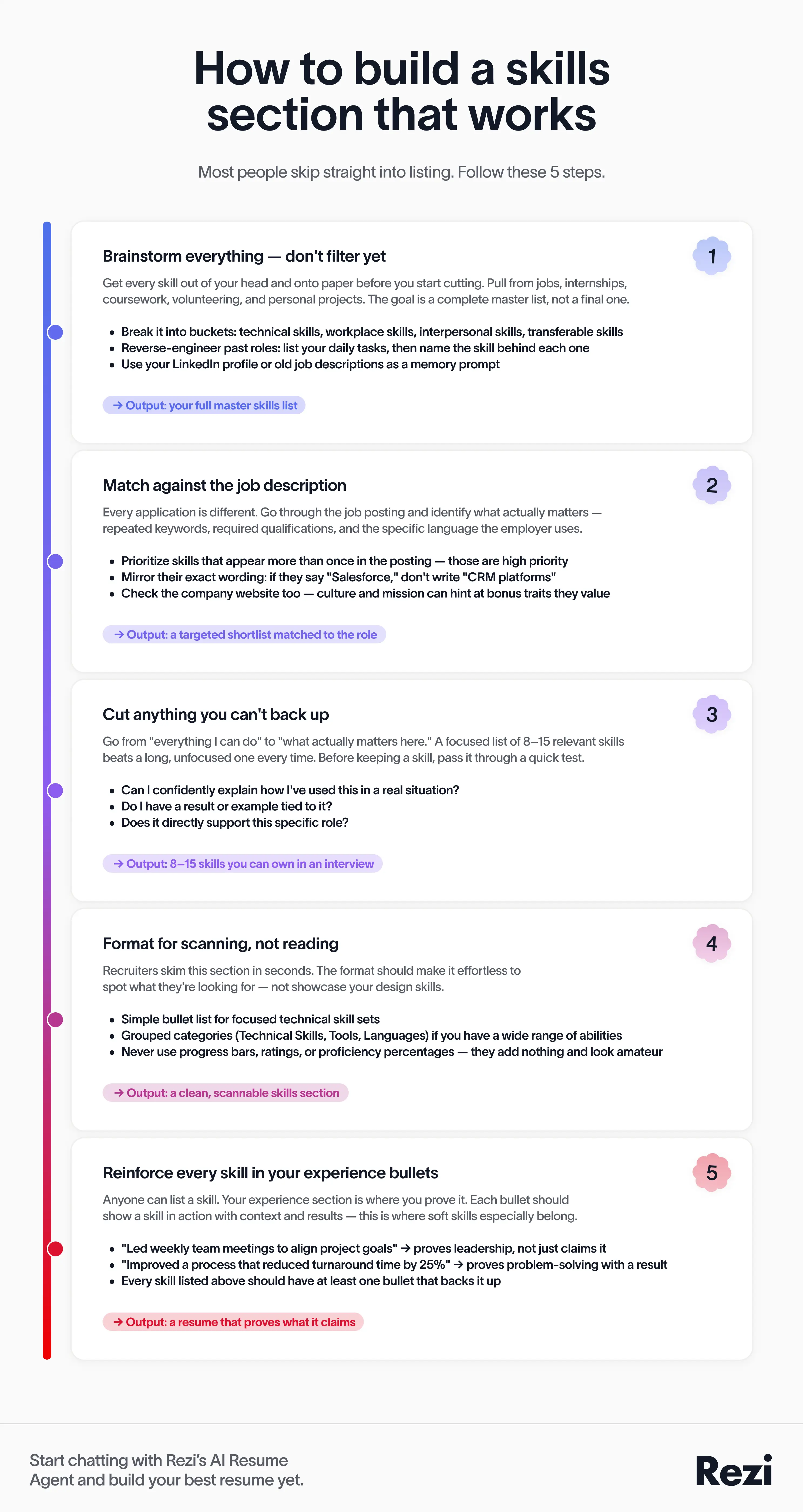
Here’s a quick breakdown of how to list skills on your resume:
- Brainstorm your key skills by getting everything out of your head and onto paper.
- Compare skills to the job description and refine your list using the keywords, required qualifications, and language the employer emphasizes.
- Choose your most relevant abilities, so your resume stays focused, keeping only the skills you can confidently explain and support with real examples.
- Build a resume skills section with an easy-to-scan format, such as a simple list or grouped categories like technical skills and tools.
- Add your skills to other resume sections by reinforcing them in your work experience with specific examples and results.
Let’s go through your skills section step-by-step with examples and tips.
1. Brainstorm your key skills
Start by getting everything out of your head and onto paper (no filtering yet). The goal is to get a full picture of what you bring to the table, not perfecting the final version. When you let yourself think freely, you’ll remember details and strengths you might have overlooked under pressure.
Look across your entire experience: jobs (this should take priority), internships, school, volunteering, and even personal projects. Break it down into different types of skills, so you don’t miss anything. For example:
- Technical skills (tools, systems, software)
- Workplace skills (time management, organization)
- Interpersonal skills (teamwork, communication)
- Transferable skills (problem-solving, leadership)
If you get stuck, use your LinkedIn profile or past job descriptions as a reference point. Another trick? Write down your daily tasks from previous roles and reverse-engineer the skills behind them. This gives you a strong resume master list to pull from later.
2. Compare skills to the job description
Now that you’ve got your master list, it’s time to be more strategic. Every job is different, so your resume should shift slightly each time you apply. Check out the job description and identify what the employer actually cares about.
Here’s what you should pay close attention to:
- Skills that show up multiple times (these are high priority)
- Required vs. “nice-to-have” qualifications
- Specific wording and terminology used
Once you spot those patterns, match your skills to them (as long as you genuinely have that experience). This is also where tailoring your resume matters most; you need to align yourself with their needs.
For instance, if the job ad lists skills such as “JavaScript” and “React” as requirements, ensure these are explicitly mentioned in your resume’s skill section.
Do not just assume the ATS will figure out your knowledge of these technologies because you mention “building dynamic and responsive web applications.” Spell out “JavaScript” and “React,” verbatim! This increases your chances of having your resume flagged as a match.
And if you want to go that extra mile, look into the company itself. Their website, mission, or team culture can hint at bonus traits they value, like teamwork, unique thinking, or adaptability.
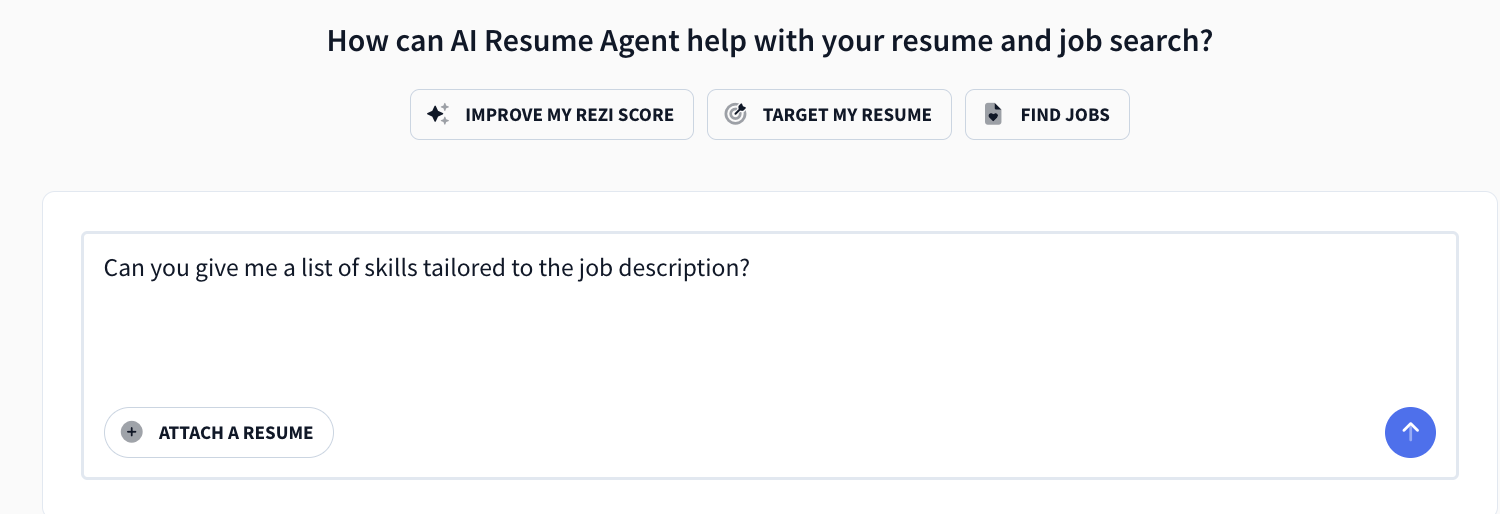
You could do this all yourself, or use our AI Resume Agent to speed up the process. Just enter the job ad and ask it to give you a tailored set of skills and even offer suggestions on how to include them in your resume. Here’s what it looks like:
3. Choose your most relevant abilities
This is where you go from “everything I can do” to “what actually matters here.” It’s tempting to include a long list of skills, but more isn’t better. Employers at an IT company simply don’t care about your cocktail-making expertise; it doesn’t prove you can actually do the job they want.
Before adding a skill, ask yourself some questions:
- Can I confidently explain how I’ve used this?
- Do I have a real example or result tied to it?
- Does it directly support this role?
If a skill doesn’t pass that test, it doesn’t make the cut.
Focus on a mix of hard and soft skills that clearly show you can succeed in the role. Keep your list concise and targeted so hiring managers can quickly scan it. A relevant list makes a stronger impression than a long, unfocused one that just takes up valuable room on the page.
4. Build a resume skills section
Now it’s time to organize everything into a strong, readable format. Your skills section usually sits toward the bottom of your resume, acting as a quick preview of your capabilities after your experience section gives all the context.
You can structure it in a couple of ways:
- A simple bullet list for straightforward skills (with a focus on technical abilities)
- Grouped categories for more complex skill sets, such as:
- Technical skills (tools, platforms, software)
- Languages
- Tools & systems
- Interpersonal skills
Grouping works especially well if you have a wide range of abilities; it keeps things organized and easier to scan. Just keep it relevant and professional. And please, skip things like progress bars or self-rated percentages (only being 80% good at marketing isn’t a selling point).
Let’s take a look at a skills section written by a Product Manager. See how well the candidate below organized their key skills into easily readable categories.
Skills
Product Management
• Roadmap strategy and execution
• Agile & Scrum methodologies
• Product lifecycle management
Technical Skills
• Prototyping tools: Sketch, InVision
• Analytics tools: Google Analytics, Tableau
• Project management software: Jira, Asana
Soft Skills
• Strong communication and presentation skills
• Critical thinking and problem-solving
• Decision-making
5. Add your skills to other resume sections
Proving your abilities doesn’t end with your skills section. It’s easy to list a bunch of abilities straight from the job description, but providing context in your work experience section will give you more credibility.
This is particularly important when including soft skills. Yes, they’re essential to any job, but anyone can write buzzwords like “team player” or “problem-solver” in their resume. Instead, it’s better to prove these soft skills with examples in your work experience section.
Here’s how to do it:
- “Led weekly team meetings to align project goals.” (leadership)
- “Resolved customer issues, improving satisfaction ratings.” (communication)
- “Improved a process that reduced turnaround time by 25%.” (problem-solving)
Each bullet point should highlight both what you did and the skill behind it. This reinforces your skills section and makes your resume way more credible.
Imagine you’re a front-end developer applying for a job that listed HTML, CSS, React, and Angular as key requirements. The job ad also suggests you’ll need strong collaboration skills to thrive.
Here’s what your resume summary could look like.
Dynamic Front-End Developer with over 5 years of experience in designing and developing user-friendly, responsive websites and applications. Proficient in HTML, CSS, JavaScript, and modern frameworks such as React and Angular. Proven track record in collaborating effectively with multi-department teams involving 10+ team members. Passionate about optimizing user experience and continuously exploring innovative front-end development techniques.
There’s a job opening for a Senior Customer Service Rep. The most important skills listed in the job ad are advanced technical support, project leadership, and process optimization.
Notice how the candidate below makes sure each bullet point in the description of their most recent job proves their proficiency in those areas.
Customer Service Representative
ABC Tech Solutions, San Francisco, CA
March 2022–Present
• Demonstrated deep product knowledge and complex problem-solving abilities by successfully resolving technical issues for over 500 customers, leading to a 30% increase in customer satisfaction scores.
• Orchestrated and led a pivotal customer feedback initiative using CRM software Salesforce. Enhanced the feedback collection mechanism, leading to a robust 25% growth in customer insights, which helped shape service improvement strategies.
• Authored and implemented a comprehensive training program for new hires focusing on advanced CRM functionalities and customer interaction techniques. This initiative reduced the learning curve by 40% and increased adherence to best practices.
• Analyzed and upgraded customer service workflow by integrating a new ticketing system, Zendesk, which cut down average issue resolution times by 35% and improved service delivery efficiency.
• Recognized with the “Customer Service Star” award quarterly for exceptional use of technology in service delivery and consistently surpassing performance benchmarks.
Here’s what a former recruiter said about weaving in your skills throughout your resume:

Need help writing strong bullet points? Check out our free AI Resume Bullet Point Generator. Simply enter a few role details and professional bullet point suggestions in seconds.
Summary
Here’s an overview of everything you need to know about the skills section of a resume:
- Focus on the skills that directly match the job so hiring managers can instantly see your value without digging through your entire resume.
- Brainstorm a master list of all your skills, such as technical, interpersonal, and transferable abilities. Pull from past roles, projects, and LinkedIn for inspiration.
- Tailor your skills for every job application. Study the job description, identify repeated keywords, and mirror that language (honestly).
- Prioritize hard skills in the skills section since they’re measurable and job-specific. Save softer traits, like communication or teamwork, for your experience section.
- Be selective and intentional with what you include. A focused list of relevant skills makes a stronger impression than a long, generic one.
- Keep the format professional and easy to scan. Use bullet points or group skills into categories like “Technical Skills” or “Tools & Software” so recruiters can quickly scan.
- Avoid gimmicks like progress bars or self-rated proficiency levels. They don’t provide meaningful insight and can actually weaken your credibility.
- Reinforce your skills in your work experience section. Use action-oriented bullet points to show how you’ve applied those skills and the results you achieved.
FAQ
How many skills should you list on a resume?
Aim for around 8–15 skills in your skills section that directly match the job you’re applying for. That’s enough to show range, without overwhelming the reader. Hiring managers usually skim, so a focused list helps them quickly spot what matters. Remember, every skill should earn its place. If it doesn’t clearly support your ability to succeed in that role, then you should cut it. A shorter, tailored list always beats a long, generic one.
What are the best keywords for resume skills?
The best resume keywords are the ones the employer already gave you in the job description. Look for repeated terms, required skills, and specific tools or qualifications. These might include technical skills like “data analysis,” “project management,” or “SEO,” depending on the role. Just don’t force it; only include keywords you genuinely have experience with so you don’t get caught out down the road.
How to write skills on a resume?
Start by identifying the skills that matter for the role, then present them in a professional, easy-to-scan format. Use bullet points or group them into categories like “Technical Skills” or “Tools & Software” if you have a broader skill set. Keep the wording simple and specific, avoiding vague terms or skill charts.
Most importantly, don’t stop at listing them. Reinforce those skills in your work experience using action verbs and results. Anyone can say they’re skilled—your job is to show it. A strong skills section works best when it’s backed up elsewhere on your resume.
What skills should you put on a resume with no experience?
If you don’t have formal work experience, focus on transferable abilities you’ve built through school, projects, volunteering, or hobbies. Things like communication, teamwork, time management, and problem-solving all count. You can also include basic technical skills, like familiarity with tools or software. Just connect those skills to real situations and results. Employers aren’t expecting perfection; they’re looking for potential. Show that you’re capable, willing to learn, and able to contribute.
Find out more: How to Write a Resume With No Experience
How to write a skills-based resume?
A skills-based, or functional resume, flips the usual format by putting your abilities front and center instead of your work history. Start with a strong summary, then create sections built around key skill categories relevant to the job. Under each category, include bullet points that show how you’ve used those skills, ideally with results or context. This format works well if you’re changing careers, have gaps, or want to highlight strengths over job titles. Just don’t skip your work history entirely; include a brief section at the end to provide context and keep everything credible.
How to list skills on a resume when changing careers?
Highlight transferable skills applicable to the new industry. Focus on universal competencies like leadership, project management, and communication. If you have a lot of experience in your “previous” field, use a combination resume format to emphasize these skills over your previous job-specific expertise.
I don’t have some of the skills the job ad requires. Can I still apply?
Apply if you meet at least 70% of the job requirements, especially if you have key skills critical to the role. Use your cover letter to address any gaps and highlight how you plan to quickly close them.

Upload or drop your resume to get started
Upload your resume to get started
Score my resume

Lauren Bedford is a seasoned writer with a track record of helping thousands of readers find practical solutions over the past five years. She's tackled a range of topics, always striving to simplify complex jargon. At Rezi, Lauren crafts genuine and actionable content that guides readers in creating standout resumes to land their dream jobs.