Resume
How to Write a CV for a Job (Examples & Tips)
Learn how to write a CV that stands out with step-by-step guidance on structure, content, skills, and formatting, plus expert tips for tailoring it to any role.

Published on
September 3, 2025
Updated on
September 4, 2025
Pick a clean, ATS-friendly template so your CV can be read by both ATS and human hiring managers. Start with your contact details, then add a short personal summary that’s tailored to the job. List your work experience in reverse order, focusing on achievements, not just duties. Include your education and relevant skills that match the job description and that you can prove. Add extra sections, such as volunteer work, languages, or awards, if they strengthen your application. Keep it concise (one to two pages), easy to read, and customised for each role.
Writing a CV. We all have to do it at some point. Unless you’re a nepo baby, in which case your “application process” might just be a quick text from your dad’s old uni mate (no judgement, just jealous). For the rest of us, it’s a confusing swirl of advice: Mum says to copy your brother’s old-fashioned design and hand it in to local businesses, your friend swears by Canva’s colourful templates (but will an Applicant Tracking System even read them?), and Google offers everything from Word docs to resume builders.
Job hunting is already stressful enough with applications, cover letters, and interview preparation. Your CV shouldn’t be the thing that makes you want to crawl back under the duvet. This guide will make it simple. You’ll get:
- The ideal CV format employers (and scanners) love.
- A step-by-step breakdown for building yours from scratch.
- Tips and examples to make your skills stand out.
If you’d rather skip the heavy lifting entirely, try our free AI CV Builder. For more help, check out these guides:
- Survival Tips for a Layoff
- How to Get a Job Fast
- How to Use AI to Write a CV
- Creating ATS CVs That Pass Filters
- 20+ Common CV Mistakes to Avoid
CV Format
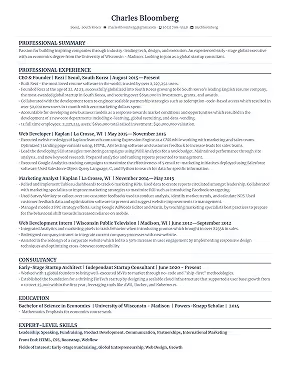
Here’s an example of a CV done right (if I do say so myself). You’ll see annotations explaining exactly what each section does and how to make it work for you. Whether you’re polishing up an old CV or starting completely from scratch, these pointers will help you create a CV that’s clear, compelling, and impossible for employers to ignore.
Side note: this one’s tailored for a senior-level project manager, but if you’re early in your career, you can tweak it. Add more detail to your education, highlight transferable skills, and slot in extra sections like volunteering, languages, or hobbies.

What is a CV?
In short: a CV is a snapshot of your career that highlights your strengths to employers. Keep it focused, well-structured, and tailored so that the most relevant details stand out. Key sections include contact details, a short profile, work history, education, and skills.
A CV (short for curriculum vitae) is your career story on paper. It’s where you showcase your work history, education, skills, and achievements in a way that makes it clear why you’re the right fit for the role.
Before you ever get an interview, your CV will be the first thing a recruiter or Applicant Tracking System (ATS) sees, so it needs to make an impact. A strong CV goes beyond listing jobs and qualifications; it’s tailored to the role and highlights the most relevant parts of your experience.
The best CVs are focused, factual, and easy to read. They’re one to two pages long, with every section earning its place. Think of it as your way of saying, “Here’s why I’m exactly what you need.”
What to include in a CV
While everyone’s CV looks a little different, most follow a structure that makes it easy for employers and ATS to find the important details:
- Contact information
- Professional profile or summary
- Work experience
- Education
- Skills
CV vs. Resume: What’s the Difference?
A US resume and an international CV share many similarities — both are designed to give an overview of your professional experiences, skills, and achievements that make you qualified for the job.
However, when it comes to applying abroad, here are some small differences to consider.
How to Write a CV for a Job Application
Here’s how to write a CV for a job application:
- Choose an ATS-friendly template that’s simple, single-column, with clean fonts and clear headings so both software and recruiters can read it easily.
- Place your name, phone, email, and location at the top, plus relevant links like LinkedIn or a portfolio.
- Write a 2–3 sentence summary that showcases your key skills, experience, and a measurable achievement, tailored to the job.
- Outline your work experience in reverse-chronological order, with strong action verbs and results-focused bullet points (the STAR method works well).
- In your education section, focus on your highest qualification, relevant coursework, and notable achievements. List your certifications separately if needed.
- Emphasise your skills in clear categories that match the job description, and only include those you can confidently back up with real experience.
- Include optional sections like volunteer work, projects, awards, or hobbies that demonstrate transferable skills or personality.
Trust me, I know how much of a nightmare updating your CV can be. But it doesn’t have to be a dreaded, all-day task. With the right tools and a clear plan, you can create a polished, job-ready CV in under an hour. If you want to make it even faster, our free AI Resume Builder can import your current CV, make it ATS-friendly in seconds, and help you tailor it to a specific job in about 10 minutes.
1. Pick a professional CV template
Your template is more than just a design choice — it’s the foundation of how your CV will be read and ranked. Before a recruiter ever sees it, there’s a good chance an Applicant Tracking System (ATS) will scan it first. If the ATS can’t process your CV correctly, your application might never even reach human eyes.
If you want to play it safe, start with a Rezi template. They’re built for ATS readability from the ground up, with no weird formatting, no layout glitches, just clean and professional designs. I’d recommend the standard CV template for a simple, classic look, or the bold CV template for a splash of color.
If you’re not using Rezi, here’s how to spot an ATS-friendly template:
- Stick to a single-column layout, as multiple columns and tables can confuse scanners.
- Choose a standard, easy-to-read font like Arial or Calibri.
- Use clear, simple headings such as “Experience” and “Skills.”
- Avoid Canva templates, because their text boxes trip up ATS.
- Keep margins around one inch and line spacing at single or 1.15.
- A little color in headings is fine, but skip heavy backgrounds, graphics, or anything that might hide text.
- Start with standard margins. Aim for about one inch (or 2.5 cm) on all sides. Need to squeeze in a bit more? You can trim it down slightly, but don’t go below 0.5 inches (1.27 cm) — anything tighter risks making the page look overcrowded.
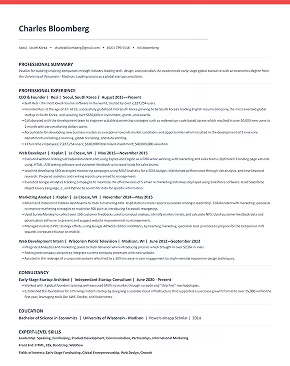
A sleek, functional design looks polished to recruiters and readable to ATS software.
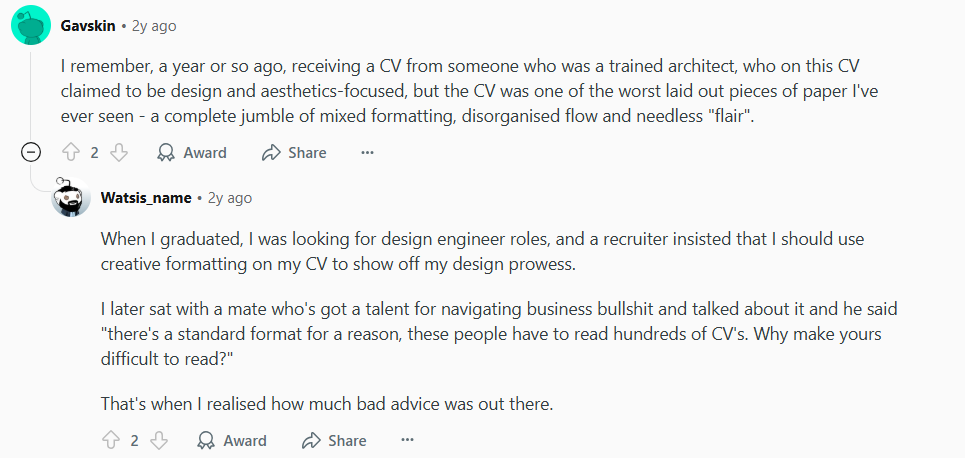
No need to get fancy, as this Reddit user shows, simplicity really does win:
2. Outline your contact details
Put your contact details right at the top of your CV in the main body (not inside the header tool).
Make your name stand out in a slightly larger font size than the rest (around 20–24pt). Add your phone number, a professional email address, and your location (city/town and county).
Add links to your LinkedIn profile or an online portfolio if they’re relevant and up to date.
To avoid discrimination (and TMI), these are details you don’t need to include on your UK CV:
- Home address: No need to share this — and honestly, you probably don’t want to put it online anyway.
- Personal details: Don’t include your age, date of birth, marital status, or nationality. This information isn’t relevant and could lead to unconscious bias.
- Photo: Unless you’re in an industry where it’s the norm (like acting or modeling), leave the photo off. Unlike other European countries, UK recruiters prefer CVs without pictures to keep the focus on your skills and experience.
Here’s an example of a resume header:

3. Write a CV summary/profile
Your CV summary (or professional profile) is the quick pitch that sits at the top — just enough to grab the hiring manager’s attention and make them want to read more.
How to nail your CV summary:
- Keep it to 2–3 sentences.
- Mention the role and company by name for a tailored touch.
- Highlight your most relevant skills and experience.
- Include one or two measurable achievements (e.g., “boosted sales by 25% in six months”).
- Use keywords from the job description so it passes the ATS check.
Example of a professional profile:
“Customer-focused retail supervisor with 6+ years’ experience managing high-volume stores. Increased customer satisfaction scores by 20% and consistently exceeded monthly sales targets. Excited to bring leadership and sales expertise to the Store Manager role at Marks & Spencer.”
Summarise your professional background
Start strong by giving the reader a sense of who you are as a professional. Here are some points you can mention when introducing yourself:
- Your current job title (or most recent if you’re unemployed)
- How many years of experience
- The direction you want your career to go
If you’re a graduate or early-career job seeker, your degree and area of study can stand in for experience. It’s also a smart move to mirror the job title from the ad, so recruiters can instantly see that you align with the position.
Cover your key skills
Don’t just reel off a long list of generic skills. Instead, include skills that tie back to what the job actually requires. You can mention 2–4 of your top hard skills (like software knowledge or technical expertise) in your CV profile, while soft skills (like teamwork or communication) should ideally be shown through your work history or backed up with examples.
Outline your career goals
Your profile isn’t just about past achievements; it’s also a chance to show where you want to go. A single line about your career aspirations can help employers see you as a long-term investment. Keep it aligned with the role you’re applying for, though. This isn’t the place for “I’d love to become a chess champion one day.”
Include personal touches
Personalising your CV profile doesn’t mean mentioning your love of cheese or medieval history. Instead, it’s about making your profile feel like you wrote it, not a generic template. Tailor the tone to match the company’s culture and highlight your enthusiasm for the role. A profile that feels specific and positive will stand out much more than one filled with stock phrases.
Swap buzzwords for specifics
This is where a lot of profiles fall flat. Generic claims like “excellent communication skills” sound nice, but mean very little. Can you deliver informative and engaging presentations, or are you just the most vocal about the faulty printer? Don’t leave the recruiter guessing.
Here are some ways you can be more specific:
- Replace “team player” with an example of collaboration
- Replace “detail-oriented” with an achievement showing accuracy
- Replace “strong leadership” with a project where you led successfully
CV profile examples by experience level
No experience
Motivated and adaptable individual with strong organisational and interpersonal skills. Experienced in coordinating volunteer activities and taking on leadership roles in various university societies. Eager to learn new skills, contribute to a professional team, and develop practical experience in a dynamic work environment.
Students and graduates
Recent university graduate with a degree in Business Management and experience leading student projects and volunteering initiatives. Skilled in research, presentation, and teamwork. Enthusiastic about applying analytical skills and project management knowledge in a professional environment while contributing to organisational success.
Entry-level
Entry-level professional with internship experience in administrative support and project coordination. Skilled in advanced Excel, data entry, and process improvement. Eager to develop professional skills, take on new challenges, and contribute to achieving organisational goals in your team-focused work environment.
Junior
Junior Software Developer with hands-on experience in Python, JavaScript, and SQL. In my last role, I developed a task automation tool, reducing processing time by 30%. Keen to expand technical expertise and contribute to new projects within a collaborative development team.
Senior
Senior Project Manager with over 12 years’ experience leading diverse teams and delivering multi-million-pound projects on time and within budget. Skilled in stakeholder management, risk mitigation, and process optimisation. Proven track record of improving efficiency, reducing costs, and driving strategic initiatives.
CV profile examples by industry
Sales
Motivated sales professional with experience in retail and B2B environments. Skilled in customer engagement, lead generation, and CRM systems, achieving a 10% increase in sales during placement. Eager to develop further in a target-driven sales role while building strong client relationships.
Finance
Finance analyst with a strong foundation in accounting and financial modelling. Experienced in preparing reports, reconciling accounts, and using Excel to analyse budgets. Achieved a 5% cost reduction during my internship project, and I’m eager to contribute these financial management skills within a dynamic team.
Engineering
Mechanical engineer with 12 years’ experience designing and managing large-scale industrial projects. Led a team to develop a new assembly line that improved production efficiency and reduced costs by £250k. Skilled in CAD, lean manufacturing, and team mentorship.
Healthcare
Junior healthcare assistant with practical experience supporting patient care during clinical placements. Skilled in patient observation, documentation, and basic medical procedures. Dedicated to delivering compassionate care and learning innovative clinical skills to contribute to a safe healthcare environment.
Marketing
Marketing assistant with experience creating content and managing social media campaigns during several internships. Skilled in SEO, email marketing, and audience engagement. Enthusiastic about applying creativity and analytical skills to support brand growth and deliver measurable marketing results.
Need a hand writing yours? Try our AI Resume Summary Generator — just enter the role and skills you want to showcase, and it’ll craft a tailored, ATS-friendly summary in seconds.
Here’s a summary from the AI Resume Summary Generator:

4. Highlight your work experience
Your work experience section is where you prove what you’ve achieved in your past roles. List your jobs in reverse-chronological order, starting with the most recent. Include:
- Job title
- Company name
- Location
- Dates of employment
Use 3–8 bullet points per role, depending on your experience. Begin each bullet with a strong action verb and focus on achievements on your resume, not just duties.
A helpful tip is to use the STAR method (Situation, Task, Action, Result) to keep your points clear and results-driven.
Examples of bullet points you could use:
• Coordinated a product launch campaign that attracted over 5,000 attendees and increased brand engagement by 40%.
• Trained and mentored three new hires, helping them reach full productivity within two months.
• Simplified staff scheduling, cutting prep time from four hours to 90 minutes per week.
• Maintained a 98% on-time delivery record over two years.
If you’re changing careers, emphasise transferable skills like communication, leadership, organisation, or technical skills. If you’re writing a resume with no formal experience, include internships, volunteering, or relevant projects instead.
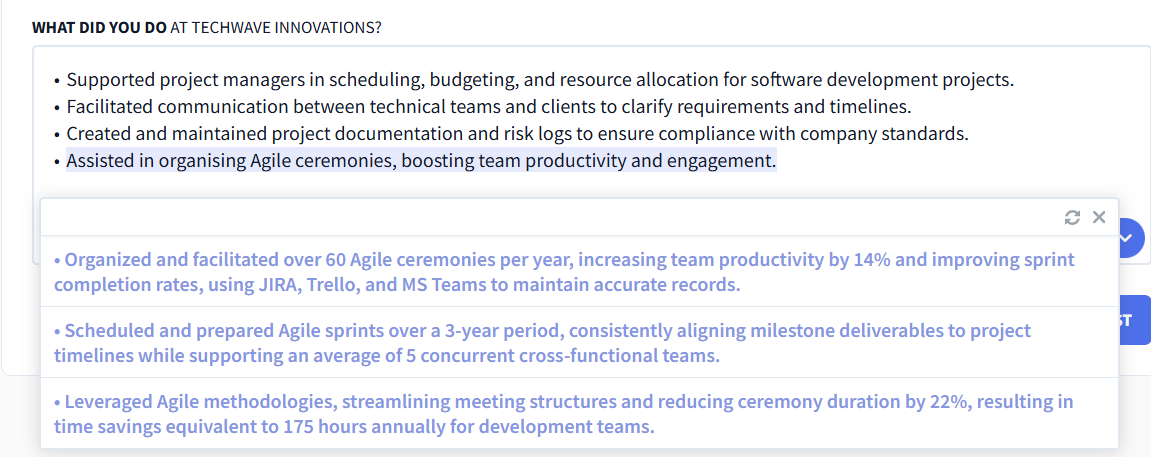
Need help writing bullet points? Try our AI Bullet Point Writer. Enter your role and company details to generate bullets, or improve existing ones with the AI Bullet Point Editor, which gives you three suggestions for better phrasing.
Here’s an example from the AI Bullet Point Editor:
5. Add your education
If you have solid work experience, just focus on your highest level of education:
- Your degree or qualification (e.g, BA, BSc, A-Levels)
- School or university name
- Graduation date (or expected date)
If you’re a recent graduate, you can also include:
- Your degree classification (e.g., 2:1, First Class).
- Relevant coursework or projects that relate to the job.
- Any academic awards or scholarships.
Are you applying from outside the UK? For international qualifications, like a U.S. GPA, it’s smart to include the UK equivalent. Most British recruiters won’t know off the top of their heads what a GPA of 3.8 means — adding equivalents shows awareness and helps skim-reading recruiters.
Here’s an approximate breakdown of the college GPA equivalents for our US readers:
For professional certifications (like IOSH or CIPD), list them here or in a separate certifications section with:
- Name of the certification
- Awarding organisation
- Date completed or “in progress”
Here’s an example of a certifications and education section:
Education
BA (Hons) Business Management | University of Manchester | July 2022
• Relevant modules: Marketing Strategy, Project Management
• Dean’s List for Academic Excellence (2021)
Certifications
• PRINCE2 Foundation Certificate in Project Management | AXELOS | 2024
• Google Data Analytics Professional Certificate | Coursera | 2023
• First Aid at Work | St John Ambulance | Expires 2026
6. Put skills on your CV
This isn’t your opportunity to list every skill you’ve ever picked up. Make sure your skills section matches the job you’re applying for. If the role highlights “data analysis” or “report writing,” those should be front and center here (and ideally elsewhere in your CV too).
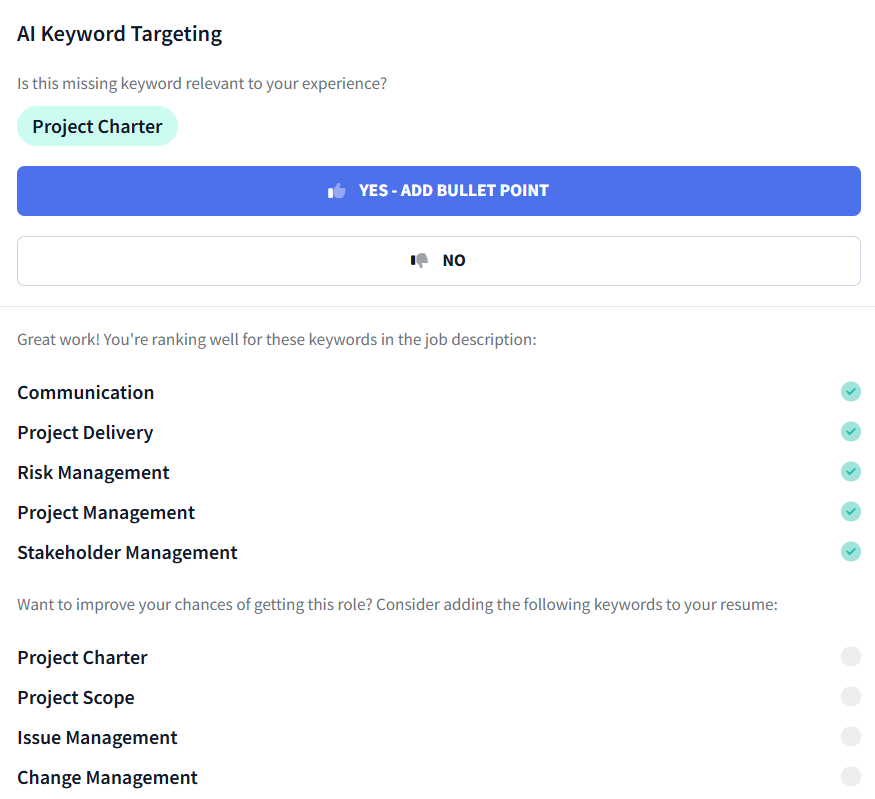
If you’re not sure which skills to take from the job description, use our AI Keyword Targeting tool. Paste the job post, and it’ll show you which keywords you’ve already used and which ones to add. It can even write bullet points for you including those keywords.
Check out the AI Keyword Targeting tool’s suggestions:
When formatting your skills section:
- Use bullet points and group similar skills into categories like “Technical Skills” or “Languages.”
- Add proficiency levels where useful, such as “Advanced Excel” or “Intermediate Python.”
- Only list skills you can back up with examples in your experience or education. For example, if you claim “project management,” point to where you’ve led a project successfully.
Keep it simple with commas or dividers (|), and skip progress bars because ATS can’t read them.
Here’s a sample skills section:
• Technical Skills: Microsoft Excel (Advanced), SQL (Intermediate), Tableau
• Languages: English (Native), French (Conversational)
• Interpersonal Skills: Team leadership, Client relationship management
Your work experience section is where you show how you used your skills. Try to work each key skill into your bullets at least once, with real examples that bring them to life.
Here’s a sample work experience section:
Customer Support Specialist | Red Panda Inc. | London | August 2024–February 2025
- Delivered excellent customer service by resolving 40+ support tickets daily with a 95% satisfaction rating.
- Applied strong communication and problem-solving skills to de-escalate client issues and retain key accounts.
- Partnered with product and engineering teams, showing teamwork and stakeholder engagement, and flagged recurring bugs that reduced complaints by 20%.
- Balanced a heavy workload through strong time management, consistently meeting daily response targets.
And if you don’t have much formal experience, don’t stress. You can still showcase skills through volunteering, education, or projects.
Here’s an example from volunteering work experience:
Volunteer Event Coordinator | Community Food Bank | London | February 2023–August 2025
- Guided a team of 15 volunteers, demonstrating leadership and collaboration to run weekly food drives.
- Improved process efficiency by creating a digital sign-up system, cutting registration time by 30%.
- Built strong client relationships with local families, ensuring support was delivered with care and respect.
If you’re still unsure what to include, our AI Skills Explorer can help. Choose a category, add one skill you have, and it’ll suggest related skills you might want to add.
Here’s what the AI Skills Explorer recommended:

7. Add extra sections
If you’re new to the job market or switching careers, extra resume sections can help showcase your skills and experiences beyond traditional jobs.
- Volunteer experience. Helping to organise a local charity fundraiser, supporting a community garden project, or volunteering at a food bank or homeless shelter shows responsibility and teamwork.
- Hobbies and interests. Include activities that demonstrate useful skills, like amateur photography, playing football for a local team, DIY crafts, or coding side projects.
- Extracurricular activities. Things like being part of your university’s debating society, organising events for a youth club, or leading a local book club highlight leadership and initiative.
- Languages. List any languages you speak and your proficiency level, whether it’s fluent Spanish, conversational French, or beginner-level Mandarin.
- Awards and honours. Have you won “Volunteer of the Year” at your local community centre? Or received a health and safety award during a summer job?
- Resume projects. Maybe you’ve created a photography portfolio, launched a small Etsy shop, or built a website for a school project. These illustrate creativity and self-motivation.
Best Skills for a CV
We’ve gathered the top skills appearing on Rezi CVs in 2025 so far. With over 3.3 million users and a 62% interview rate, these skills are definitely worth highlighting — especially if they align with the skills listed in your target job’s description.
- Project management
- Data analysis
- Communication
- Customer service
- Collaboration
- Team leadership
- Inventory management
- Problem solving
- Strategic planning
- Process improvement
- Time management
- Team management
- Team collaboration
- Budget management
- Training and development
- Troubleshooting
- Stakeholder engagement
- Attention to detail
- Client relationship management
- Negotiation
1. Project management
- “Led a cross-functional team of 12 to deliver a product launch three weeks ahead of schedule.”
- “Oversaw multiple client projects worth over $2M annually, ensuring on-time and on-budget delivery.”
- “Used agile project management methods to coordinate workflows between design, engineering, and QA.”
2. Data analysis
- “Analysed customer behaviour data to identify trends, leading to a 15% increase in retention.”
- “Conducted weekly data analysis in Excel and Power BI, creating dashboards to track KPIs across five regions.”
- “Applied data analysis to A/B testing results, reducing marketing spend by 20% while improving conversions.”
3. Communication
- “Demonstrated strong communication skills by presenting complex technical updates in clear, actionable terms for non-technical stakeholders.”
- “Applied written communication skills to craft client proposals that secured $500K+ in new business.”
- “Used verbal communication to mentor and train five new team members, ensuring smooth onboarding.”
4. Customer service
- “Delivered excellent customer service by resolving 30+ client issues daily while maintaining a 95% satisfaction rating.”
- “Provided personalised customer service support that increased repeat business by 20%.”
- “Assisted customers with billing and technical questions, showing strong customer service and communication skills.”
5. Collaboration
- “Demonstrated strong collaboration by working with cross-functional teams to launch three new marketing campaigns.”
- “Partnered with engineering and product teams, showcasing effective collaboration to meet tight deadlines.”
- “Worked closely with peers to share knowledge and improve team performance, highlighting strong collaborative skills.”
6. Team leadership
- “Exercised team leadership by supervising 10 employees and improving productivity by 18%.”
- “Provided day-to-day leadership in a fast-paced restaurant, ensuring smooth service and staff coordination.”
- “Trained and coached 12 new hires, showing strong leadership and mentoring skills.”
7. Inventory management
- “Applied inventory management processes to reduce stock shortages by 25%.”
- “Oversaw daily inventory management of 5,000+ SKUs, maintaining accuracy above 98%.”
- “Used Excel and ERP software for efficient stock control and inventory tracking.”
8. Problem-solving
- “Applied strong problem-solving skills to resolve technical issues that reduced system downtime by 30%.”
- “Handled customer complaints with effective problem-solving, improving satisfaction ratings.”
- “Identified workflow inefficiencies and suggested fixes, showing proactive problem-solving abilities.”
9. Strategic planning
- “Led strategic planning initiatives that aligned company goals with new market opportunities.”
- “Conducted research and contributed to strategic planning sessions, helping shape annual budgets.”
- “Developed long-term growth strategies, showing strong strategic and analytical thinking.”
10. Process improvement
- “Implemented process improvement initiatives that cut order processing time by 20%.”
- “Identified bottlenecks in workflows and suggested changes, showing strong problem-solving and process improvement skills.”
- “Used Lean Six Sigma methods to support process improvement projects across multiple departments.”
11. Time management
- “Demonstrated excellent time management by juggling multiple client projects and consistently meeting deadlines.”
- “Prioritised competing tasks effectively, showing strong time management skills in a fast-paced environment.”
- “Used digital tools like Trello and Asana to support efficient scheduling and time management.”
12. Team management
- “Applied strong team management skills to oversee 15 staff members, improving productivity by 10%.”
- “Managed scheduling, training, and performance reviews as part of day-to-day team management responsibilities.”
- “Supported team management by mentoring junior staff and encouraging collaboration across departments.”
13. Team collaboration
- “Demonstrated strong team collaboration during cross-departmental projects, ensuring smooth delivery of outcomes.”
- “Partnered with designers and developers, showing effective team collaboration to launch new product features.”
- “Contributed ideas in weekly meetings, highlighting proactive collaborative skills within the team.”
14. Budget management
- “Applied budget management to control costs on projects worth $1M+, keeping spend within 5% of forecasts.”
- “Reduced expenses by 12% through careful budget management and vendor negotiations.”
- “Assisted with quarterly forecasting, showcasing strong financial acumen and budget management skills.”
15. Training and development
- “Designed and delivered training and development sessions that improved employee performance scores by 15%.”
- “Mentored junior staff, providing ongoing training and professional development opportunities.”
- “Created onboarding programs to support training and development for new hires, reducing turnover.”
16. Troubleshooting
- “Applied strong troubleshooting skills to resolve 95% of technical support tickets on first contact.”
- “Diagnosed and repaired hardware issues, showing effective technical troubleshooting in a fast-paced environment.”
- “Supported clients with software errors, highlighting proactive problem-solving and troubleshooting abilities.”
17. Stakeholder engagement
- “Led stakeholder engagement sessions to align business requirements with IT project goals.”
- “Built strong relationships with clients and internal teams through effective stakeholder engagement.”
- “Facilitated workshops with diverse stakeholders, showing excellent communication and engagement skills.”
18. Attention to detail
- “Demonstrated strong attention to detail by reviewing contracts with 100% accuracy.”
- “Ensured quality control in manufacturing processes, highlighting excellent detail-oriented work.”
- “Conducted data entry with a focus on accuracy and attention to detail, reducing errors by 25%.”
19. Client relationship management
- “Strengthened client relationship management by maintaining regular contact with 20+ key accounts.”
- “Applied strong relationship management skills to increase client retention by 15%.”
- “Partnered with clients to identify new opportunities, demonstrating proactive CRM abilities.”
20. Negotiation
- “Used strong negotiation skills to secure vendor contracts that cut costs by 12%.”
- “Applied effective negotiation techniques in sales, increasing revenue by $500K annually.”
- “Mediated team conflicts, showing excellent negotiation and conflict resolution abilities.”
Hard Skills vs. Soft Skills
Employers want both — hard skills prove you can do the job, soft skills show how you do it.
Hard skills are specific, teachable, and measurable. You pick them up through training, school, or experience. For example, bookkeeping, curriculum design, or forklift driving. Technical skills like coding or robotics fall under this, but not all hard skills are technical, like foreign languages, public speaking, and copywriting.
Soft skills are personal qualities that shape how you work with others. They’re harder to measure but just as important; communication, problem-solving, leadership, time management, and teamwork all fall here.
Both matter, but hiring managers usually look at hard skills first. Put those front and centre in your skills section, then use your work experience to show off both hard and soft skills in action.
CV Tips for Different Jobs
Every job has its own CV language — the little details that make hiring managers think, “yes, this person gets it.” The overall structure of a good CV stays the same, but what you choose to emphasise can make a big difference.
Here’s how I’d write a CV for different roles:
- Administration job. Lead with organisational skills, the ability to manage multiple tasks, and proficiency with tools like Microsoft Office, spreadsheets, or scheduling software. Give examples where you kept things running smoothly under pressure.
- Waitress / Restaurant job. Focus on customer service skills, teamwork, and staying cool during busy shifts. Mention cash handling, upselling, or any training in food hygiene.
- Retail / Sales assistant job. Emphasise sales results, product knowledge, and customer service wins. If you’ve met or exceeded sales targets, include the numbers.
- Receptionist. Showcase your communication skills, professionalism, and experience with phone systems, booking software, or front-desk operations. Employers love to see that you can make a great first impression.
- Supermarket job. Point to skills in stocking, tills, teamwork, and meeting deadlines. If you’ve trained others or handled high-volume shifts, make sure it’s in there.
- Teaching job. Highlight your classroom management, subject expertise, and ability to create engaging lessons. Include measurable outcomes, like improved test scores or attendance rates.
- Cleaning job. Focus on attention to detail, reliability, and any specialist cleaning knowledge (like health & safety procedures or equipment use). If you’ve worked in sensitive environments, note your discretion and professionalism.
- Nursing job. Showcase clinical skills, patient care, and teamwork skills. Mention any specialisations, certifications, or examples where you went the extra mile for patients.
- Warehouse job. Highlight your ability to work quickly and accurately, operate machinery (like forklifts), and follow safety procedures. If you’ve improved efficiency in a past role, share how.
- Customer service job. Emphasise problem-solving, empathy, and handling difficult situations calmly. If you’ve achieved high customer satisfaction scores, add those stats.
If your role’s not on this list, check out our 300+ CV Examples for All Jobs.
Example CVs & UK Template
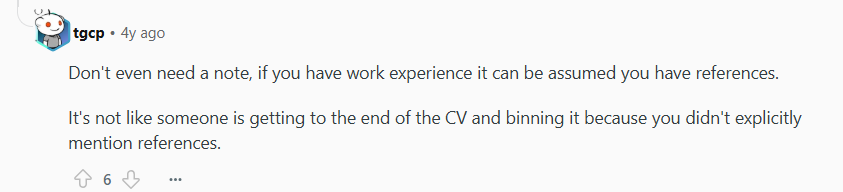
I’ve put together some ready-to-use examples you can take inspiration from, and an editable template you can use if you’ve decided you want to make your CV on Word or Google Docs. Remember to leave out a photo, your date of birth, and your full address, and don’t mention any references.
Take it from this Reddit user:
Reverse chronological CV
This is the most popular CV format, and one I’d advise you to adopt, regardless of your experience. It’s easy to scan and outlines your experience clearly with no distractions.

Skills-based CV
Put your detailed skills section before your work experience section to make them stand out, followed by a brief work history. Just keep in mind that most hiring managers expect work experience first, so this approach could be a disadvantage.

Graduate CV
Emphasise your projects, placements, and degree. Focus on how all this experience has prepared you for the role.

Student CV
In your student or internship CV, you need to customise your volunteering experience, part-time jobs, extracurriculars, and relevant coursework on your CV, so that it aligns with the role and puts you in the best light for the job.

Academic CV
An academic CV is more detailed than a standard CV, showcasing your full academic career. It should cover your research, teaching experience, awards, publications, conferences, and presentations, providing a comprehensive record of your contributions to your field.
Dr. Michael Carter
Department of Sociology
University of Edinburgh
Edinburgh, UK
Phone: +44 131 650 4321
Email: mcarter@ed.ac.uk
Website: www.michaelcartersociology.com
LinkedIn: linkedin.com/in/michaelcarterphd
Sociologist with over 12 years of academic experience specialising in social inequality, migration, and urban communities. Experienced in leading large-scale qualitative and quantitative studies, publishing extensively in peer-reviewed journals, and supervising PhD candidates. Seeking a senior lecturer position to contribute to cutting-edge research and dynamic teaching environments.
Education
Ph.D. in Sociology
London School of Economics and Political Science | London | 2017
• Dissertation: “Social Networks and Migrant Integration in Urban Britain”
• Advisor: Prof. Helen Saunders
• Committee: Prof. James Mitchell, Dr. Laura Chen, Prof. David Bailey
M.Sc. in Social Research Methods
University of Manchester | Manchester | 2013
• Thesis: “Quantitative Approaches to Measuring Urban Social Capital”
B.A. (Hons) Sociology
University of Glasgow | Glasgow | 2011
• Graduated with First Class Honours
Research Experience
Senior Research Fellow
University of Edinburgh, Department of Sociology | Edinburgh | 2021–Present
• Lead interdisciplinary research projects on urban inequality and migrant communities across the UK.
• Manage a team of 8 researchers in the “Urban Integration and Social Capital” project funded by the Economic and Social Research Council (ESRC), securing £1.8 million in grants.
• Published 15+ articles in journals such as Social Science & Medicine and Urban Studies.
• Organise community workshops to share research findings and inform local policy.
Postdoctoral Researcher
University College London, Institute of Social Research | London | 2017–2021
• Investigated the impact of migration policies on social cohesion in metropolitan areas.
• Developed mixed-method research protocols combining surveys, interviews, and social network analysis.
• Presented findings at major international conferences, including the International Sociological Association Congress.
Teaching Experience
Lecturer
University of Edinburgh, Department of Sociology | Edinburgh | 2021–Present
• Design and deliver undergraduate and postgraduate courses on Migration Studies, Social Theory, and Research Methods.
• Supervise 12 PhD students, many of whom have published in top-tier journals.
• Introduce blended learning techniques and case-study workshops to increase student engagement.
Teaching Assistant
London School of Economics and Political Science, Department of Sociology | London | 2014–2017
• Assisted in courses on Quantitative Methods and Urban Sociology.
• Led tutorial sessions, graded assignments, and provided tailored academic support.
Awards, Honours, and Grants
• ESRC Research Grant, £1.8 million — Lead Investigator, 2021
• Early Career Researcher Award — British Sociological Association, 2019
• Outstanding Teaching Award — University of Edinburgh, 2022
• University of Glasgow Academic Excellence Scholarship, 2011
Publications
Peer-Reviewed Articles
• Carter, M., Saunders, H. (2023). “Networks of Support: Migrant Integration in Scottish Cities.” Social Science & Medicine, 320, 115635.
• Carter, M. (2021). “Urban Inequality and Social Capital: Evidence from London.” Urban Studies, 58(12), 2567–2585.
• Carter, M., Mitchell, J. (2019). “Migration Policies and Social Cohesion: A UK Perspective.” Journal of Ethnic and Migration Studies, 45(7), 1201–1219.
• Carter, M. (2017). “Quantitative Approaches to Measuring Social Capital.” Sociological Research Online, 22(3), 45–61.
Book Chapters
• Carter, M. (2022). “Migration and Urban Change.” In J. Brown (Ed.), Contemporary Urban Sociology (pp. 89–110). Routledge.
Conferences and Presentations
Invited Talks
• “Social Networks and Migrant Communities,” University of Oxford, Centre for Migration Studies, March 2024.
• “Urban Inequality in the UK,” British Sociological Association Annual Conference, Manchester, September 2022.
Oral Presentations
• “Measuring Social Capital in Diverse Urban Areas,” International Sociological Association Congress, Melbourne, July 2023.
Poster Presentations
• “Policy Impacts on Migrant Integration,” ESRC Festival of Social Science, Edinburgh, November 2019.
Professional Affiliations
• Member, British Sociological Association (BSA)
• Member, International Sociological Association (ISA)
• Member, Urban Affairs Association (UAA)
References
Prof. Helen Saunders
Professor of Sociology
London School of Economics and Political Science
Houghton Street, London, WC2A 2AE, UK
Phone: +44 20 7955 1234
Email: h.saunders@lse.ac.uk
Prof. David Bailey
Professor of Urban Studies
University of Edinburgh
Old Medical School, Teviot Place, Edinburgh, EH8 9AG, UK
Phone: +44 131 650 5678
Email: david.bailey@ed.ac.uk
Customisable CV template
This CV template is ready for you to copy and paste into Word or Google Docs. It’s fully customisable, and the bracketed notes will guide you step-by-step on what to include and how to tailor it for your own experience.
[Your Full Name]
[Phone number] | [Email] | [Location] | [LinkedIn] | [Portfolio/Website]
Summary
[Write 2–3 sentences summarising who you are professionally, your key skills, and what you’re aiming for. Tailor it to the job.]
Experience
Job Title | Company Name | Month Year–Month Year | Location
• [Start each bullet with a strong action verb describing your achievements or responsibilities.]
• [Focus on results where possible and include figures, percentages, or timeframes.]
• [Keep it concise, 3–8 bullet points per role.]
Job Title | Company Name | Month Year–Month Year | Location
• [Start each bullet with a strong action verb describing your achievements or responsibilities.]
• [Focus on results where possible and include figures, percentages, or timeframes.]
• [Keep it concise, 3–8 bullet points per role.]
Job Title | Company Name | Month Year–Month Year | Location
• [Start each bullet with a strong action verb describing your achievements or responsibilities.]
• [Focus on results where possible and include figures, percentages, or timeframes.]
• [Keep it concise, 3–8 bullet points per role.]
Education
Qualification | Institution Name | Graduation Year
• [Add any relevant modules, awards, or dissertation title if you’re early career or it relates to the job.]
Certifications
[Qualification Name] | [Issuing organisation] | [Year]
Skills
• [Group related skills in categories, e.g., Technical Skills, Software, Languages.]
• [Focus on skills mentioned in the job description.]
• [Only list skills you can confidently demonstrate or back up.]
Summary
Here’s a recap on how to write a CV for a job:
- Your CV should be tailored to the job, factual, and easy to read, ideally one or two pages.
- Use an ATS-friendly template that’s single-column, with standard fonts, clear headings, and minimal graphics.
- Place contact details at the top, including your name, phone, professional email, location, and relevant links.
- Write a 2–3 sentence CV summary highlighting relevant skills, measurable accomplishments, and keywords from the job description.
- List work experience in reverse-chronological order, using achievement-focused bullet points and the STAR method.
- Put your highest qualifications in your education section. If you’re a recent graduate, also list relevant coursework, projects, and any awards.
- Match your skills to the job, group them by category, and include only what you can prove.
- Add optional sections (e.g., volunteering, hobbies, extracurricular activities, languages, awards, projects) to showcase extra value.
- Tailor your CV to the role by emphasising the most relevant skills and results for that industry or position.
FAQ
How to write a CV for a job with no experience?
Make the most of what you do have, like volunteering, internships, projects, or part-time jobs. Highlight transferable skills like communication, teamwork, and organisation. Follow a standard CV layout, but emphasise your education and skills. Tailor every section to the job so employers see you’re a great fit, even without a long work history.
What should a CV look like in the UK?
A UK CV is usually one or two pages (one for students or early-career applicants, two for experienced professionals). Use clear headings, like Profile, Work Experience, Education, and Skills. Avoid photos, bright colours, or fancy fonts — stick to something like Arial or Calibri with one-inch margins.
What makes a CV for the UK different from other European CVs?
UK CVs have distinct differences and similarities compared to those in other European countries. Photos are commonly included in CVs for countries like Switzerland, Italy, Austria, Germany, Belgium, and Spain, but are not expected in the UK.
A UK CV typically prioritizes your work experience, listing roles in reverse chronological order, followed by your education and skills. However, some countries like France or Germany may emphasize education first. Additionally, UK CVs frequently feature a concise profile or summary at the top, while in some European formats, a simple job title is preferred.
What is a Europass CV?
A Europass CV is a standardized CV format used across Europe to make job applications consistent and easy to understand. It’s free to create online and follows a structured template, including sections for personal information, work experience, education, skills, and languages.
This type of CV is particularly handy if you’re applying for roles in multiple European countries, as it aligns with EU hiring practices. However, it can feel rigid or generic, and many could consider it outdated compared to more modern CVs.
How long should a CV be?
In the UK, most CVs are two pages max. If you’re just starting out, one page is fine. Focus on quality over quantity, as every word should earn its place. Cut out outdated or irrelevant details so your most relevant skills, achievements, and experience stand out.
Do you put your address on a CV?
No need for your full address — just your city or town and county will do. If applying abroad, add your country. Employers mainly want to know if you’re within commuting distance or already based in the country, not your exact street.
How many skills to put on a CV?
Aim for 6–10 skills that closely match the job description. Group them into categories like “Technical Skills” or “Languages” so they’re easy to read.
How to write a cover letter for a job?
Open with a short introduction explaining why you’re excited about the role and the company. In the next paragraph or two, link your skills and achievements directly to what they’re looking for and use concrete examples to prove it. End with a confident closing line that shows enthusiasm and invites a response. Keep it under one page, and make it feel like it was written just for them.
Learn more about how to write your cover letter or try out our AI Cover Letter Builder.
How to write a CV for a job application as a student?
Spotlight your education, key skills, and achievements. Highlight coursework, projects, or extracurriculars that show relevant abilities, like leading a student society or completing research. Include part-time jobs, volunteering, or internships, even if they’re in a different field, to show responsibility and transferable skills. Keep it short, relevant, and focused on what you can bring to the role.
Should I send my CV as a PDF or Word document?
The safest bet for most situations is to save your CV as a PDF file. PDFs lock in your formatting, so your CV will look the same no matter what device or software the recruiter uses to open it. This is especially important if you’ve spent time perfecting the layout and design.
That said, if the job ad specifically asks for a Word document, make sure to provide one. Many big companies use Applicant Tracking Systems (ATS), and Word files tend to play nicer with these systems. Plus, some recruiters prefer an editable file to tweak or anonymize your contact details before passing it on to employers.
My advice? Create your CV in Word first, then export it as a PDF. This way, you’ll have both formats ready to go, and you can choose the best option depending on the situation.
What are 5 hard skills and soft skills for a resume?
Five hard skills are data analysis, programming, cybersecurity, project management, and languages. They’re measurable and teachable. Soft skills are more about your personality and how you work with others, like leadership, teamwork, communication, problem-solving, and adaptability.
What skills to put on a CV for retail?
Retail jobs value both customer-facing and behind-the-scenes skills. Some strong ones to include are customer service, communication, teamwork, cash handling, sales, inventory management, and problem-solving. If you’ve had experience with point-of-sale systems, that’s worth adding too.

Upload or drop your resume to get started
Upload your resume to get started
Score my resume

Sarah Coghlan is a writer and editor passionate about making resume and career advice clear and accessible to all. Based in Barcelona, her goal is to help job seekers create standout resumes and navigate the job search process with confidence and ease.