Resume
How to Use Rezi for Creative Job Applications
Learn how to use Rezi for creative job applications to create standout resumes, highlight future-proof skills, and prepare for interviews.

Published on
November 26, 2025
Updated on
March 16, 2026
The creative job market is evolving with AI, automation, and new digital tools reshaping the field and which skills employers value. Employers now expect creatives to combine data, personalization, and expertise with design, talent, and storytelling. AI-generated content is everywhere, so those who can blend human creativity with technology have a strong edge. Rezi can help job seekers with tools like AI Job Search to find relevant roles, AI Skills Explorer to uncover in-demand abilities, and AI Keyword Targeting to ensure your resume matches each role.
Creative job seekers are feeling the pressure right now. Brands are rolling out AI-generated logos, ChatGPT is churning out articles in seconds, and design tools can draft concepts before your coffee even cools. It’s easy to question what exactly you’re competing with.
But the competition isn’t necessarily with technology. The challenge is learning how to work alongside it. Today’s creative roles still value storytelling, originality, and taste. But employers also want to see that you can adapt, learn new tools, and use technology to amplify your ideas rather than replace them.
And that’s what you have to prove in your job application. If you understand the pressures in the market, you can shape your resume, portfolio, and overall pitch to show that you’re keeping up and ready to thrive.
In this guide, we’ll talk through:
- The reality of today’s creative job market.
- All the obstacles and trends shaping the creative industry.
- How to use Rezi to prove your worth in this evolving space.
If you’re ready to find your next creative job, check out Rezi’s free AI Resume Builder. Our technology can generate a personalized resume for any industry in minutes.
And take a look at these creative resume examples for inspiration:
- Creative Director Resumes
- Copywriter Resume Examples
- Creative Resume Templates and Examples
- Freelance Graphic Designer Resume Examples
How Creative Professionals Are Adapting to Stay Competitive
AI tools are raising questions about the value of human creativity. At the same time, employers expect candidates to blend artistry with technology while creating personalized content. This is the landscape creative job seekers are stepping into.
Let’s break down these challenges: AI disruption, the need for tech skills, the push for personalization, and copyright concerns — and explore what creatives can do to stay ahead.
Threat of AI
If you’d asked me five years ago which careers AI might disrupt, creative roles would be at the bottom of my list. But here we are. There’s a growing tension between human-made work and AI-generated content, and many creators are feeling the heat.
AI tools like Midjourney, DALL·E, and Figma can whip up entire design concepts or user flows in seconds. That kind of speed naturally sparks fear that the “human touch” is losing its edge. The Future of Jobs Report specifically lists graphic designers among the fastest-declining roles, citing AI and increased digital access.
And creators themselves are noticing the pressure. In a survey by the Society of Authors,
- 57% said they don’t think their creative field is a sustainable career,
- 72% feel generative AI has hurt their opportunities,
- But interestingly, 75% still believe AI can’t truly replace human creativity.
It’s a mixed bag: concern, frustration, but also a stubborn belief in the value of human imagination. The challenge moving forward will be finding a balance, using AI where it helps, while keeping human originality at the center.
Check out the most popular AI skills to stand out in your job search: AI Skills for Your Resume
Blending creativity and technology
AI and technology is becoming part of the creative job description.
Tech skills used to be a “nice-to-have,” but now they’re becoming a fixture of modern creative roles. AI is everywhere, from idea generation to automating tedious tasks. But instead of eliminating creatives, it can push them into higher-level thinking: strategy, direction, and storytelling.
People who succeed in this era tend to do a few things really well:
- Use AI as a brainstorming partner
- Let it handle the repetitive stuff
- Focus their energy on concept, emotion, and originality
- Understand enough about AI to guide it rather than fear it
But (and this is important) AI isn’t like learning a new Photoshop feature. It’s changing how creative work gets made at a fundamental level. So job seekers can’t treat it as a casual add-on. It requires ongoing learning, curiosity, and a willingness to evolve.
Push for personalization
Nowadays, the world wants everything personalized. Consumers expect brands to know their preferences, habits, tastes, and even what mood they’re in. That means creatives are expected to produce content that’s not just pretty, but also deeply tailored.
A CMO Alliance survey on creative personalization found that:
- Personalized ads drive higher engagement and conversions.
- 79% of marketers now include creative optimization in their media budgets.
- But 73% say there’s still a gap between brand messaging and real customer experience.
And the demand keeps rising. More content, more variations, more platforms, more complexity. A fitness app might personalize workout videos based on your past activity. Netflix can serve specific recommendations shaped by your obsession with true crime documentaries. Travel sites now customize ads using your browsing history and even seasonal behavior.
Creative job seekers must prove they have the ability to blend data-driven expectations of personalization with the human spark that makes creative work memorable.
The copyright gray zone
This one has arguments on both sides, but here’s the general gist: many AI systems are trained on copyrighted images scraped from the internet — without artists’ consent.
In a BBC interview, digital artist Greg Rutkowski claimed his name had been used in AI prompts over 400,000 times. Artist Kelly McKernan also told the New Yorker that they found their name appearing in more than 12,000 prompts. Platforms like Midjourney and Stable Diffusion learn by analyzing billions of images, many of which belong to real artists.
That raises thorny questions:
- Who owns the rights?
- The person who wrote the prompt?
- The artist whose style was mimicked?
- The company that built the model?
Some argue that AI is just finding inspiration, like any human artist would. Others see it as exploitation. Either way, for job seekers, it adds uncertainty about how their work may be used, copied, or devalued.
How to Use Rezi to Get Job Offers for Creative Roles
Here’s a quick overview of how to use Rezi to get a creative job:
- Find creative roles using AI Job Search by letting Rezi pull real, up-to-date listings.
- Stay professional with an ATS-friendly template by using Rezi’s minimal designs that highlight your experience with subtle creative flair.
- Emphasize your technical and creative abilities with AI Skills Explorer by identifying the right blend of creative, software, and production skills.
- Use AI Keyword Targeting to speak to the employer’s needs by aligning your resume’s language with the exact tools, responsibilities, and terms hiring managers want.
- Connect creative and technical skills using AI Bullet Point Writer by generating impactful statements that show how you merge artistry, technology, and results.
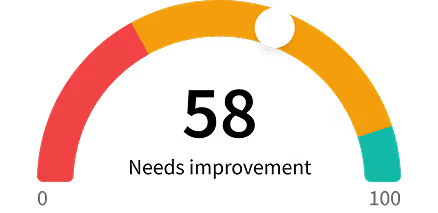
- Check your Rezi Score to strengthen your creative resume by getting instant, data-backed feedback.
- Go beyond your resume with AI Interview by practicing real creative interview questions and refining how you speak about your process.
Let’s explore Rezi’s features in more detail and how they can help your job search.
1. Find creative job openings using Rezi Job Search
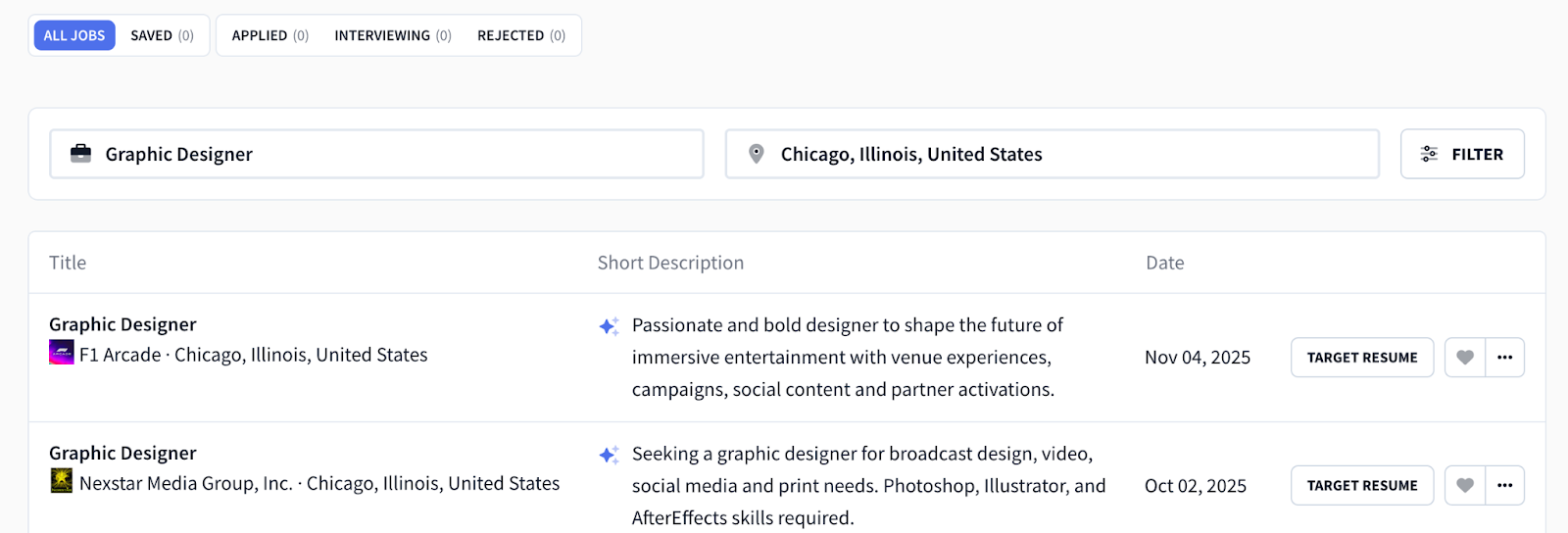
Rezi’s Job Search pulls updated and fresh listings directly from company websites. Instead of getting swamped with fake job ads, you can spot industry trends, see which skills employers want, and identify companies whose style matches your own. This is especially helpful in a field where competition is high and expectations shift quickly with new tech and design trends.
- Search for creative roles that match your preferences, location, and specialty (e.g., product design, branding, motion design).
- Use our AI-generated summaries to get a solid understanding of the position without clicking into every job ad.
- Click ‘Target Resume’ to tailor your existing resume to any job description.
- Keep on top of your applications by saving them or sorting them into these statuses: Applied, Interviewing, or Rejected.
Want to expand your job search? Take a look: Best Job Search Engines
2. Keep your creative resume professional by using an ATS-friendly template
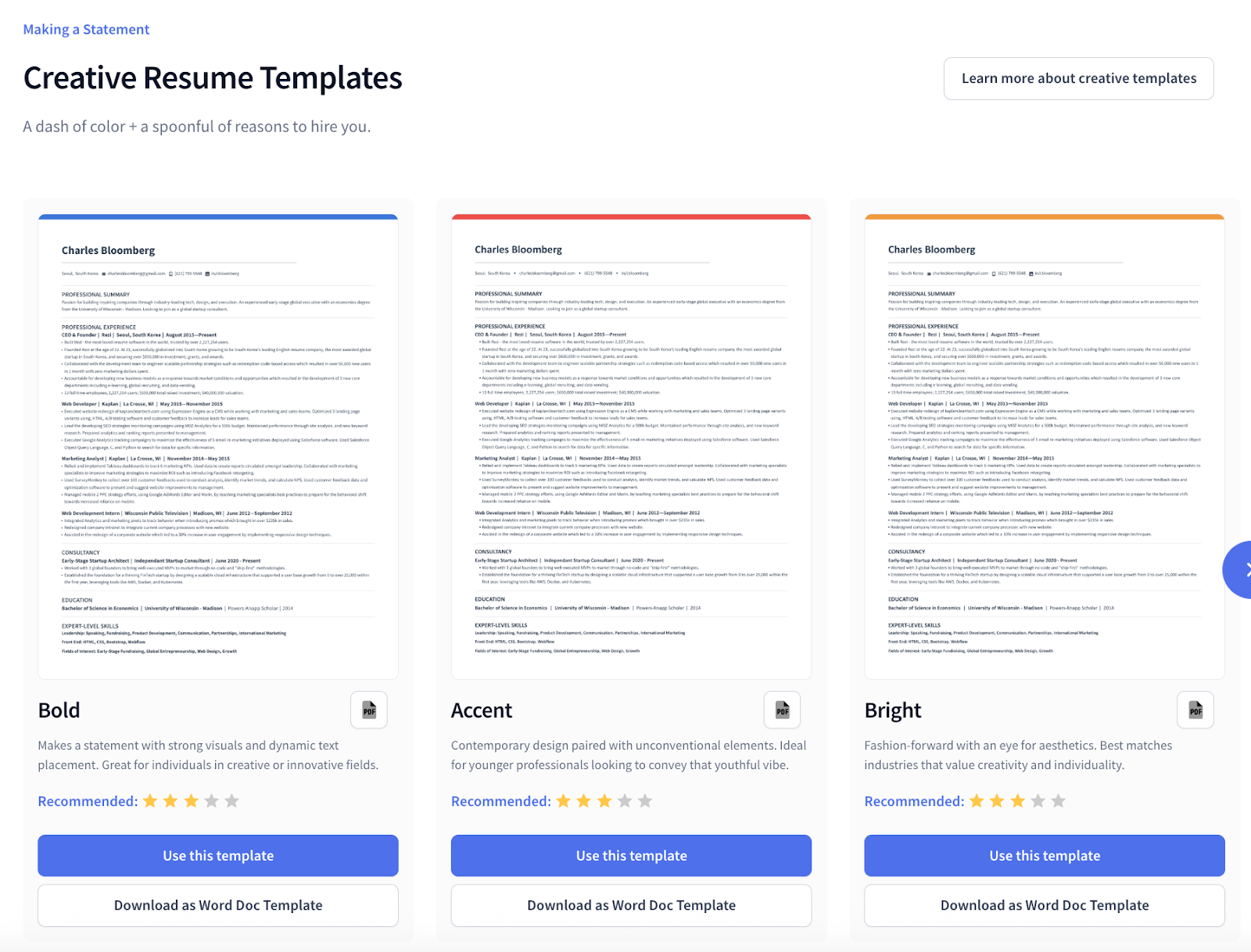
In creative fields, it’s tempting to treat your resume like a mini-portfolio, but that’s what your actual portfolio is for. Rezi’s ATS-friendly templates keep things scannable and recruiter-ready while still giving you room for subtle personality. You get a professional document that stands out for the right reasons, not because a parser can’t read it.
Luke, a visual designer, shared how he used Rezi’s resume templates to focus on content over design:
Here are my tips for using Rezi’s resume templates as a creative professional:
- Choose a Rezi template with a subtle color accent (like Bold or Modern) to reflect your creative style without overwhelming the ATS.
- Pick a suitable resume font, but with a bit more character than default system fonts. Creative yet professional options include Avenir Next, Lato, and Didot.
- Keep your design elements minimal: one pop of color, consistent spacing, and clear section headers.
- Leave the visuals to your portfolio; keep the resume focused on clarity, skills, and impact.
Learn more about choosing a resume template: How to Pick the Right Resume Template
3. Emphasize your technical and creative abilities with AI Skills Explorer
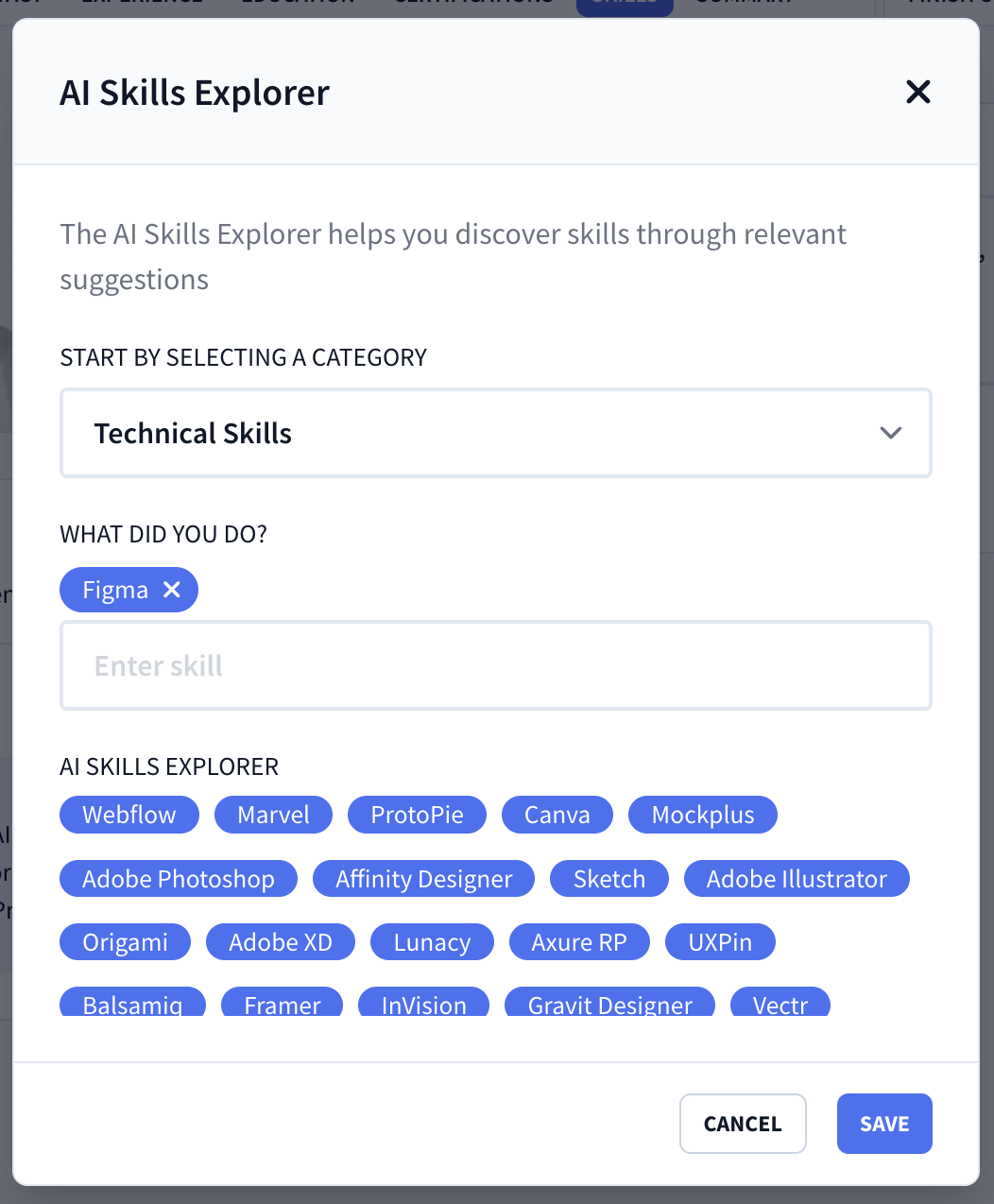
Creative roles now demand strong tech skills. Rezi’s AI Skills Explorer helps you identify the right mix of creative and technical skills, so your resume reflects what the modern industry expects. It ensures you highlight not just your ideas, but your ability to bring them to life with real tools, platforms, and technologies.
- Enter specific creative skills or tasks (e.g., “designed website UI,” “edited brand campaign videos”) to get tailored skill suggestions.
- Choose from the following categories to build a balanced range of abilities: hard skills, soft skills, technical skills, and languages.
- Add the tools that match the creative job description, such as Adobe Creative Suite, Figma, Blender, Logic Pro, etc.
- Avoid skill charts or icons; stick to Rezi’s simple bullet list to stay recruiter- and ATS-friendly.
Check out more popular resume skills: Skills Section for a Resume
4. Use a resume keyword scanner to speak to the employer’s needs
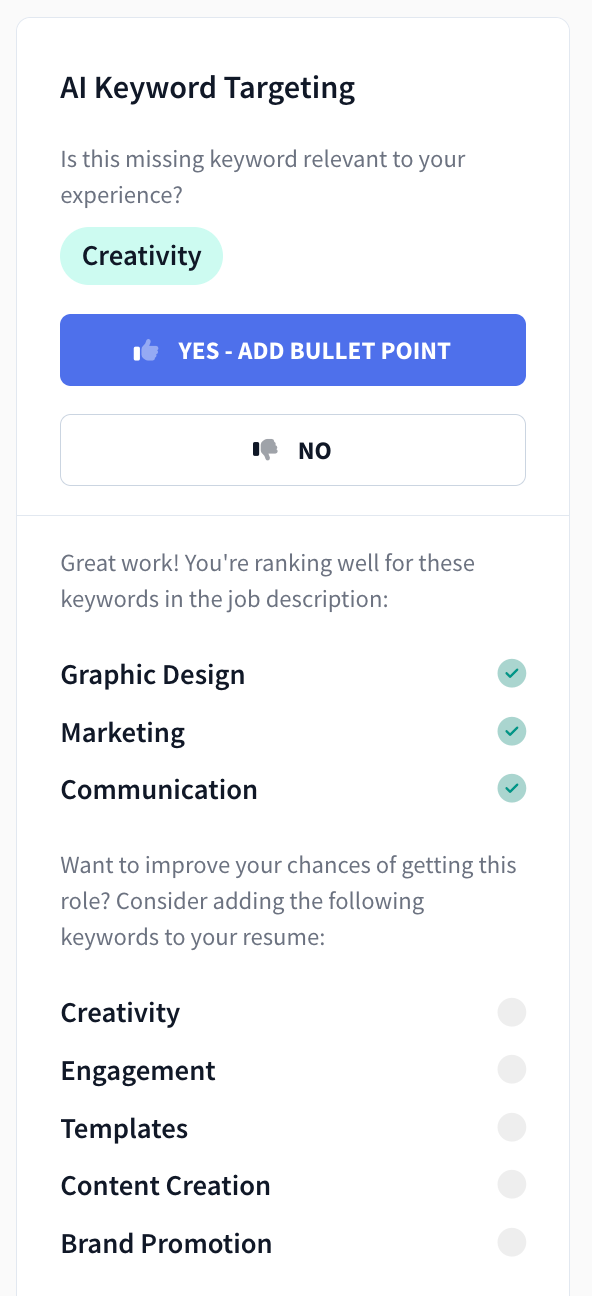
Even with all the creative and technical chops, it won’t matter if your skills don’t match what the employer wants. Rezi’s AI Keyword Targeting helps in identifying exactly which words your resume needs to match a job post. It helps align your resume with both ATS filters and human expectations, especially when mass-applying (because who has the time to do it all manually?)
Rahul, a product designer, told us how useful this tool was in aligning his resume with the job description:
Here’s how the AI Keyword Targeting tool helps you improve your creative resume:
- Paste a job description into Rezi and review the missing keywords tied to tools, responsibilities, or styles.
- Add keywords naturally into your bullet points, summary, or skills section.
- Use “Add Bullet Point” to generate tailored lines that include missing terms.
- Adjust your resume tone (corporate, creative, minimal, etc.) to fit each company’s brand.
Learn more about tailoring your job application: How to Use AI to Tailor a Resume
5. Connect creative and technical skills using AI Bullet Point Writer
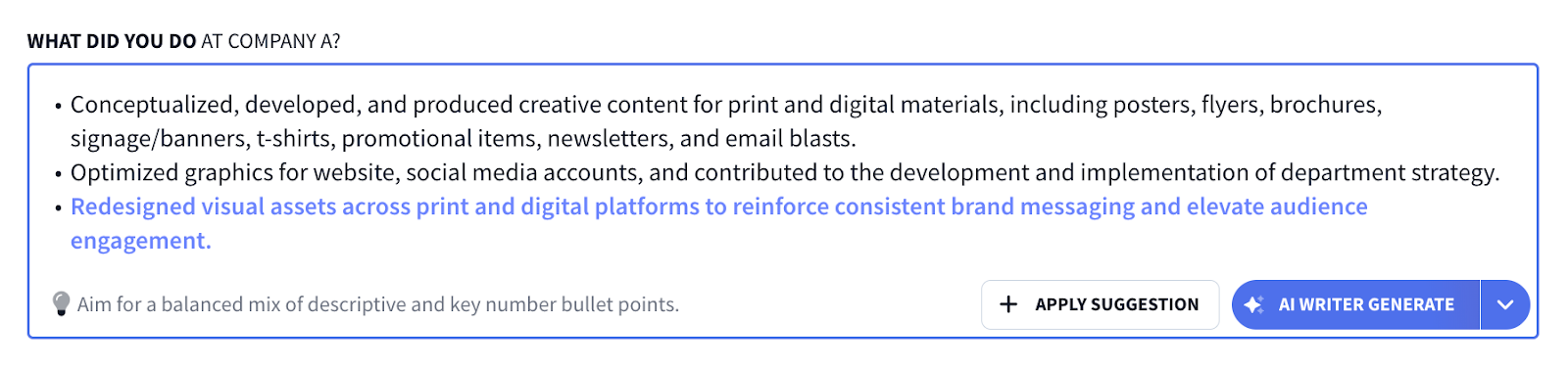
Modern creative roles favor candidates who can blend artistry with tech; storytelling with software, and design with data. Rezi’s AI Bullet Point Writer helps you express that hybrid skill set in your work history. It turns your experiences into industry-ready statements that show how you use technology alongside your creative work.
Here’s a summary of how to use the AI Bullet Point Writer for showcasing creative work experience:
- Enter each project or role and let Rezi generate creative-specific resume bullet points showcasing tools, processes, and impact.
- Choose quantified bullet points when relevant (e.g., “boosted engagement by 30% through redesigned visuals”).
- Highlight cross-discipline work and review each bullet for authenticity and voice so it still sounds like you.
6. Check your Rezi Score to strengthen your creative resume
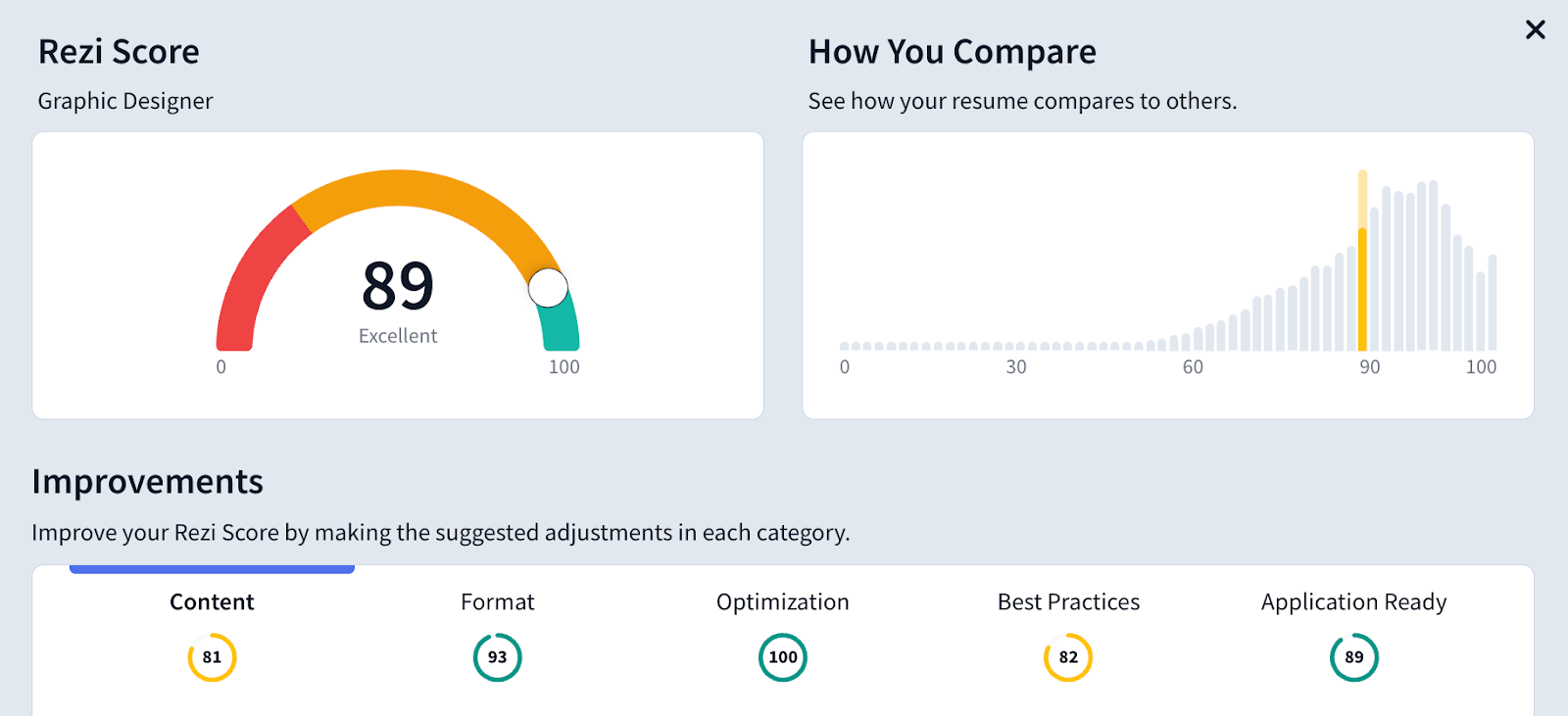
It’s hard to know whether your resume says “creative professional” or “too creative for ATS.” Rezi Score solves that by giving instant feedback on formatting, keywords, clarity, and content strength. Entry-level creatives can get guidance on bullet count and structure, while seasoned professionals could get suggestions for improving impact and focus.
Here’s how to check the score of your creative resume:
- Edit your resume and watch the Real-Time Analysis feature update so you know exactly what to fix.
- Review suggestions on formatting to keep things professional without losing personality.
- Use the score as a final quality check before submitting applications.
7. Practice for creative job interviews with an AI Interview tool
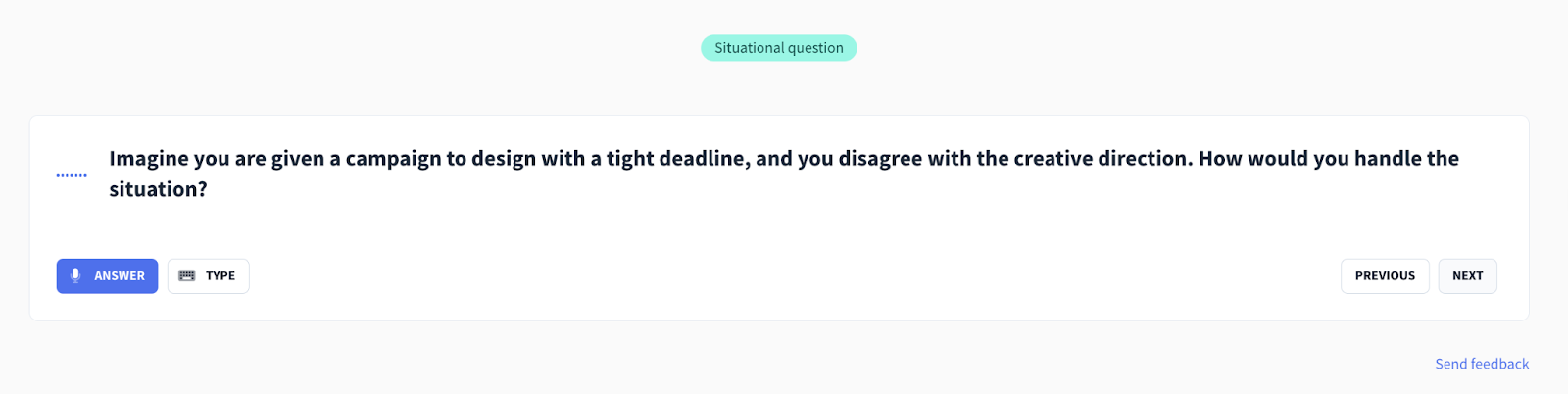
Creative job interviews give you the chance to explain the thought and methods behind your work. Rezi’s AI Interview tool helps you practice explaining projects, discussing software choices, and presenting your creative process in a confident way. You get specific questions and feedback so you’re prepared for both portfolio walk-throughs and behavioral questions.
This is how it works:
- Upload your resume to get interview questions tailored to your experience and creative specialty.
- Practice explaining your favorite projects, such as why you made certain choices, what tech you used, and what problem you solved.
- Use voice mode to rehearse your tone, pacing, and storytelling style.
- Review feedback to refine your delivery and boost your confidence before the real interview.
Check out more interview tips, examples, and practice questions:
- STAR Method Interview Guide
- Phone Interview Questions to Prepare For
- Unique Interview Questions to Ask Employers
- Common Interview Questions & Good Sample Answers
Is the Creative Job Market Changing?
Technology has always had its place in the creative world, but now it’s starting to define it.
Every year, tools for design, filmmaking, and digital content get more powerful and accessible. What used to take a full production team can now be done by a single determined person with the right software. Being “creative” now means being comfortable with new tech, automation tools, and platforms. And if you can’t keep up, technology will do the job for you.
Hiring trends are reflecting these shifts. The Demand for Skilled Talent report points out that marketing and creative teams are doubling down on roles that support things like:
- Marketing automation
- Web and mobile app development
- SEO and paid search
- Content marketing
- Customer experience
That brings us to generative AI. Creative industries like advertising, publishing, and design are already experimenting. And the appeal is obvious: AI takes care of repetitive tasks, builds customized content at scale, sparks new ideas, and reacts to trends in real time. You basically have an endlessly energetic intern who never gets tired.
But we may be heading into a world where AI-generated content will blend so much with human-made work that telling the difference will be nearly impossible. The solution? Creatives need to evolve.
Value is shifting from “Can you make something?” to “Can you make something with vision, direction, and emotional intelligence?” Those are the things the algorithms still can’t fake. If you’re willing to adapt, keep learning new tools, and pair your creativity with tech literacy, you’re setting yourself up for success.
Learn more about how AI is switching things up: AI is Reshaping Work
Final Thoughts
The creative job market can feel overwhelming when you’re trying to prove yourself with new tools, technology, and expectations. AI, personalization, and growing platforms are changing the way work gets done — but they don’t replace the human perspective and creativity that really draws people in.
Job seekers who focus on showing both skill and originality, while adapting to new technologies, are the ones who stand out. Tools like Rezi can help make that process more manageable, giving you a way to show your experience, highlight your skills, and prepare for interviews with confidence. You don’t need to chase every trend; just focus on what you uniquely bring to the table and make sure the right people see it.
FAQ
What is a creative resume?
A creative resume includes the typical jobs and responsibilities, but it’s also a reflection of your style, approach, and creative abilities. The best creative resumes highlight experience, results, technical skills, and soft skills like collaboration or storytelling, using clean layouts, legible fonts, and restrained color or design accents to convey personality without overwhelming the reader.
How to make a creative job application?
Creating a strong application for a creative role requires a thoughtful, tailored approach. Here are some steps to make yours stand out:
- Customize your resume: Highlight projects and skills that match the job description.
- Cover the basics: Include sections for work history, education, skills, and a summary.
- Back up your portfolio: Provide context in your resume for your key portfolio projects, including challenges, tools used, and results.
- Include measurable outcomes: Demonstrate impact with metrics or client feedback.
- Keep it professional but personal: Show your style and personality without overwhelming the content.
What are the best jobs in the creative industry?
Positions like UX/UI designer, project manager, creative director, product designer, and marketing or brand strategist are in high demand. These roles reward professionals who can blend artistry with strategy, use technology effectively, and tell compelling stories through design, content, or campaigns. With AI and digital tools becoming standard, the most competitive candidates are those who demonstrate skills that are hard for AI to replicate.
What is the best AI tool to create resumes?
AI tools can help creative professionals create resumes that are both tailored and professional. Platforms like Teal, Enhancv, and Kickresume offer templates and automated phrasing, but Rezi stands out for its ability to optimize resumes for ATS systems while highlighting creative and technical skills. Rezi can tailor bullet points to specific job descriptions, helping your resume clearly show the skills and results employers are looking for, without losing the human touch.
Find out more: Best AI Resume Builders
Can Rezi improve your resume?
Yes, Rezi can help you build skill-focused and industry-specific bullet points, ensuring your resume passes ATS filters and gives you a clear structure that balances professionalism with readability. For creative job seekers, this means you can highlight both technical tools and imaginative problem-solving, adapt your resume for multiple roles quickly, and even practice for interviews so your experience comes across confidently in conversation.
Find out how to level-up your job application: How to Update Your Resume

Upload or drop your resume to get started
Upload your resume to get started
Score my resume

Lauren Bedford is a seasoned writer with a track record of helping thousands of readers find practical solutions over the past five years. She's tackled a range of topics, always striving to simplify complex jargon. At Rezi, Lauren crafts genuine and actionable content that guides readers in creating standout resumes to land their dream jobs.