
Career Advice
How to Become a Project Manager (Step-by-Step Guide)
Learn how to become a project manager step-by-step. Discover education options, skills, and the steps to start your career in project management.
Published on
January 20, 2026
Updated on
March 26, 2026
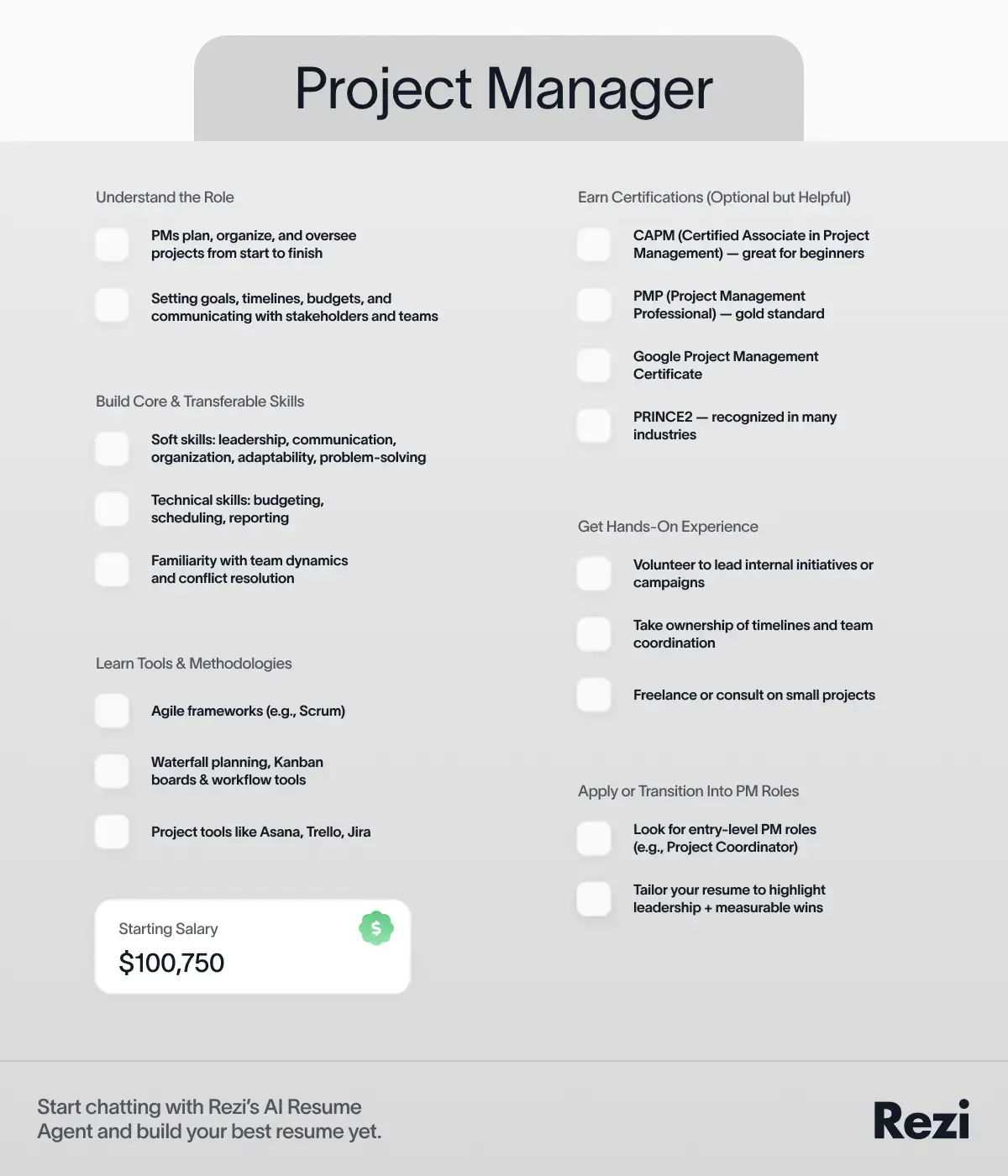
To become a project manager, first, build the core and transferable project management skills. Learn the tools and methodologies, earn certifications, and get hands-on experience. From there, start applying for project manager roles or transition internally.
You don’t have to have “project manager” in your job title to be one. You’re probably already doing things that a project manager does. That could involve juggling deadlines, coordinating teams, managing budgets, and keeping everyone on track. That’s part of project management already.
If you’ve ever led a team through chaos and somehow delivered on time (even with last-minute changes and that one person who always forgets to reply), you’ve got more project management experience than you might think.
In this guide, I’ll show you how to turn those experiences into an actual career as a project manager. Here’s what we’ll be breaking down:
- What a project manager really does.
- The skills and education you need.
- How to transition into the role even from a creative or nontraditional background.
- Tips for getting certified and landing your first PM job.
Skip this guide and get right into building a professional resume for project manager roles with our AI resume builder. You can get started for free!
What Does a Project Manager Do? (And What It Pays)
A project manager (PM) is the person who turns big ideas into finished results. They plan, organize, and oversee projects from start to finish making sure everything runs smoothly, on budget, and on schedule.
Depending on the industry and the company's needs, this might mean launching a new product, coordinating marketing campaigns, managing construction timelines, or overseeing software development.
PMs create project plans, assign tasks, track progress, and keep communication flowing between stakeholders and teams. They’re also the ones who catch issues before they snowball (and often have to explain why the deadline just moved… again).
Here’s what common project manager responsibilities look like:
- Setting project goals and timelines
- Allocating resources and managing budgets
- Leading team meetings and reporting progress
- Managing risks, changes, and dependencies
- Communicating with executives, clients, and vendors
PMs are the ones who catch issues before they snowball. And yes, they're often the ones explaining why the deadline just moved... again.
Median pay for project management specialists: $100,750 per year in 2024 (U.S. Bureau of Labor Statistics). Employment in the project management field is also projected to grow. However, salaries and pay can vary depending on your experience, location, and industry. For instance, project managers may see higher earning potential.
Need career tools to help you land a job in a new field? I’d recommend the following resources:
- Rezi for Project Manager Roles
- Rezi for HR Jobs
- Rezi for Jobs in Tech
- Rezi for Marketing Roles
- Rezi for a Career Change Job Application
How to Become a Project Manager
This is how to become a project manager:
- Build the core and transferable project management skills.
- Learn the tools and methodologies.
- Earn certifications (optional but helpful).
- Get hands-on experience.
- Position yourself for PM roles.
Breaking into project management is more doable than most people think. One Reddit user shared that they started out in marketing and eventually transitioned into a project manager role simply because their skills aligned so well. Their company recognized the overlap and moved them into a PM position, as you can see in their comment below:
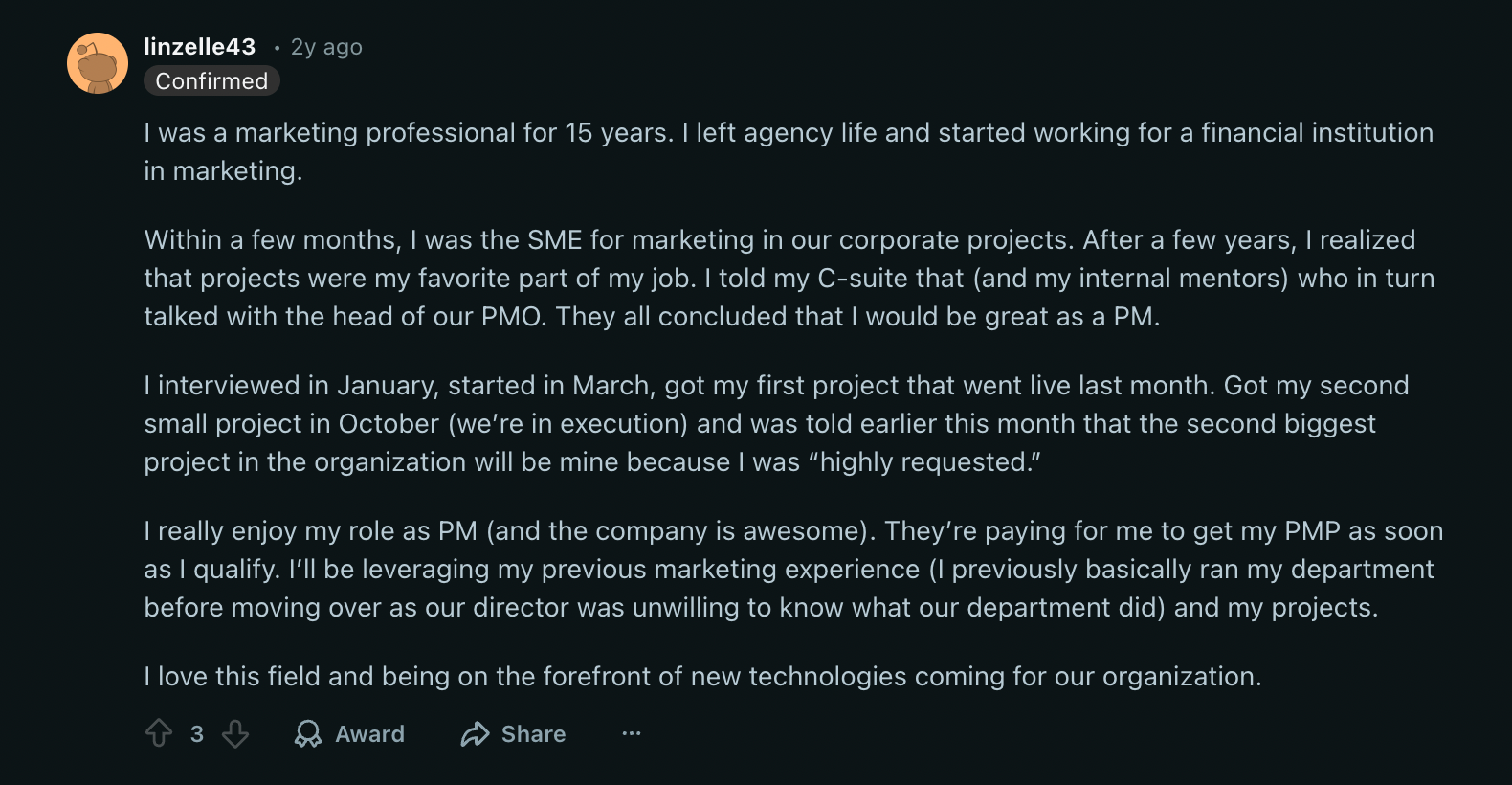
With that in mind, transitioning into project management is realistic across a wide range of careers.
Let’s unpack each step further below.
1. Build the core and transferable project management skills
Strong PMs are part strategist, part diplomat, part cat-herder. You’ll need a mix of soft and technical skills to thrive.
Here are some of the top soft skills for PMs:
- Leadership and communication.
- Organization and time management.
- Problem-solving and adaptability.
- Negotiation and conflict resolution.
And here are some of the top technical skills for PMs:
- Familiarity with project management tools (like Asana, Trello, ClickUp, or Jira).
- Understanding project methodologies (Agile, Scrum, Waterfall, etc.).
- Budgeting, scheduling, and reporting.
If you’ve worked in editing, marketing, operations, or management, you likely already have many of these, especially when it comes to communication, deadlines, and team coordination.
Relevant guides:
- Organizational Skills to Put on a Resume
- Interpersonal Skills for a Resume
- How to Describe Leadership Skills on a Resume
- Communication Skills to Put on a Resume
2. Learn the tools and methodologies
You don’t need a project management degree to get started, but you do need to know how PM frameworks work in practice.
Start by getting comfortable with:
- Agile: used in tech and startups; emphasizes flexibility and iteration.
- Scrum: a framework within Agile focused on sprints and team collaboration.
- Waterfall: traditional, linear approach—good for construction or publishing projects.
- Kanban: visual workflow management (think boards and task cards).
There are tons of free resources online to get fluent in these, such as LinkedIn Learning, Coursera, or YouTube.
Related articles:
- Best AI Skills for a Resume
- Computer Skills for a Resume
- Technical Skills to Include on a Resume
- Best Resume Hard Skills
- Best Resume Soft Skills
3. Earn certifications (optional but helpful)
Certifications aren’t always required but they can fast-track your career, especially when you’re transitioning from another field.
Here are some of the most recognized ones:
- CAPM (Certified Associate in Project Management): great for beginners.
- PMP (Project Management Professional): the gold standard; requires experience and exam prep.
- Google Project Management Certificate: beginner-friendly, practical, and affordable.
- PRINCE2: widely recognized in Europe and government sectors.
These can be a good starting point as it bridges theory with the tools you would actually use in the workplace.
Learn more:
- How to List Certifications on a Resume
- How to Put Education on a Resume
- Awards to Put on a Resume
- Publications on a Resume
4. Get hands-on experience
This part matters most. You can’t manage projects without actually managing projects. If you’re not in a PM role yet, here’s where you could start:
- Volunteer to lead internal projects or campaigns.
- Take ownership of timelines and team coordination.
- Offer to manage cross-functional tasks (content launches, product rollouts, events).
You could also freelance or consult small businesses. For instance, help them plan product launches, marketing projects, or process improvements. Every experience adds to your PM toolkit.
As you build experience, keep a record of each project and task. Monitor budgets, goals, challenges, and outcomes. Use these as portfolio pieces when applying later.
Further resources:
- How to Write the Resume Work Experience Section
- How to List Your Best Projects on a Resume
- Freelance Work Experience on a Resume
- How to Describe Remote Work Experience on a Resume
- Volunteer Experience on a Resume
5. Position yourself for PM roles
Once you’ve built some experience, start applying for entry-level or associate project manager roles.
Job titles may vary depending on the company. Don't get too fixated on the exact title and instead, look for roles where the responsibilities match what you've been doing. And when you're working on your resume, emphasize measurable outcomes and leadership moments. For example, “Managed editorial calendar of 50+ projects per month, coordinating 10+ contributors and reducing missed deadlines by 30%.”
It's common for career changers applying to PM roles to struggle with telling the story of their old career in their resume. Your experience managing timelines, coordinating teams, and delivering projects might be buried under job titles that don't scream "project manager."
To make these experiences more clear, use the right keywords. You can paste the job description for the PM role you're applying to into Rezi AI Keyword Targeting, and it pulls out the specific keywords and skills the company is looking for. Things like "stakeholder management," "Agile methodology," "resource allocation," or "cross-functional collaboration." You can see which of those terms are missing from your resume and add them where they're genuine.

Need inspiration for your PM resume? Check out: Best Project Manager Resume Examples
If you need help with your resume, you’ll find these guides useful:
- How to Write a Good Resume
- How to Write a Resume With No Professional Experience
- How to Write a Resume for a Career Change
How Soon Could You Transition Into Project Management?
This depends on your starting point:
- If you already manage people, processes, or projects informally: 6–12 months to transition (or possibly sooner).
- If you’re brand-new to coordination or business workflows: expect closer to 1–2 years.
Although certification courses can be completed in a few weeks, experience and confidence take time to build.
Summary
Here’s a recap of how to become a project manager:
- Build your leadership, communication, and organization skills.
- Learn PM tools and methodologies (Agile, Scrum, Kanban).
- Get certified (CAPM, PMP, or Google Project Management).
- Gain hands-on experience—volunteer, freelance, or lead projects at work.
- Apply for PM roles and use measurable wins to show your impact.
Project managers aren’t all about bossing people around and micromanaging everyone. Instead, you’re the glue that holds everything together. You’re the one that makes sure everyone moves in the same direction and that nothing gets lost in the cracks.
If you’ve already thrived managing deadlines, wrangling people, and turning chaos into progress, you’re halfway there.
FAQs
Do you need a degree to become a project manager?
Not necessarily. Many PMs come from nontraditional backgrounds, including writing, design, or operations. While a degree in business, management, or a related field helps, employers care more about your ability to organize teams, meet deadlines, and deliver results. Certifications like the CAPM or Google Project Management Certificate can also boost your credibility.
Can I become a project manager without experience?
Yes, but you’ll need to show you’ve managed something. That could mean coordinating marketing campaigns, planning events, or leading cross-team projects in your current job. Start small, track your results, and use that experience as proof of your project management skills when applying for PM roles.
What’s the difference between a project coordinator and a project manager?
A project coordinator supports the project manager by handling administrative tasks, scheduling meetings, and tracking progress. A project manager oversees the entire project — from planning and budgeting to leading the team and reporting results. Coordinating is often the best entry point if you’re new to the field.

Upload or drop your resume to get started
Upload your resume to get started
Score my resume

Astley Cervania is a career writer and editor who has been sharing resume and job search insights for 5+ years. He shapes the direction of the Rezi blog, providing practical answers for important career-related questions and helping hundreds of thousands of people navigate the job market and build resumes that land interviews.