Career Advice
7 Reasons for Unemployed Graduates: A College Crisis
Discover why so many college graduates struggle to find work and learn practical steps to boost your skills, experience, and job prospects.

Published on
December 22, 2025
Updated on
December 22, 2025
College graduates are struggling to find work because there are more grads than ever, many jobs no longer require degrees, and AI is taking over the entry-level roles they once relied on. Hiring is slower, competition is fierce, and even entry-level positions often ask for experience. The good news is there are steps you can take: get any kind of hands-on experience, pick up in-demand skills, highlight soft skills, lean on your network, and make your resume count. By being proactive, flexible, and strategic, graduates can still find opportunities and launch their careers.
I know all too well how it feels to leave university full of promise, after studying for most of your life, ready to finally make money and build something for yourself, only to end up unemployed.
It’s a harsh whack of reality. At least I saw it coming. Halfway through my course, I realized how pointless my degree really was. I wasn’t the only one who noticed either; the program got discontinued the year after I graduated.
But now, this experience is becoming way too familiar for new grads. Degrees that once practically guaranteed a job are struggling to hold their value.
This guide will cover:
- What the job market looks like for graduates today.
- Why so many graduates are unemployed.
- What you can do to improve your chances.
Beat the competition by creating your resume with our free AI Resume Builder, or check out these guides:
- Gen Z Job Market: What Needs to Change in the Workplace
- How to Use Rezi for Student & Graduate Job Applications
- What to Do When Unemployed
- AI Impact on White-Collar Jobs
What Is the Unemployment Rate for College Graduates?
It’s a rough time to be graduating. The unemployment rate for 22 to 27-year-old grads was 4.8% in May 2025. Better than 5.3% in April, but still higher than anyone wants to see. It’s lower than the 7.4% rate for all young workers, but that gap is closing fast (New York Fed).
Some majors are getting hit harder than others. Encoura reports that unemployment is highest for:
- Anthropology (9.4%)
- Computer engineering (7.5%)
- Fine arts (7%)
- Computer science (6.1%)
- Public policy and law (5.5%)
Even tech, which once felt untouchable, is feeling the squeeze. Unemployment in computer-related roles has climbed from 1.98% in 2019 to 3.02% in 2025 (St. Louis Fed).
The long-term trend is worrying too. Among workers who’ve been out of a job for over six months, college graduates now make up one-third, up from one-fifth a decade ago — and it’s only gotten worse in the last year (New York Times).
Even lawmakers are sounding the alarm. Senator Mark Warner cautioned that overall recent-grad unemployment could reach 25% as major employers continue cutting early-career opportunities like internships. As he put it, “If we eliminate that front end of the pipeline, how are people ever going to get to that mid-career spot?” (CNBC).
It raises a real question: if entry-level workers can’t get their foot in the door, what does the future look like?
There’s one light at the end of the tunnel: employers predict a 1.6% increase in hiring for 2026 grads compared to the class of 2025 (NACE). It’s something, but it doesn’t cancel out how challenging the job market feels right now.
How Is the Job Market Right Now?
The job market isn’t great. Overall unemployment stood at 4.4% in September (Bureau of Labor Statistics).
Layoffs are also piling up. Employers announced 153,074 job cuts in October alone, a 175% increase over October last year and 183% higher than the previous month (Challenger, Gray & Christmas). It’s one of the sharpest jumps we’ve seen in years.
Relevant articles:
- What Fiverr’s CEO Says About the Job Market
- Big Company Layoffs in 2025
- When Will Tech Layoffs Stop?
- How to Get a Job Fast
Why Are College Graduates Unemployed? 7 Reasons for Increasing Unemployed Graduates
Here are the top reasons for unemployed graduates:
- Companies are still pulling back.
- There are more graduates than ever.
- Many jobs don’t require a degree anymore.
- AI is taking over entry-level tasks.
- Companies are hiring fewer people overall.
- Entry-level roles now ask for experience.
- Layoffs are increasing competition.
There isn’t one single reason; it’s a combination of economic pressure, changing skill demands, and too much competition.
Companies are still pulling back
Many industries are correcting after the post-pandemic hiring spree, with some announcing layoffs and others freezing or slowing hiring. This trend shows up in the July BLS Job Openings and Labor Turnover Survey, where job openings edged down while hires and separations barely changed. Overall, employers are realizing they went a bit overboard during that period.
There are more graduates than ever
From 1993 to 2023, the number of adults with a degree rose by 74.9% (Education Data Initiative). We were always going to feel that impact eventually. When almost everyone has a degree, it stops being a clear advantage.
Many jobs don’t require a degree anymore
Last year, 52% of US job postings didn’t list formal education requirements at all (Indeed Hiring Lab). That means grads are competing with each other, and non-degree candidates too.
AI is taking over entry-level tasks
AI is hitting entry-level roles the hardest — customer service, data analysis, research, and admin work — the very jobs new grads used to rely on to start their careers (Oxford Economics).
At the same time, NACE reports that 61% of employers say AI isn’t replacing entry-level workers (yet), with another 14% only discussing it. AI isn’t eliminating jobs entirely, but workers will need to learn how to leverage it to stay efficient.
Companies are hiring fewer people overall
High interest rates, tariffs, and general economic anxiety mean employers are playing it safe. According to NACE, 60% expect to keep hiring flat, and only about 25% plan to increase hiring for 2026 grads.
Entry-level roles now ask for experience
Competition is so intense that it’s normal to see entry-level jobs asking for 2–3 years of experience. It creates the classic catch-22: you need experience to get experience.
Layoffs are increasing competition
DOGE-related disruptions have already contributed to 293,753 planned layoffs in 2025 (Challenger Gray). That means experienced workers are also entering the job market and applying for the same roles that graduates are targeting.
Read about How to Survive a Layoff.
How Graduates Can Improve Job Prospects
Here’s how graduates can improve job prospects:
- Get any experience you can: short-term, part-time, or even unpaid internships in fields like pharmacy, marketing, or engineering, to boost your resume and skills.
- Grab a survival job in food service, driving, home health, or similar roles. They provide income and transferable skills while you keep searching.
- Learn in-demand skills like AI, machine learning, computer vision, and prompt engineering to be more competitive for entry-level roles.
- Highlight your communication, problem-solving, and adaptability skills; they’re highly valued and hard for AI to replace.
- Reach out to classmates, professors, alumni, or LinkedIn contacts, and attend events to meet people in person.
- Tailor your resume to each job, emphasize key skills, and run it through tools like Rezi Score to get it optimized.
I’ve been brutally honest (borderline negative) so far, but your degree isn’t useless. It still helps you get hired, earn more, and move up faster. The job market is just messy right now, so you’ll need to be more strategic about how you stand out.
And yes, AI is changing everything, but not in a “robots are taking all our jobs” way. Some tasks are getting automated, but companies still need real humans to train these systems, guide them, and handle everything AI can’t do.
So while employers figure themselves out, here are some practical steps you can take right now to boost your job prospects:
1. Get experience however you can
Internships are down; postings dropped below 2019 levels this year (Hiring Lab). Not ideal. But some fields are still hiring interns at higher rates, like pharmacy, marketing, civil engineering, media and communications, and architecture.
If you can land an internship, even part-time or short-term, take it. It builds experience and gives you something valuable for your resume. And if it’s unpaid, don’t stress; lots of grads balance an unpaid internship with a paid job.
Related reading:
- Internship Resume Examples
- How to Write a Resume With No Work Experience
- How to Write a Cover Letter for an Internship
2. Find a survival job for now
If you need work right now, in-person roles are hiring the most, especially food service, driving, sanitation, personal care, and home health (Hiring Lab).
Honestly, home health might be the hidden gem here. The population is aging, demand is high, and the work isn’t going anywhere.
Even if it’s temporary, a survival job gives you real-world experience and plenty of transferable skills you can highlight on your resume, like communication, reliability, customer service, problem-solving, you name it.
Learn more:
- How to Write a Survival Job Resume
- Best Communication Skills for Your Resume
- Customer Service Skills to Put on a Resume
- Teamwork Skills to Put on a Resume
- Top Resume Interpersonal Skills
3. Upskill and get certifications
To stand out right now, you need the skills employers are actually hiring for. Nearly 11% of entry-level roles already ask for AI skills (NACE).
Some of the most in-demand AI skills include GenAI, machine learning, applied ML, computer vision, and prompt engineering. And good for you, you can learn most of these through short courses or certifications you can add to your resume.
4. Emphasize your soft skills
Soft skills are transferable, impressive, and best of all, AI can’t replace them.
With AI reshaping work, skills like critical thinking, communication, and data analysis are more important than ever. Show off how you work with others, solve problems, and adapt; they’ll strengthen your application in any field.
Read more:
5. Use your connections
You might not have a huge network yet, but you definitely have more connections than you think.
- Ask your fellow grads. See where they’re working and whether their companies are hiring.
- Talk to your professors. They often know alumni and employers and are happy to make introductions for students who show initiative.
- Reach out to your circle. Family, LinkedIn contacts, old club members; anyone who knows you exists is a potential lead.
- Reconnect with past placements. If you did an internship or work placement, check back in. They already know what you can do.
- Show up to events. Job fairs, networking nights, alumni meetups — meeting someone in person can make all the difference.
6. Optimize your resume
Companies get flooded with applications, so most of them rely on Applicant Tracking Systems (ATS).
ATS scans for keywords, and if your resume doesn’t match the skills and experience they’re looking for, it gets pushed down the list. The more aligned your resume is, the better your chances of landing an interview.
And I know I might seem biased here, but Rezi really is one of the easiest ways to make your resume ATS-friendly.
Here’s what you can do:
- Tailor your resume to the job. Highlight the skills and experience the employer wants. If something shows up multiple times in the job description, it should be emphasized clearly on your resume. Our AI Keyword Targeting tool makes this process way faster.
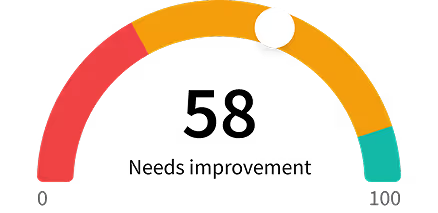
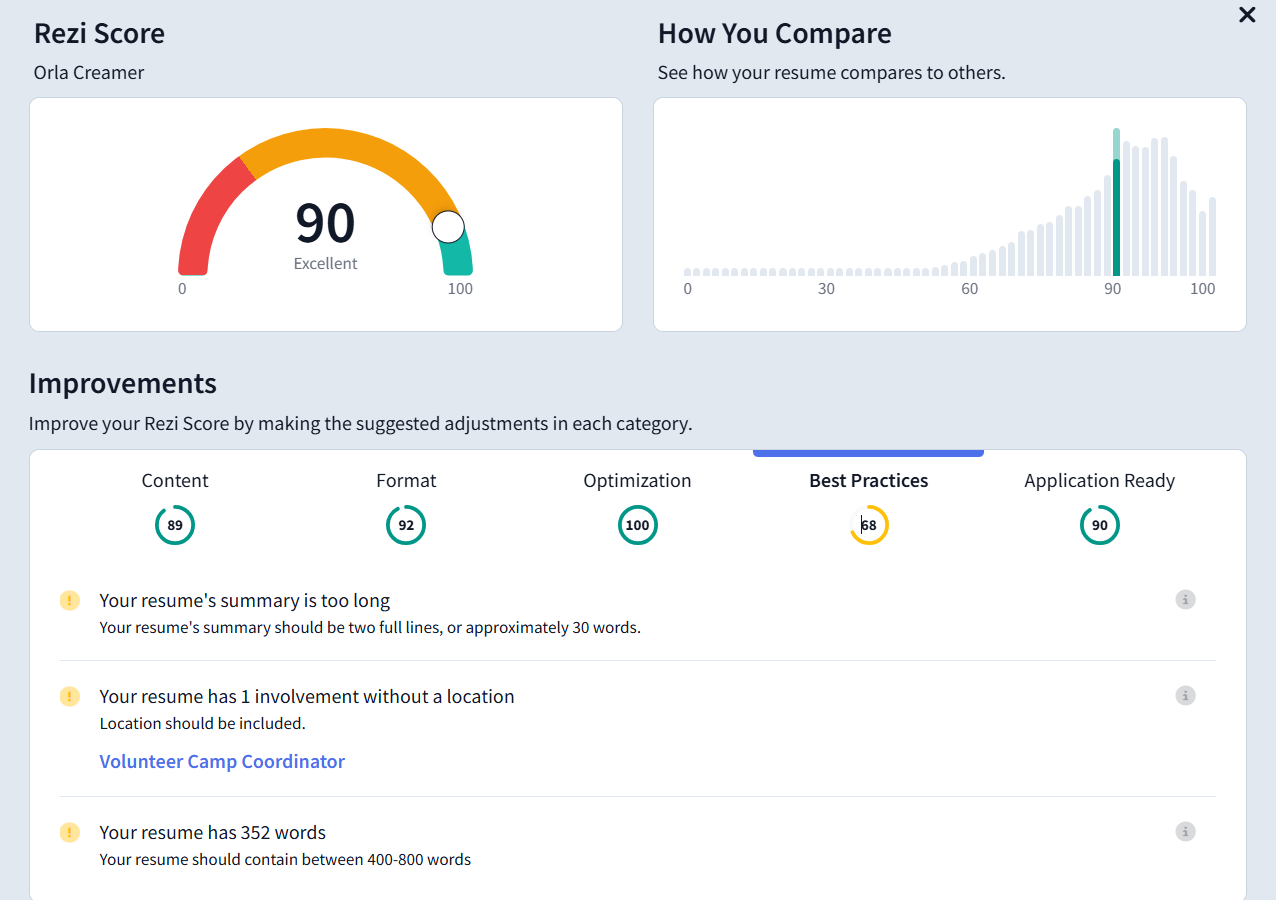
- Run your resume through the Rezi Score. It grades your content, format, optimization, and overall readiness so you know when it’s good to go. Anything above 90 is great, but why not aim for 100?
Here’s a sample Rezi Score:
Rezi can help you target your resume to the job description in minutes, saving you the hours it would take to manually optimize every application.
And it’s not just me saying this. Here’s what Gabriel, a computer science student who landed multiple internship interviews, had to say:
“Using Rezi, I’m able to apply a lot faster than a lot of other people, so I can get more applications in, and I know it’s going to be a numbers game in the end.”
Relevant guides:
- The Best AI Resume Builders
- The Top Resume Builders
- Rezi vs. ChatGPT
- Is Rezi Worth It? An Honest Review
High-Paying Jobs That Don’t Require a Bachelor’s Degree
If you’re wondering whether college is the right choice, here are some alternative paths you can take instead:
Related reading:
Final Thoughts
All hope isn’t lost. Yes, the job market is tough, AI is changing how work gets done, and entry-level roles are harder to snag, but it’s far from impossible.
No algorithm can replace creativity, problem-solving, and adaptability (yet). Focus on what you can control: gaining experience, learning in-demand skills, networking, and crafting a resume that actually gets read.
Stay persistent, creative, curious, and flexible, and you’ll find something. It might look different than what you imagined, but sometimes the best opportunities do.
FAQ
What are the hardest majors?
The hardest majors are usually those with heavy workloads, tough labs or projects, and lower average GPAs, like chemistry, engineering, physics, computer science, architecture, and nursing. These fields demand strong math and problem-solving skills, long study hours, and often competitive grading.
What is the average US salary?
As of September 2025, the average weekly salary in the US is about $1254, which adds up to over $65,000 a year (YCharts). Keep in mind this is an overall average; what you earn can vary a lot depending on your industry, experience, and location.
What is the NY unemployment rate?
As of August 2025, New York’s unemployment rate was 4.7% (St. Louis Fed). That’s slightly higher than the national average, reflecting ongoing challenges in certain sectors, especially for entry-level and service jobs.
What is the New York population?
New York City’s population hit about 8.48 million in 2024 (NYC.gov), with all five boroughs seeing growth over the previous year.

Upload or drop your resume to get started
Upload your resume to get started
Score my resume

Sarah Coghlan is a writer and editor passionate about making resume and career advice clear and accessible to all. Based in Barcelona, her goal is to help job seekers create standout resumes and navigate the job search process with confidence and ease.