
Career Advice
How to Become a Business Analyst (Even If You Have No Experience)
Learn how to become a business analyst step-by-step. Discover education options, skills, and the steps to start your business analyst career.

Published on
January 20, 2026
Updated on
March 27, 2026
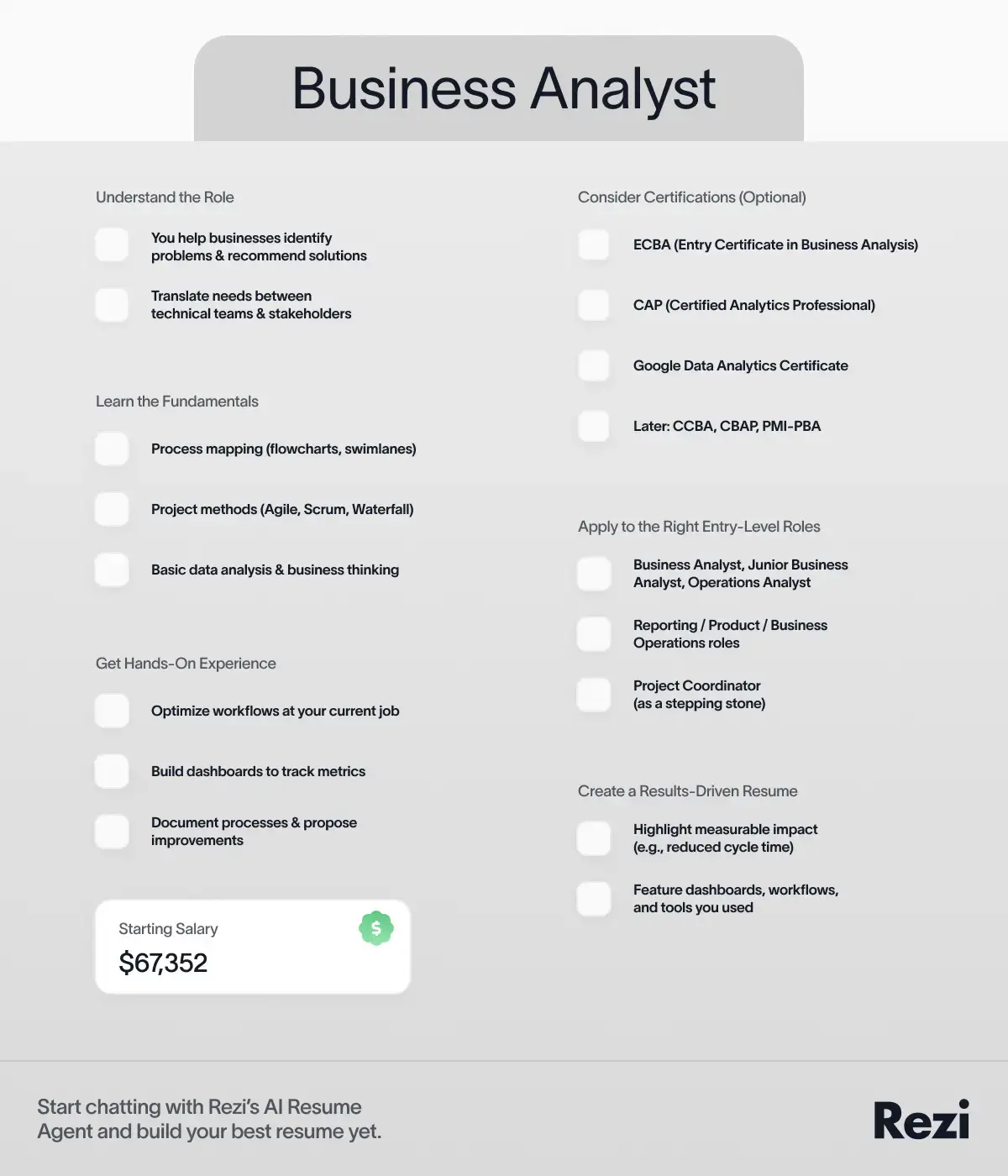
To become a business analyst, first learn the fundamentals of business analysis. Develop your soft skills and build the key technical skills. Next, get hands-on experience and consider relevant certifications to reinforce your credentials. Afterward, create a tailored resume and then apply for the right entry-level roles.
Becoming a business analyst is more accessible than people think, even if you don’t have formal experience yet.
Here’s what we’ll cover:
- What business analysts actually do.
- Skills you really need (and which ones you can learn on the job).
- Step-by-step guide to becoming a business analyst.
- How long it might take and how much you could earn.
And if you’re already gearing up for job applications, use our free AI Resume Builder to create a professional business analyst resume in minutes.
Can You Become a Business Analyst Without Experience?
It’s absolutely possible. If you're a recent graduate or student looking to land a role as a business analyst, you'll have to double down on academic credentials and relevant skills or projects. Prove that you can think like one and that you have the potential to succeed in the role.
Also, many business analysts that got started in another field first. For many career changers, you likely have transferable skills. Candidates for BA roles have transitioned from fields like:
- Customer support
- Sales
- Retail
- Operations
- Project coordination
- Admin roles
- Marketing
- IT support
If you can analyze a problem, talk to people, and help make things better, you’ve got the raw ingredients.
How to Become a Business Analyst
Here’s how to become a business analyst:
- Learn the fundamentals of business analysis.
- Build foundational skills like SQL, Excel, and communication.
- Get hands-on experience through projects, volunteering, or junior roles.
- Earn certifications (optional but helpful).
- Create a business analyst resume with data, outcomes, and project examples.
- Apply for business analyst, junior BA, or operations analyst roles.
Being a good business analyst requires more than technical expertise. Strong communication skills and solid product or domain knowledge are just as important, as one Reddit user points out:

Business analysts spend a significant amount of time translating between stakeholders, clarifying requirements, and making sure teams are aligned. And, that’s why you shouldn’t neglect soft skills as you move through this path.
Tools can be taught; the ability to ask the right questions, manage expectations, and turn messy conversations into clear requirements is what separates a decent analyst from a great one.
Now let’s dive into each step.
1. Learn the fundamentals of business analysis
You don’t need a specific degree to start. Plenty of business analysts come from psychology, business, IT, marketing, retail, or completely unrelated fields.
What does matter is understanding the fundamentals of the role.
Start by learning:
- Requirements gathering & documentation.
- User stories and acceptance criteria.
- Process mapping (flowcharts, swimlanes).
- Basic data analysis.
- Project methodologies (Agile, Scrum, Waterfall).
A few beginner-friendly resources worth exploring:
- Google Data Analytics Certificate.
- Coursera’s Business Analysis courses.
- YouTube walkthroughs of BA tools like Lucidchart, Jira, or Power BI.
Learn more:
- Computer Skills for a Resume
- Technical Skills to Include on a Resume
- Best Resume Hard Skills
- Programming Skills to Put on a Resume
- Best AI Skills for a Resume
- High-Income Skills to Learn
2. Build the essential business analyst skills
Most business analysts use a hybrid of soft skills, business knowledge, and technical tools. See below for what to focus on.
Soft skills:
- Communication
- Critical thinking
- Problem-solving
- Stakeholder management
- Requirements gathering
These are the skills that help you get hired, even more than technical tools. However, technical expertise is still important. So, get comfortable with the following:
- Excel or Google Sheets
- SQL basics
- Power BI or Tableau
- Process modeling tools (Lucidchart, Miro)
- Jira, Confluence, or similar project tools
Related articles:
- Best Resume Soft Skills
- Organizational Skills for a Resume
- Interpersonal Skills to Put on a Resume
- How to Describe Leadership Skills on a Resume
- Communication Skills to Put on a Resume
3. Get hands-on experience (even without a business analyst job)
You don’t need a business analyst job title to get experience. You can build it through:
- Optimizing a workflow at your current job.
- Creating a dashboard to track performance.
- Documenting a process and proposing improvements.
- Volunteering with nonprofits who need help streamlining operations.
- Freelance projects.
If you’ve ever solved a recurring problem, created a system, or analyzed performance, then you’ve already done some business analysis work. All you need to do now is just frame it properly.
4. Consider business analyst certifications
Certifications aren’t required, but they absolutely help if you’re breaking into the field or want to signal credibility.
Entry-level business analyst certifications:
- ECBA (Entry Certificate in Business Analysis) — IIBA
- CAP (Certified Analytics Professional) — INFORMS
- Google Data Analytics Certificate
More advanced business analyst certifications (for later in your career):
- CCBA (Certification of Capability in Business Analysis) — IIBA
- CBAP (Certified Business Analysis Professional) — IIBA
- PMI-PBA (Professional in Business Analysis)
Learn more:
5. Create a business analyst resume that shows impact
Even if you haven’t held a BA role before, you can show BA-related skills. Focus your resume on:
- Measurable results
- Process improvements
- Data-driven insights
- Problem-solving examples
- Stakeholder collaboration
Good resume sentences for a business analyst look like:
- “Reduced onboarding time by 30% by streamlining the training workflow.”
- “Analyzed weekly metrics to identify performance gaps, improving efficiency by 12%.”
- “Created process documentation for a team of 25, reducing errors by half.”
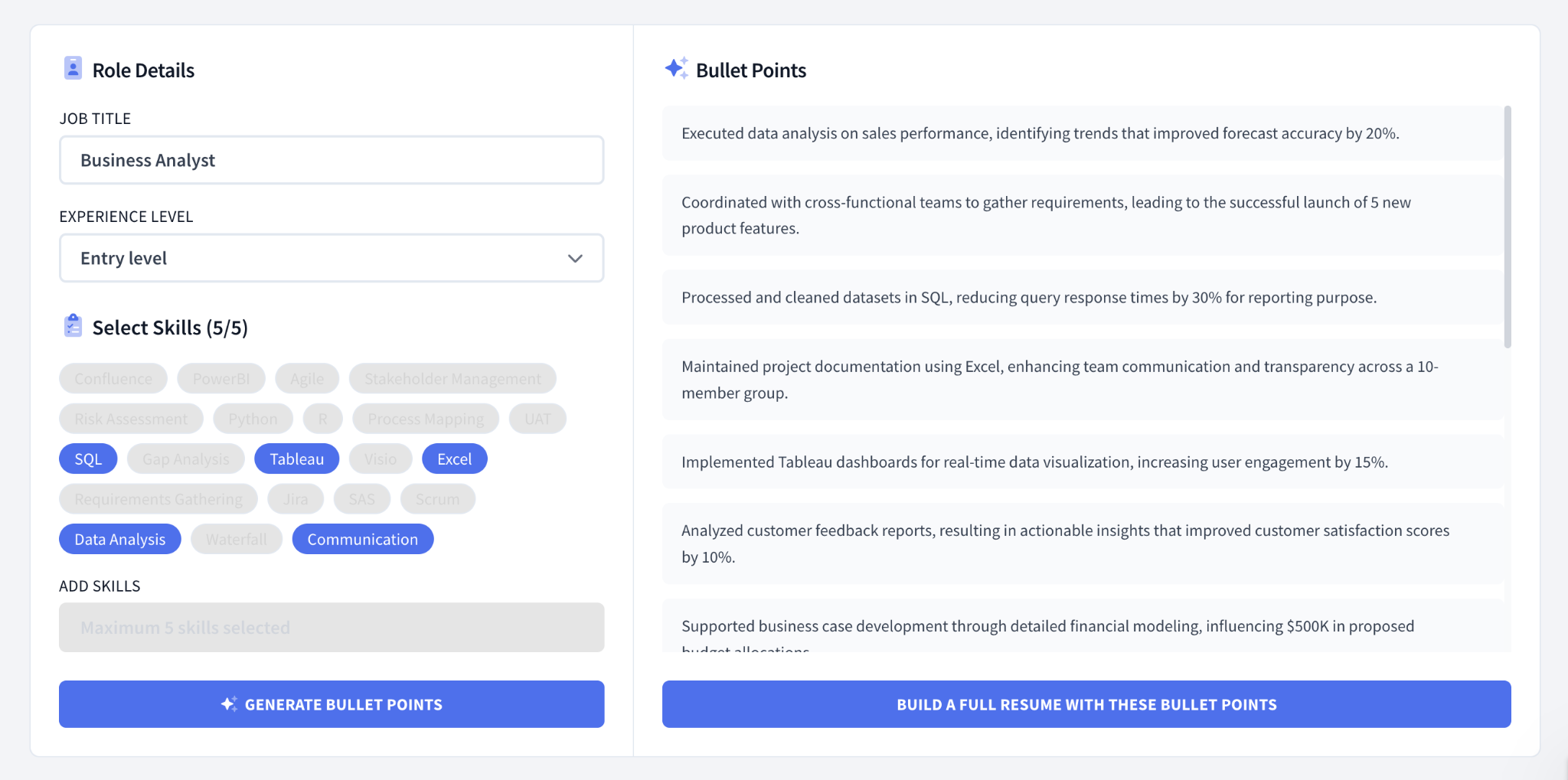
If you need help writing your resume to highlight impact that would be impressive for recruiters hiring for a business analyst, you can use a resume bullet point generator for free. Enter the job title (e.g., Business Analyst) along with your experience level. Next, add your most relevant skills, and it can then generate bullet points for your BA resume based on the details you added.
Want to learn how to write a stronger BA resume? Check out these resources:
- Best Business Analyst Resume Examples
- How to Write a Strong Resume
- How to Use ChatGPT to Write a Professional Resume
- How to Write a Resume With No Work Experience
- How to Write a Resume for a Career Change
6. Apply for the right entry-level roles
Don’t limit yourself to titles that say “business analyst.” Consider all related roles like:
- Junior Business Analyst
- Operations Analyst
- Data Analyst (Entry-Level)
- Reporting Analyst
- Project Coordinator
- Product Analyst
- Business Operations Associate
These roles also build business analyst skills and often lead directly into full business analyst positions within a year or two.
Related articles:
- The Best Job Search Strategies
- Top Job Search Engines
- Why It’s Hard to Find a Job (And What You Should Do)
Daily Tasks of a Business Analyst
A business analyst (BA) is the person organizations rely on to understand problems, gather requirements, and translate business needs into solutions. They typically work between technical teams and non-technical stakeholders.
Think of BAs as the interpreters, troubleshooters, and process improvers of the business world.
The day-to-day business analyst responsibilities may include:
- Analyzing data to uncover trends or issues.
- Interviewing stakeholders to gather requirements.
- Documenting processes and recommending improvements.
- Creating reports, diagrams, and models.
- Collaborating with engineering, product, finance, and operations.
- Helping teams align on priorities and solutions.
Some BAs are more technical (think SQL queries and dashboards), while others are more strategic (workflows, stakeholder management, decision-making). Either way, the role suits people who enjoy problem-solving, communication, and making messy things simpler.
Curious about how to use the best career tools to land certain roles? Check out these guides:
- Rezi for Marketing Job Applications
- Rezi for Finance Job Applications
- Rezi for Tech Job Applications
- Rezi for Project Management Job Applications
- Rezi for HR Job Applications
- Rezi for Students and Graduates
Is It Possible to Become a Business Analyst Quickly?
How soon you can become a business analyst depends on your own professional background and if you have any relevant experience. It can take up to 3–12 months, or more.
Here’s an example breakdown:
- Learning fundamentals: 4–8 weeks
- Building technical skills: 1–3 months
- Completing a certification (optional): 1–2 months
- Building experience through projects: 1–3 months
You don’t always need a degree. Most people start applying after a few solid months of preparation. Certifications and professional training can be just as helpful for breaking into this field.
What Are Salary Expectations for a Business Analyst?
The estimated average base salary for a business analyst in the United States is $67,352, and can go as high as $101,932 according to Indeed. There are other factors to consider that can affect your earnings, such as experience level, industry, and location.
Summary
Let’s recap on how to become a business analyst:
- Learn the fundamentals of business analysis.
- Build the required soft skills and technical skills (Excel, SQL, dashboards).
- Get hands-on experience through projects, volunteering, or your current job.
- Consider earning certifications to boost credibility.
- Create a results-driven business analyst resume.
- Apply to BA, operations, or analyst-adjacent roles.
Having years of experience and a technical degree might give you an advantage, but you can still break into the field without these. What’s more important is having the curiosity, persistence, and willingness to learn how businesses actually work behind the scenes.
FAQs
Do you need a degree to become a business analyst?
Some companies may add a degree as a requirement to apply for their business analyst role. It’s often preferred in fields like business, IT, finance, economics, and analytics. However, this doesn’t apply to all organizations. A degree is certainly helpful, but not always required. If you don’t have a degree, you can still break in by emphasizing real project experience, relevant certifications, technical skills, soft skills, and a strong portfolio which includes examples of dashboards and process maps.
How do I become a business analyst with no experience?
Here’s how most people break in without having any formal experience under a business analyst role:
- Improve a process at your current job.
- Build a data dashboard with free tools.
- Document workflows or systems.
- Volunteer for analytics or reporting tasks.
- Complete beginner business analyst courses.
- Earn an entry-level certification.
- Highlight transferable skills (communication, analysis, documentation).
Roles like operations analyst, reporting analyst, or project coordinator also serve as stepping stones to a full business analyst role.

Upload or drop your resume to get started
Upload your resume to get started
Score my resume

Astley Cervania is a career writer and editor who has been sharing resume and job search insights for 5+ years. He shapes the direction of the Rezi blog, providing practical answers for important career-related questions and helping hundreds of thousands of people navigate the job market and build resumes that land interviews.