
Career Advice
How to Become a Data Engineer (Step-by-Step Guide & Tips)
Learn how to become a data engineer step-by-step. Discover education options, skills, and the steps to start your data engineering career.

Published on
January 20, 2026
Updated on
March 27, 2026
Here’s how to become a data engineer: learn the core data engineering skills, start working on real-world projects, and create a portfolio. Next, get a certificate or take a structured course. Build up practical experience, and then start applying for data engineering roles. Optimize your resume, and consider transitioning into a data engineer role at your current company by demonstrating that you have the required core skills.
Data engineering is where software meets data. It’s less “predicting the future with machine learning” and more “making sure everyone has clean, reliable data so they can do their jobs better.”
This guide will cover all that you need to know about how to become a data engineer. We’ll go through:
- What data engineers do.
- What to do to land a data engineer role.
- How long the journey could take.
- Salary expectations.
If you want to get straight into building a professional resume for data engineering roles, use our AI resume builder. It helps you create your resume in minutes using AI that’s been trained on the best resume practices and ATS compliance.
What Does the Day-to-Day of a Data Engineer Look Like?
This is what the day-to-day responsibilities of a data engineer can look like:
- Designing and maintaining data pipelines.
- Building data warehouses and data lakes.
- Moving data from different sources into one clean system.
- Ensuring data is reliable, consistent, and accessible.
- Setting up cloud infrastructure.
- Optimizing performance.
Think of data engineers as the people who build the “roads” that data travels on. If data scientists are analyzing and modeling, data engineers are the ones making the data usable in the first place.
If you enjoy building systems, solving technical puzzles, and making things run efficiently, this job might just click for you.
Curious about how you can use Rezi for different fields and industries? Check out our guides:
- Rezi for Jobs in Tech
- Rezi for Engineering Roles
- Rezi for Project Management
- Rezi for Human Resources (HR)
- Rezi for Marketing Roles
- Rezi for Making a Career Change
How to Become a Data Engineer
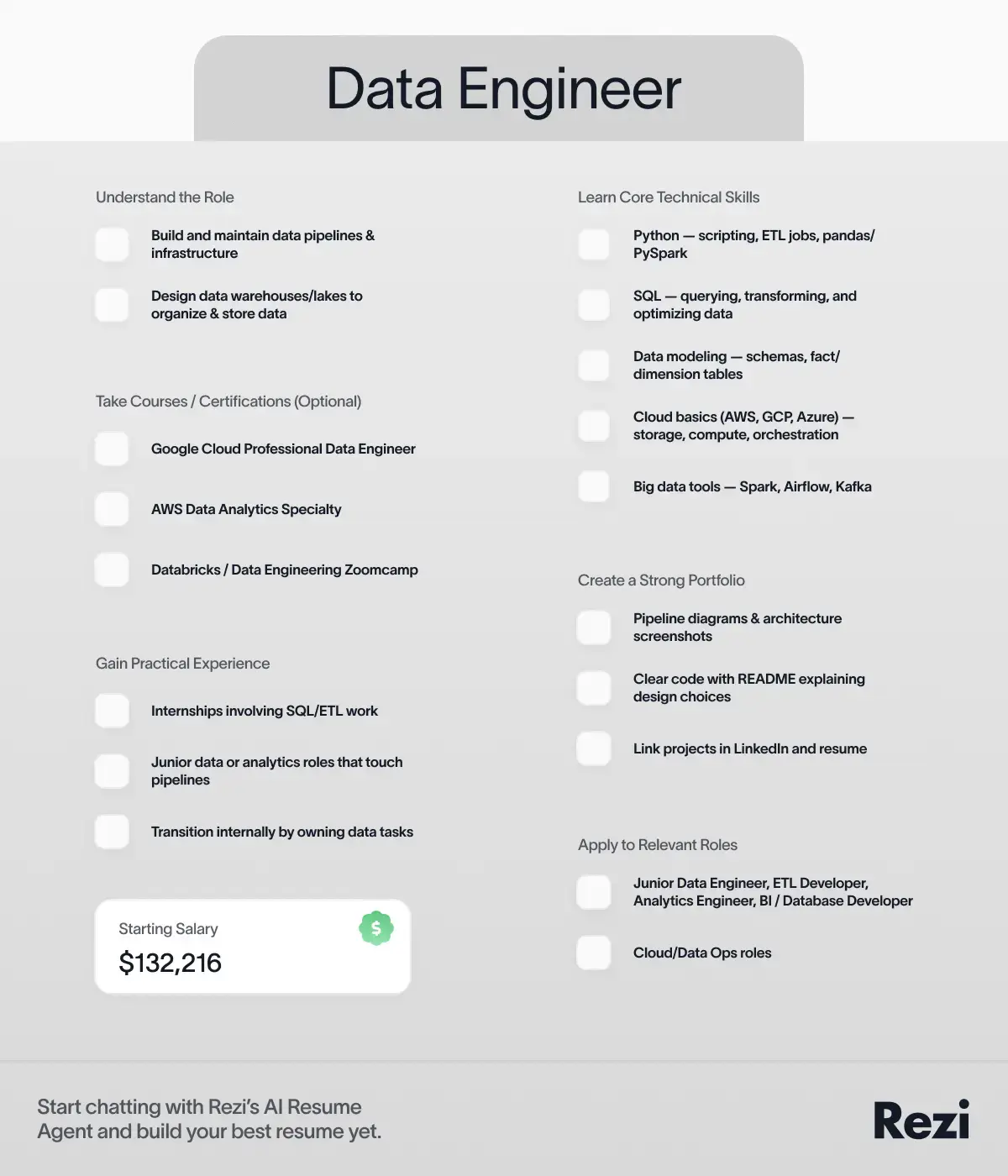
Here’s how to become a data engineer:
- Learn the core data engineering skills.
- Start working on projects that show real-world problem-solving.
- Create a portfolio on GitHub or a personal website.
- Get a certificate and take a structured course.
- Build up practical experience.
- Apply for data engineering roles.
One of the most important skills you need as a data engineer is a strong foundation in SQL and Python. This is consistently emphasized by experienced professionals — including a Reddit user in a discussion about how to become a data engineer, shown below.

While there’s a lot more that you could possibly learn in data engineering, SQL and Python sit at the core of the role. Focus on mastering these first and applying them in real projects. Build a solid understanding of the underlying principles before jumping straight into specific tools or frameworks.
Let’s break it all down below.
1. Learn the core data engineering skills
These are the foundational tools you’re going to use constantly:
- Python. This is the workhorse of data engineering because it’s perfect for writing ETL scripts, automating workflows, and handling data in pipelines. Learn to use pandas for data manipulation, and then PySpark for large datasets.
- SQL. You’ll use SQL for creating tables, transforming data, writing complex queries, and optimizing performance.
- Data modeling. You need to understand things like star vs. snowflake schemas, fact and dimension tables, and normalization vs. denormalization.
- Cloud platforms. These include AWS (most common), Google Cloud, and Azure. You don’t need to learn all of them, but pick one big cloud provider to start. And, focus on the core services, storage (S3, GCS, Azure Blob), compute (EC2, Lambda, Dataproc), and orchestration (Airflow, Glue, Dataflow).
- Big data tools. You can start with Apache Spark, Apache Airflow, and Kafka (for streaming).
Related articles:
- AI Skills to Put On a Resume
- Examples of Resume Computer Skills
- Technical Skills to Include on a Resume
- Programming Skills for Your Resume
- Best Transferable Skills to Put On a Resume
2. Start working on projects that show real-world problem-solving
Projects matter for data engineers because companies want proof you can build working systems.
Here are some examples of strong data engineering project ideas:
- A pipeline that pulls weather data daily, processes it, and loads it into a warehouse.
- A movie analytics ETL built with Airflow and Spark.
- A real-time streaming app using Kafka.
- A data warehouse built on Snowflake or BigQuery.
- An API you built that loads structured data into cloud storage.
Show end-to-end thinking, from sourcing data to cleaning, storing, and making it usable.
Learn more about showcasing projects on a resume:
3. Create a portfolio on GitHub or a personal website
Hiring managers want to see your systems-thinking mindset. So, prove it with a data engineering portfolio.
Include:
- Pipeline diagrams.
- Infrastructure screenshots.
- Code for orchestration (Airflow DAGs, for example).
- Documentation explaining design choices.
The key is clarity. Someone should be able to look at your repo and think, “Yes, this person gets it.”
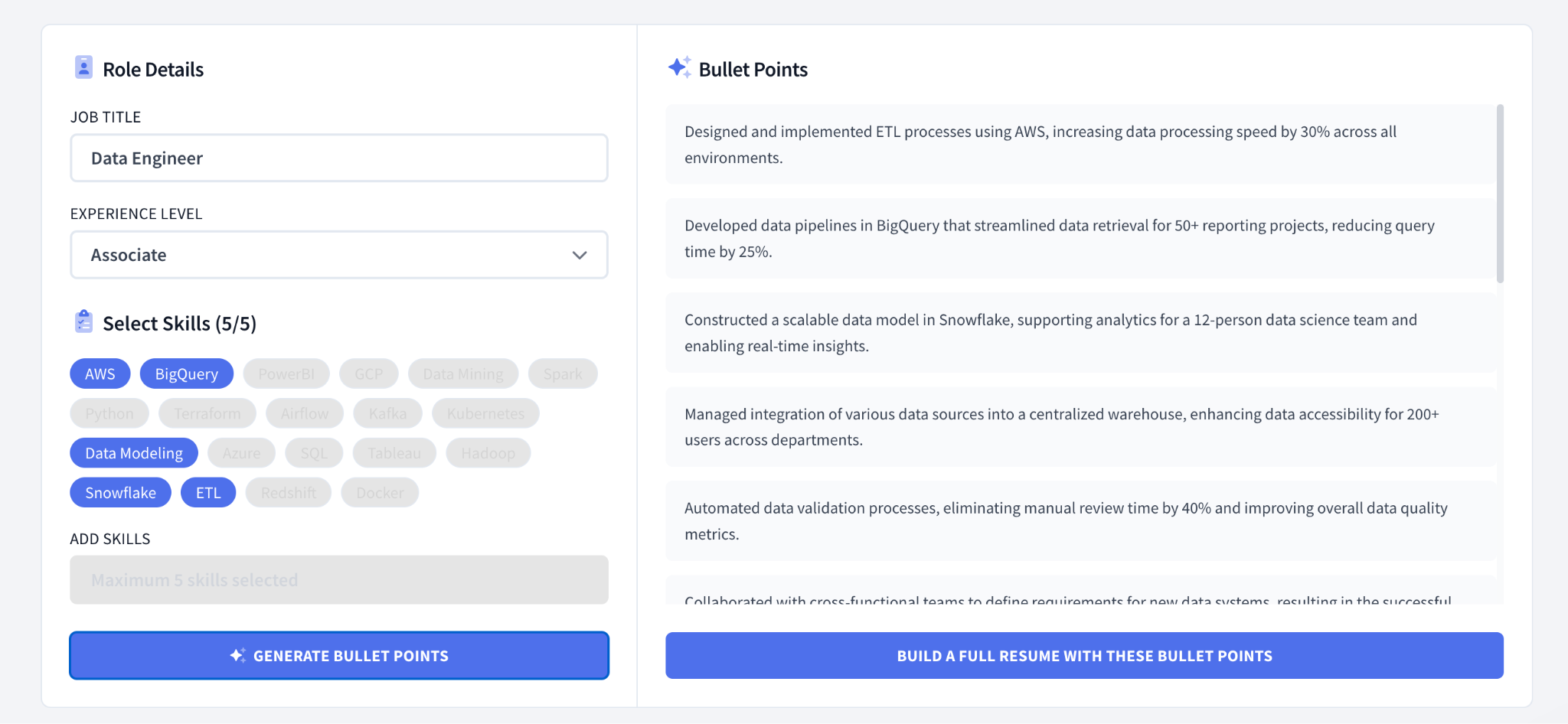
Once you’ve built your portfolio, you can add them to the header section of your resume and LinkedIn profile. If you need help writing bullet points that matter for data engineer roles, use a free resume sentence generator. Input the role (e.g., Data Engineer) followed by your experience level and top skills. It'll then offer suggestions that you can tweak and use as your own for your resume or LinkedIn profile.
4. Get a certificate and take a structured course
Data engineering is big on tools, and structured programs can speed things up.
Here are some examples of popular options:
- Google Cloud Data Engineer Certification.
- AWS Data Analytics Specialty.
- Data Engineering Zoomcamp.
- Databricks Lakehouse Fundamentals.
These don’t replace projects, but they do complement them by giving you more structure and hands-on practice. They also boost your credibility for when you start looking for jobs or freelance gigs.
Side Note: You might also find this data engineer roadmap helpful.
Read more:
5. Build up practical experience
You don’t need a data engineer title to start gaining experience. Here are some ways to get your feet wet in the data engineering field:
- Internships that involve database work, ETL, and ELT.
- Junior data analyst roles with SQL-heavy tasks.
- Software engineering internships that touch data systems.
- Freelance gigs building pipelines for small businesses.
- Volunteer projects (nonprofits need better data, trust me).
Data engineering experience builds naturally. If you can show that you’ve worked with data pipelines in any form, you’re already competitive.
Further guides:
- How to Describe Resume Work Experience
- How to Write a Professional Resume
- How to Write a Strong Resume With No Experience
- How to Write a Career Change Resume
6. Apply for data engineering roles
Many data engineers never started as “data engineer” being their job title. Instead, they began in adjacent roles that build the necessary skills.
Entry-level job titles to target include:
- Data Engineer (junior).
- ETL Developer.
- Data Analyst.
- Business Intelligence Engineer.
- Analytics Engineer.
- Database Developer.
- Cloud Engineering Intern.
When applying for data engineering roles, tailor your resume to show that you’re a strong fit for the position. Highlight relevant skills, projects, and experience in areas like SQL, data pipelines, cloud platforms, and ETL/ELT workflows to demonstrate your qualifications.
Alternatively, you can land a data engineer role by making the transition at your current company by raising your hand for data-heavy projects, helping out with pipelines or reporting, and showing that you already have the skills to do the job.
Relevant guides for job searching:
- Best Job Search Strategies
- Best Job Search Engines
- Why It’s Hard to Find a Job (And What to Do)
- How to Get a New Job Quickly
Data Engineer Salary: What You Can Expect
The estimated average base salary for a data engineer in the US is $132,216, according to Indeed. Pay could range from $85,675 to $204,040. Data engineering usually pays well because it’s a technical, high-impact role.
Does It Take Really Long to Become a Data Engineer?
It could take anywhere from 6–12 months or more (or less) depending on your experience, qualifications, and background.
Here’s an example timeline:
- 0–3 months: Python and SQL.
- 3–6 months: Data warehouses, modeling, and cloud.
- 6–9 months: Spark, Airflow, Kafka fundamentals.
- 9–12+ months: Projects, portfolio, applications.
Summary
Let’s recap on how to become a data engineer:
- Learn the essentials: Python, SQL, cloud, data modeling, and big data tools.
- Build real projects that showcase pipelines and architecture.
- Create a clear portfolio documenting your systems.
- Consider structured courses or certifications.
- Get hands-on experience however you can.
- Apply for junior roles in engineering, data, or analytics.
If you enjoy building, optimizing, and architecting the systems that make data useful, data engineering is a deeply rewarding career. On top of that, the demand isn’t slowing down.
FAQs
Do I need a degree to become a data engineer?
Not necessarily. A computer science or engineering degree helps, but it’s not always required by some companies. Many data engineers started in different fields and transitioned through a mix of online courses, certifications, and hands-on projects. What matters most is proving you understand pipelines, SQL, Python, cloud tools, and data architecture.
What programming languages do I need to learn for data engineering?
At minimum, you need Python and SQL. Python handles automation and data processing, while SQL is essential for querying and structuring data. Later on, you can add tools like Scala, Java, or PySpark. However, those aren’t necessary to get started in an entry-level role.
Is data engineering hard to learn?
It’s challenging, but rewarding. The hardest part is usually getting comfortable with large systems: cloud tools, pipelines, and distributed processing. Once you build a few real projects, everything starts clicking.

Upload or drop your resume to get started
Upload your resume to get started
Score my resume

Astley Cervania is a career writer and editor who has been sharing resume and job search insights for 5+ years. He shapes the direction of the Rezi blog, providing practical answers for important career-related questions and helping hundreds of thousands of people navigate the job market and build resumes that land interviews.

.webp)