
Career Advice
How to Become a Data Scientist (What to Do to Get Hired)
Learn how to become a data scientist step-by-step. Discover education options, skills, and the steps to start your career in data science.
Published on
January 20, 2026
Updated on
March 27, 2026
To become a data scientist, you first need to learn the core skills, including Python, SQL, statistics, and machine learning. Next, build projects that demonstrate your ability to solve real-world problems. Create a portfolio, take a certificate or structured course, and get practical experience. Once you’ve built up your professional background and key skills, apply for data science jobs.
Data science can feel intimidating from the outside. All the buzzwords, math, machine learning, Python memes… I get it, but this career is actually more accessible than most people might think.
You don’t need to be a Silicon Valley genius or a PhD-level mathematician. It might be tough, but it’s certainly possible to break into this field with enough curiosity, persistence, and willingness to learn.
In this guide, we’ll walk you through what to do to land your next role as a data scientist.
And if you want to get straight into creating a professional resume to land your next role in data science, use our AI resume builder. Our AI tools help you build a targeted resume in minutes.
Are Data Scientists Paid Well?
Generally speaking, many data scientists are paid well. The median pay for data scientists in 2024 was $112,590 per year, according to the U.S. Bureau of Labor Statistics. Your pay rate will vary by company, location, and experience but the earning potential is strong across the board. Data science is one of the highest-paying career paths in tech, and it’s also considered a high-income skill.
Sample Timeline to Become a Data Scientist
It’s possible to get job-ready for a data scientist role in 6–12 months. That said, here’s a sample timeline:
- 0–3 months: Python, SQL, and basic stats
- 3–6 months: Projects + GitHub portfolio
- 6–9 months: Machine learning + advanced projects
- 9–12 months: Applications, interviews, and polishing your resume
If you’re transitioning from a related field (like data analytics), the process can be much faster. How soon it takes depends on how much time you can put into learning the fundamentals of data science and applying them.
How to Become a Data Scientist
Here’s how to become a data scientist:
- Learn the core skills: Python, SQL, statistics, and machine learning basics.
- Build projects that show real-world problem solving.
- Create a portfolio on GitHub or a personal website.
- Take a certificate or structured course (optional, but helps).
- Get practical experience via internships, freelance work, or Kaggle competitions.
- Apply for entry-level data roles, then move towards the data scientist job title.
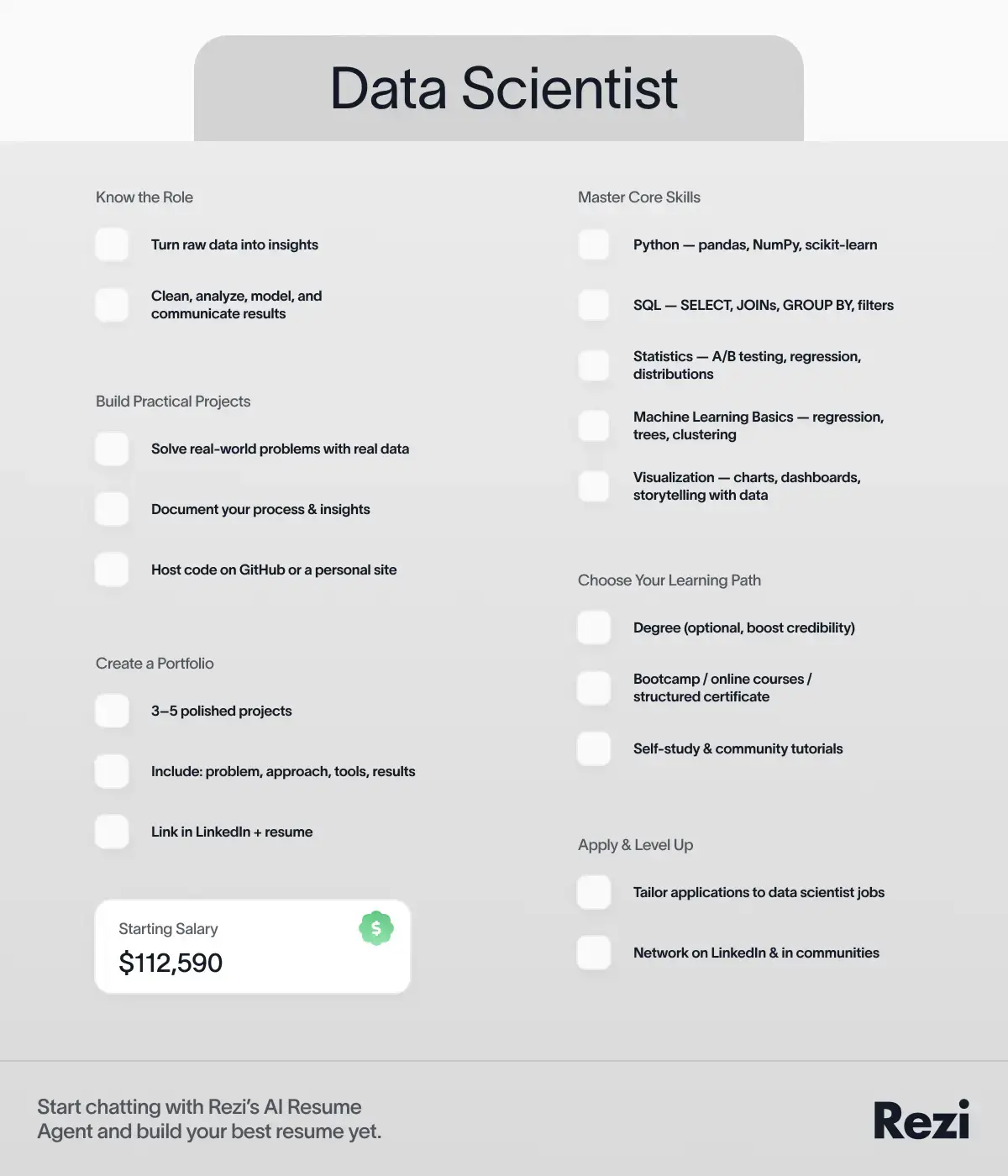
In practice, most data science roles revolve around data engineering, analytics, and machine learning, as shown by one Reddit user below.

That might sound like a lot (and, honestly, it is), but once you’ve built the key skills, the next challenge is learning how to communicate them clearly on your resume, in your portfolio, and during interviews. That’s often what separates strong candidates from the ones who get overlooked.
Let’s break down the steps to getting hired as a data scientist below.
1. Learn the core skills
Before you worry about fancy AI models or building the next ChatGPT, you need the data science fundamentals.
These are the “non-negotiables” every data scientist relies on daily:
Python
Python is the bread and butter of data science. It’s readable, flexible, and loaded with libraries that handle everything from data cleaning to deep learning.
Start with:
- pandas (data cleaning)
- NumPy (math + arrays)
- Matplotlib/Seaborn (visualization)
- scikit-learn (classic ML models)
Once you understand these, the rest of the ecosystem starts making sense.
SQL
SQL is how you actually get data. Every company stores data in a database, and SQL is what extracts it.
Get familiar with the following:
- SELECT, JOIN, GROUP BY
- Filtering and sorting
- Basic window functions (bonus points)
SQL is also often tested in interviews, so don’t skip this.
Statistics
Focus on the following:
- A/B testing
- Probability basics
- Regression
- Sampling + distributions
- Statistical significance
If you can explain your results without confusing the room, then you’re already ahead.
Machine learning basics
You don’t always need to jump into neural networks first. Start with classic algorithms:
- Linear/logistic regression
- Decision trees
- Random forests
- KNN
- Clustering
The goal here is to understand when and why to use each model. You can also use this AI and data scientist roadmap for a more structured view on what to learn.
Read more on adding relevant skills to your resume:
- Best Technical Skills on a Resume
- Top Hard Skills for a Resume
- Best AI Skills to Put on a Resume
- Computer Skills for Your Resume
- Best Resume Soft Skills
2. Build projects that show real-world problem solving
Projects are your “proof of work.” They show employers you can actually apply what you know, not just watch tutorials.
Great projects:
- Solve an actual problem
- Use real, messy data
- Walk through your thought process
- Produce actionable insights
Here are some ideas to build your portfolio as a data professional:
- Predicting housing or Airbnb prices
- Customer churn prediction
- Stock trend exploration (careful with claims!)
- Fake review detection
- Spotify listening analysis
3. Create a portfolio on GitHub or a personal website
Here’s what to include in your portfolio:
- Your code (clean + commented)
- A project README written like a case study
- Visualizations
- Key findings
- Links to datasets or notebooks
And here’s where you could host it:
- GitHub
- A personal site
- LinkedIn posts summarizing your work (very underrated)
If someone can scan your portfolio and quickly understand your skills, you’re golden. Add these to your resume header and LinkedIn profile.
4. Take a certificate or structured course
Courses aren’t always required for a data scientist job application but they give you structure and help reinforce your credibility. They also help fill in gaps you may not know you have.
Here are some examples:
- Google Data Analytics Certificate
- IBM Data Science Professional Certificate
- Coursera, edX, Udacity Nanodegrees
- MITx or HarvardX statistics courses
Bootcamps can also help, however, take into account the ones with solid job placement support. Plus, if you’re self-taught, a certificate can help reassure employers that you’ve built a real foundation.
Related articles:
- How to Put Certifications on a Resume
- How to List Education on a Resume
- Awards to Highlight on a Resume
- Publications on a Resume
5. Get practical experience
Companies want proof that you can work with real data in real environments. Fortunately, you don’t need a full-time job to build experience.
Here are ways to get hands-on practice:
- Internships (ideal if you can swing it)
- Freelance projects (small businesses have tons of data problems)
- Kaggle competitions (great for sharpening your modeling skills)
- Volunteering your analytics skills (nonprofits, student orgs, local businesses)
- Open-source contributions (shows teamwork and coding discipline)
Even 1–2 small real-world projects can separate you from other candidates.
Related articles:
- How to Write the Work Experience Section
- How to List Projects on a Resume
- Freelance Experience on a Resume
- How to Describe Remote Work on a Resume
6. Apply for entry-level data roles, then move towards the data scientist job title
You don’t usually walk straight into “data scientist” as your first tech job. Instead, most people start in roles that build your analytical and technical muscles.
Here are some entry-level positions to consider targeting:
- Data Analyst
- Business Intelligence (BI) Analyst
- Analytics Engineer (junior)
- Machine Learning Assistant
- Operations/Data Specialist roles
Once you have 1–2 years of consistent experience handling data, building dashboards, or working with models, the transition to a full data scientist role becomes much smoother.
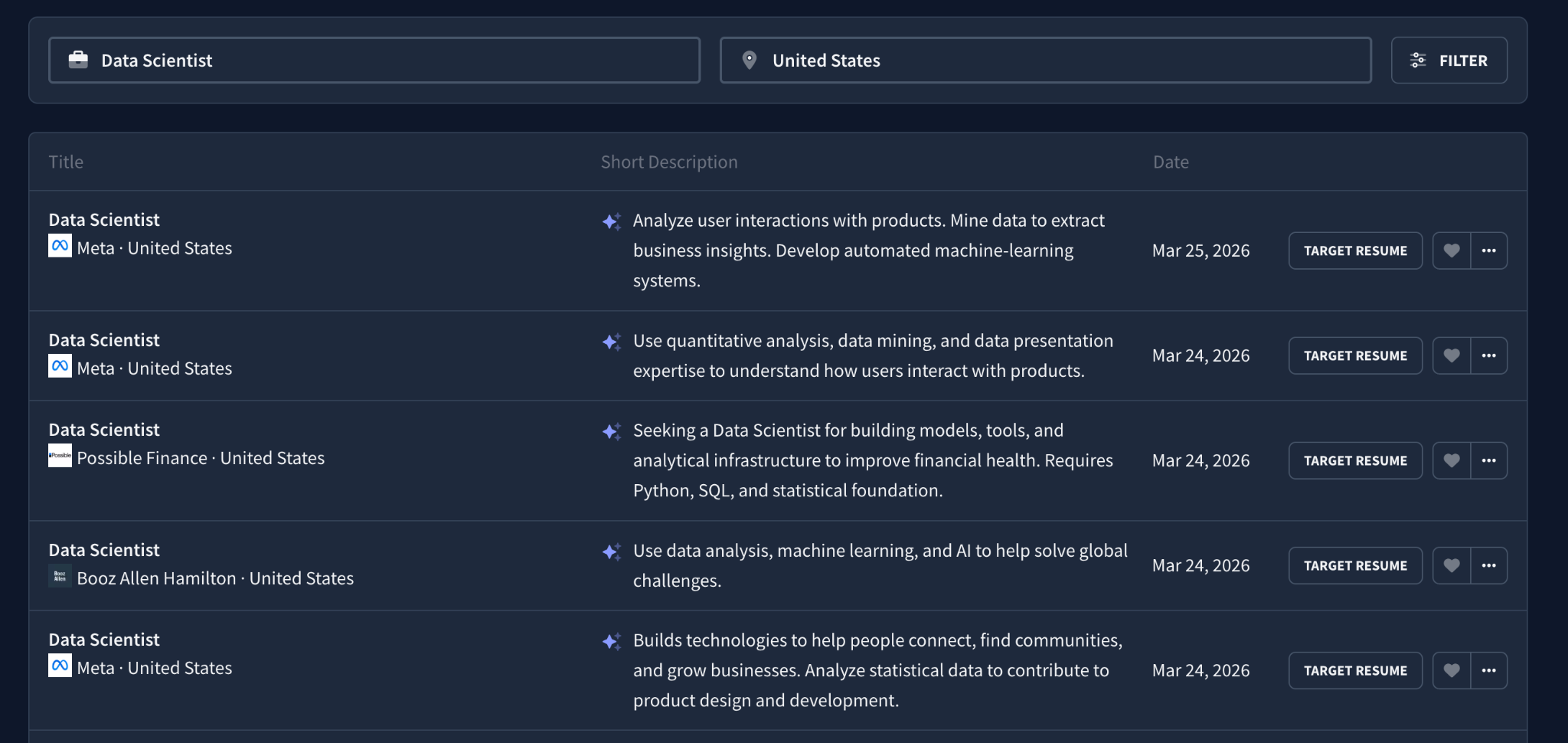
You can use tools like Rezi Job Search to help you find data science roles in your area. Just enter the job title and location, and it'll pull data job listings directly from company websites. You can even use this to help you tailor your resume for the specific job description.
Relevant guides on job hunting:
- The Best Job Search Strategies
- Top Career Websites and Job Search Engines
- Tips to Get a Job Fast
- What to Do When You Can’t Find a Job
What Do Data Scientists Actually Do?
You can see data scientists almost like translators since they take messy, confusing data and turn them into insights people can actually use.
Companies collect absurd amounts of information: customer behavior, sales trends, product usage, support logs, sensor data, you name it. However, raw data by itself is basically just digital dust. A data scientist makes sense of it.
Here’s what that usually looks like:
- Cleaning and organizing data.
- Analyzing data to find patterns or problems.
- Building machine learning models.
- Creating dashboards and reports.
- Presenting insights to teams who really don’t want to see a single line of code.
- Working with engineering, product, or business teams to make data-driven decisions.
If you like solving problems and using data to tell stories, this career can feel very satisfying.
Learn how to use the best career tools that can help you land your next role:
- Rezi for Jobs in Tech
- Rezi for Engineering Jobs
- Rezi for Project Management Jobs
- Rezi for HR Jobs
- Rezi for Marketing Roles
- Rezi for a Career Change Job Application
Summary
Here’s a recap of how to become a data scientist:
- Learn the essentials: Python, SQL, statistics, machine learning.
- Build practical, real-world projects.
- Create a portfolio that shows your thought process.
- Choose your education path.
- Get experience via internships, Kaggle, or entry-level analytics roles.
- Tailor your resume and start applying.
If you’re curious, analytical, and enjoy solving problems, becoming a data scientist might just be for you.
FAQs
Do I need a degree to become a data scientist?
Many data scientist job postings may include a degree as a requirement. Therefore, it certainly helps to have a degree. However, some data scientists out there come from non-technical backgrounds like marketing, finance, biology, or even journalism. What tends to matter most is your portfolio, skills, and ability to work with real data. Certificates and structured courses can also fill the gap if you’re self-taught.
Do I need to know advanced math or deep learning?
No, you don’t need advanced Ph.D. level knowledge in math and deep learning. However, you will need practical statistics, problem-solving skills, and a good grasp of basic machine learning. Advanced math or deep learning is optional unless you’re targeting heavy research or AI engineering roles.
Is data science still in demand or is the field too saturated?
Data science is still in demand. Companies are collecting more data than ever, and they need people who can make sense of it. Entry-level roles can feel competitive, but a strong portfolio can set you apart from the sea of generic applicants.
How do data scientists differ from data analysts?
Data analysts focus more on reporting, dashboards, and business insights. In contrast, data scientists go deeper by building models, running experiments, and working with larger, messier datasets. A lot of people start as analysts and then move into data science after building more technical skills.
Will AI or automation replace data scientists?
In short, no. It may automate tasks, but likely cannot automate things like business context, asking the right questions, interpreting results, designing experiments, and communicating insights. Companies still need humans who understand nuance and can guide decisions.

Upload or drop your resume to get started
Upload your resume to get started
Score my resume

Astley Cervania is a career writer and editor who has been sharing resume and job search insights for 5+ years. He shapes the direction of the Rezi blog, providing practical answers for important career-related questions and helping hundreds of thousands of people navigate the job market and build resumes that land interviews.