Resume
How to Use Rezi for Corporate Job Applications
Learn how to use Rezi to land corporate jobs and explore tips for tailored resumes, ATS-friendly applications, and interview preparation to stand out.

Published on
February 25, 2026
Updated on
March 16, 2026
Getting a corporate job is competitive, and companies want candidates who can hit the ground running with the right mix of technical and soft skills. Between long application processes, ATS filters, and multi-stage interviews, it’s easy to feel overwhelmed. But Rezi can help you take back control. Our tools help you work smarter: highlighting your most relevant skills, tailoring your resume for each role, optimizing keywords for ATS, and prepping you for interviews. It doesn’t do all the work for you, but it can help you get noticed in a stacked market.
Welcome to corporate America, where finance bros and dress-code enforcers run rampant.
Still, the business world does have its perks. You get a steady paycheck, some much-needed stability, and, if you play your cards right, a pleasantly hefty annual bonus.
And that’s why there’s so much competition.
Everyone’s trying to stand out, prove they belong, and get noticed in a stack of resumes and LinkedIn profiles. Rezi can’t replace hard work or experience, but it can help move you to the top of the pile. Our tools ensure your resume shows your value, highlights the right skills, and helps you feel more confident walking into the corporate jungle.
Find out how. This guide will cover:
- The realities of the corporate job market.
- All the challenges of breaking into this industry.
- How Rezi can help you find and secure a corporate role.
Or you can cut to the chase and try our free AI Resume Builder. Our advanced features and feedback can help you build a tailored, ATS-friendly resume in minutes.
And check out more ways to use Rezi:
- Rezi for HR Job Applications
- Rezi for Tech Job Applications
- Rezi for Legal Job Applications
- Rezi for Finance Job Applications
What to Know About the Corporate Job Market
Corporate roles (the classic ‘white-collar jobs’) still exist in large numbers, but hiring momentum has slowed in recent years. Data from the U.S. Bureau of Labor Statistics backs this up, with job openings trending down to about 6.5 million late last year.
What’s causing the slowdown?
High interest rates, corporate risk-cutting, and trade pressures have made companies cautious and more selective, shifting negotiating power toward employers. Some people have coined this a “white-collar recession,” especially because growth has been much stronger in fields like healthcare and construction.
But despite layoff headlines and fears that AI is wiping out white-collar work, the data doesn’t show a complete collapse. Research from Vanguard suggests layoff levels have mostly returned to normal, pre-pandemic patterns.
So, we’re not seeing corporate jobs disappearing; it’s just that they’re harder to get and slower to move through, which is frustrating, but also very cyclical historically.
Learn more about the bigger picture:
- How AI Is Changing the Job Market
- What Does Fiverr’s CEO Email Say About the Job Market
- How the Job Market Became a Dead Internet Battleground
What Do Corporate Job Seekers Find Challenging?
Landing a corporate job these days isn’t easy. There are fewer openings, higher skill expectations, and the pace of change can feel relentless. Of course, opportunities exist, but it helps to understand the obstacles so you can be ready to tackle them.
Here’s a look at the main challenges people face when trying to break into the corporate world.
Breaking into a more competitive market
Landing a corporate job is harder than it used to be; you can’t just walk into an office with your fancy degree and resume (as much as our parents insist).
Research from ADP found that hiring rates for jobs that typically require a bachelor’s degree have fallen sharply since mid-2022, especially for young workers. New graduates are also competing against thousands of fresh-out-of-college job seekers and those with years of experience for the same jobs.
Add in high interest rates, new tariffs, and companies being cautious with spending, and you get a market where employers can afford to be picky.
Experience gaps and the “skills mismatch” problem
A major reason entry-level workers and new grads struggle to find work is that expectations are so high. A ManpowerGroup survey of over 40,000 employers globally found 74% struggle to find skilled talent, and only 16% of leaders feel confident in their tech teams.
The World Economic Forum’s Future of Jobs Report 2025 also estimates that 59% of workers will need reskilling by 2030, and more than 120 million people could be at risk of job disruption if they don’t get it.
The shift is toward newer, technical, or hybrid skills; sometimes tools or platforms that didn’t even exist five years ago. Because of that, companies often run longer interview processes while asking for more specialized experience.
Keeping up with AI and automation
Since tools like ChatGPT became mainstream, companies have poured money into automation to improve productivity and customer experience. Some industry leaders, like Dario Amodei speaking to Axios, have warned that AI could remove a large portion of entry-level white-collar work in the next few years, especially in admin, legal, tech support, and junior corporate roles.
Even if the worst predictions don’t happen (aka, a complete AI takeover), the direction is clear. The Future of Jobs Report 2025 shows the fastest-growing skill areas are:
- AI and big data
- Cybersecurity and networking
- General tech literacy
Basically, tech knowledge is becoming standard, not “extra.”
Learn more about the skills and roles of the future:
Proving you’re more than just technical
Ironically, as tech gets more important, so do human skills. New research shows foundational abilities like collaboration, adaptability, and problem-solving matter just as much as knowing your way around a laptop.
The Future of Work Report 2025 echoes this, with employers consistently prioritizing:
- Analytical thinking
- Resilience and adaptability
- Leadership and influence
- Creativity
- Motivation and self-awareness
Why do these skills come out on top? Technical skills expire faster now. The people who stay valuable are those who can learn fast, communicate well, and adapt when tools or strategies change.
How to Use Rezi for Corporate Job Applications (Top Tools and Tips)
Here’s an overview of how to use Rezi to get a corporate job:
- Get help from AI Resume Agent to prove your value and tailor your resume.
- Find a corporate role using AI Job Search and apply directly on company pages.
- Improve your corporate resume with Rezi Score by targeting quality and keywords.
- Find in-demand technical skills with AI Skills Explorer to squash any skill gap doubts.
- Tailor your application using AI Keyword Targeting to improve your odds with ATS.
- Use AI Bullet Point Writer to prove your skills and emphasize measurable results.
- Practice like it’s the real thing with AI Interview and improve your confidence.
Let’s explore these features and how to use them for corporate job applications.
1. Get corporate resume and job search advice from AI Resume Agent
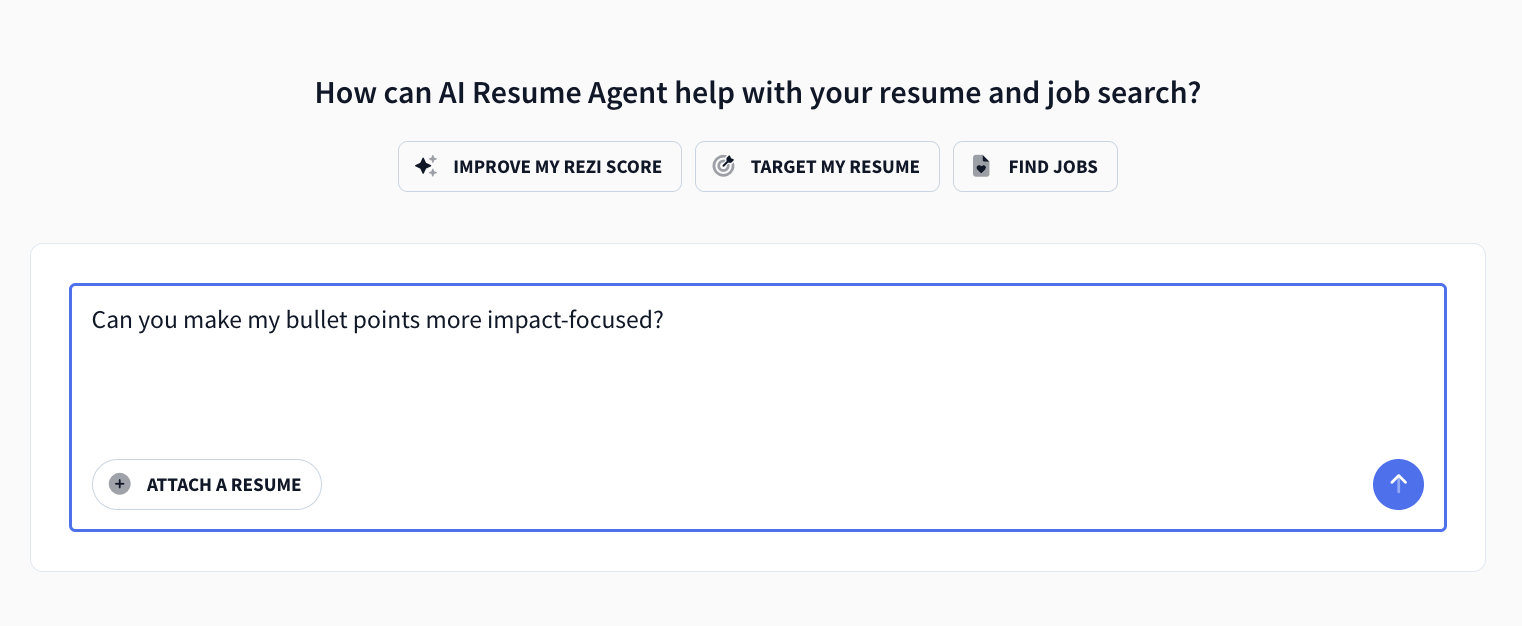
The AI Resume Agent is like ChatGPT for everything related to your job search and application. One of its key features is helping you adapt your resume to each corporate role, which is necessary when employers want candidates who match their needs at first glance.
This is how you can use the AI resume agent tool as a corporate professional:
- Upload your resume and a corporate job description, then ask the AI Agent to tailor your summary and bullet points.
- Ask for help translating your experience into business outcomes (revenue, productivity, cost savings).
- Generate multiple resume versions for different corporate roles and companies.
- Use it to prepare answers for corporate behavioral interviews based on your resume.
2. Find corporate job openings that align with your background
Hiring is slow, there are fewer openings, and companies are taking their sweet time to review corporate job applications. With that said, nobody wants to waste their time searching through spammy, ghost job listings.
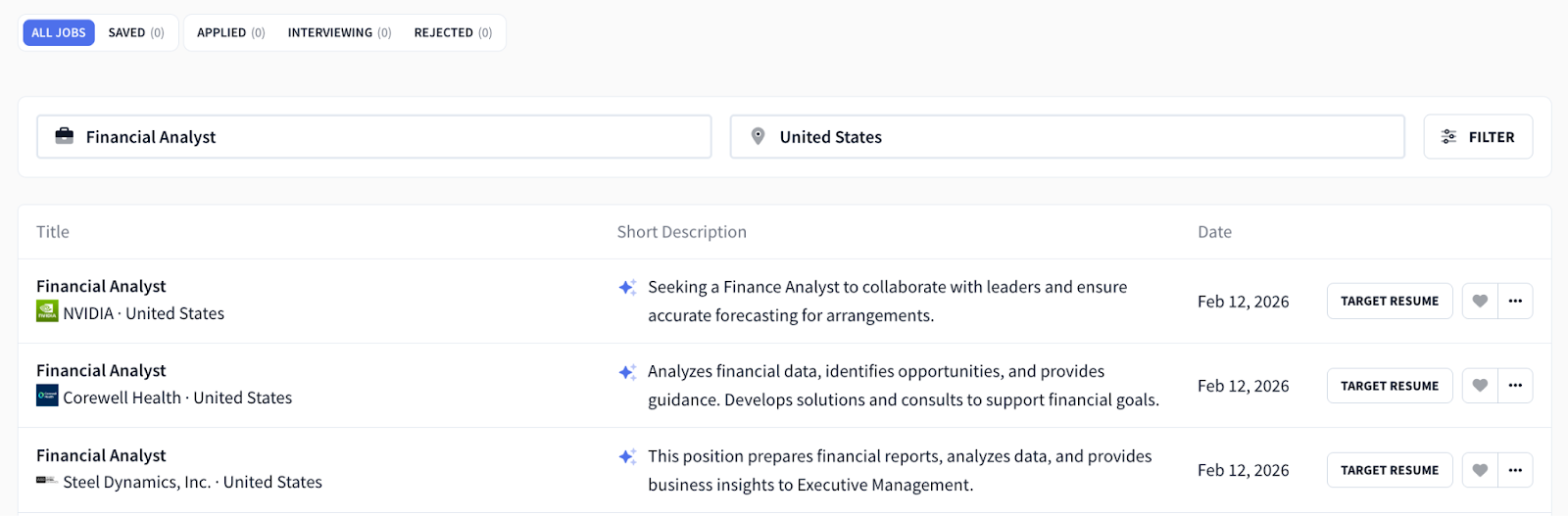
Rezi Job Search helps by pulling listings directly from company career pages, which is handy since many large corporations prefer candidates who apply through their own systems. It also helps you stay organized when you’re applying to multiple competitive roles at once.
Do this when using Rezi Job Search to find corporate roles:
- Target Fortune 500 or large corporate employers directly through their company career listings.
- Filter by corporate functions like finance, marketing, operations, or IT.
- Track every application on your dashboard so you can follow up (important in slower hiring cycles)
- Use the job description and our tools to tailor your resume to that specific role.
You can also broaden your search: Best Job Search Engines
3. Improve your corporate resume with Rezi Score
Many corporate roles require attention to detail, and it starts with your job application. Formatting, keyword density, and structure all come into play due to ATS filters and recruiter speed scanning.
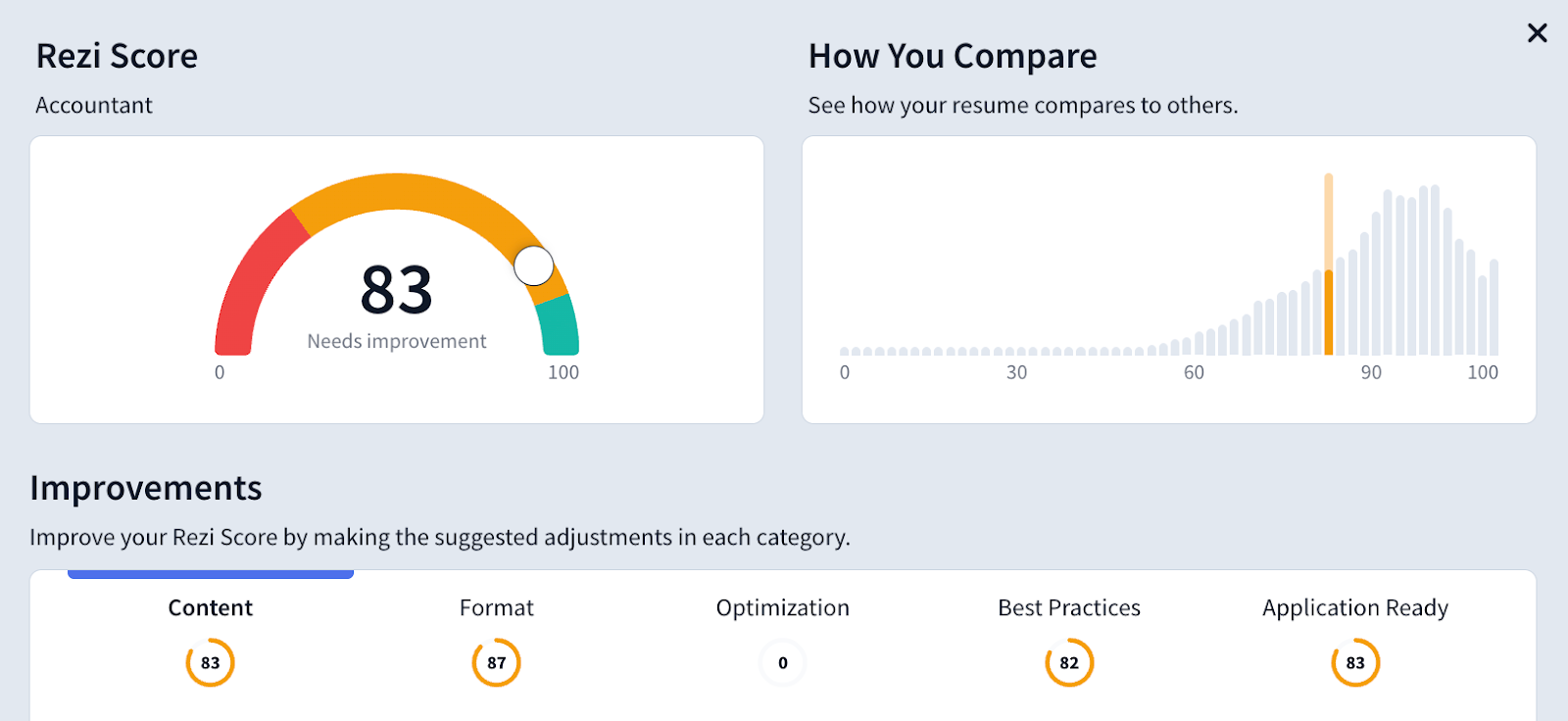
Rezi Score gives you instant feedback so you know if your resume meets real corporate hiring standards. When there’s no shortage of competition, your score can show you if your resume is “almost good enough” or about to get overlooked for a more refined application.
Here are my top tips for using this report for your corporate resume:
- Aim for a high score (90 or above) before applying to competitive corporate roles.
- Check the suggestions to fix formatting issues and maintain ATS-friendly layouts.
- Focus on flagged areas tied to corporate expectations (clarity, metrics, keyword usage).
- Use our Real-Time Analysis tool to improve as you build and customize your resume for each job.
4. Find in-demand technical skills with AI Skills Explorer
Corporate hiring is shifting toward hybrid skill sets. Employers are looking for the whole shebang, meaning you need both business understanding and technical chops to get noticed.
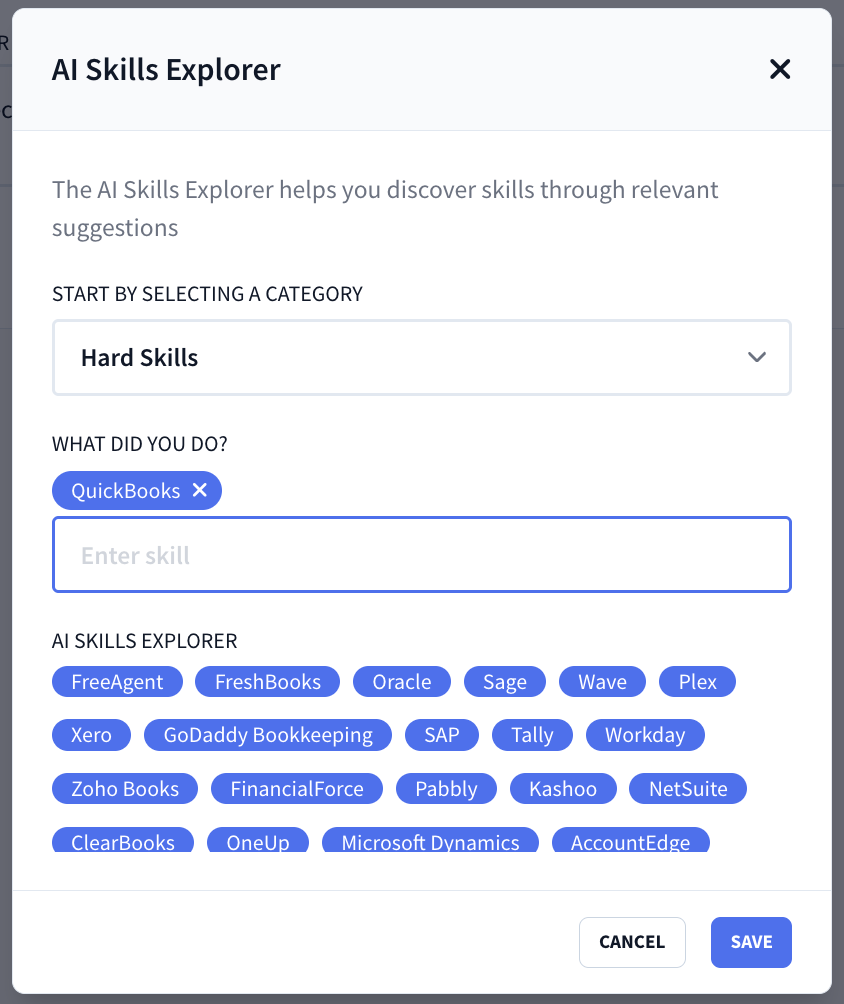
AI Skills Explorer helps you identify missing skills and strengthen your profile, especially in areas like data or AI literacy that are growing fast. Yes, it’s only a small section of your resume, but it gives you the chance to steer away any doubts surrounding potential skill gaps.
This is how corporate job seekers use Rezi AI Skills Explorer:
- Compare your current skill list to what corporate job postings repeatedly ask for.
- Use the tool to mirror those skills or add adjacent ones to show you’re the right fit.
- Balance technical and business skills to match corporate expectations.
- Identify in-demand soft skills like leadership or adaptability if you’re low on technical or hard skills (just remember to prove them in your work experience section).
Check out the most popular resume skills:
5. Match your corporate resume to the specific job description by using AI Keyword Scanner
Most companies hiring for corporate professionals use ATS systems to filter, sort, and rank applications before a human sees them.
Rezi's AI keyword scanner helps you match your resume to what the company is actually searching for by analyzing your desired position and job description. The goal? To show you understand the role and can deliver real value.
Here's an overview of how you can use this AI keyword scanner:
- Paste the corporate job description and scan your resume for missing keywords.
- Add industry-specific tools, certifications, or systems mentioned in the posting.
- Use the tool to customize each application (just a few tweaks are usually enough).
- Check job descriptions to find specific keywords (projects, tools, software), so you don’t end up in the generic resume pile.

Learn more about customizing your application:
6. Use AI Bullet Point Writer to prove your expertise in corporate roles
Let’s be honest, the corporate world is all about making a buck. Hiring managers care less about responsibilities and more about how you can contribute to business impact. Adding numbers and measurable outcomes instantly adds more credibility and shows what you can do.
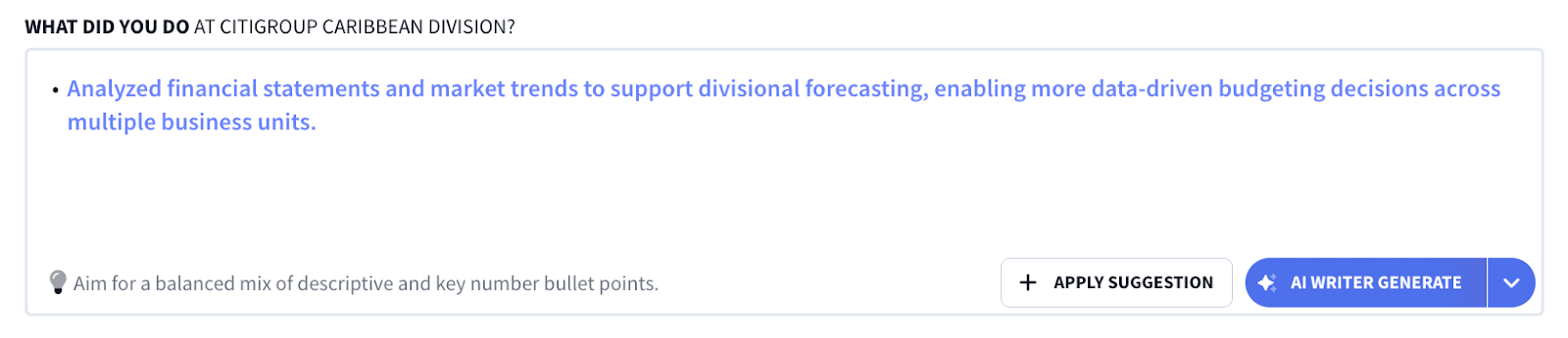
The AI Bullet Point Writer helps you turn normal tasks into achievement-focused points using popular formulas like the X-Y-Z formula (recommended by Google), which is especially effective in corporate environments focused on performance and results.
Let's see how you can use an AI Bullet Point Writer:
- Use our tool to help form the X-Y-Z formula to structure achievements: Accomplished X, as measured by Y, by doing Z.
- Generate data-driven bullets using metrics like revenue, savings, client satisfaction, or growth.
- Rewrite and update old corporate experience to match modern business language.
- Use the AI Bullet Point Editor to expand existing points and make them clearer.
Relevant guides:
7. Practice like it’s the real thing with AI Interview
Corporate interviews are usually multi-round, structured, and intense. Like I said, they can afford to be picky, and many companies are happy to drag out the hiring process to make sure you have the right skills and attitude for the job.
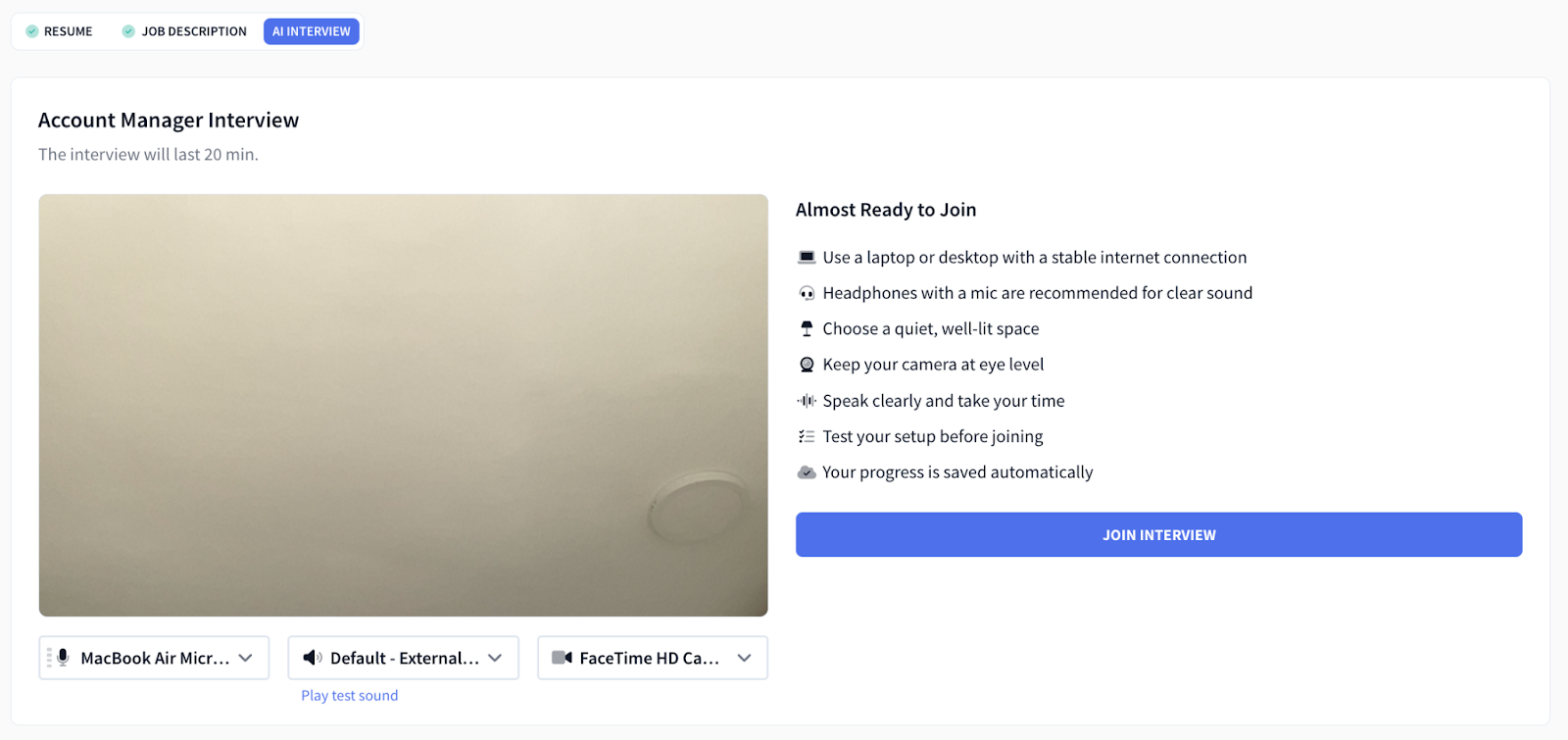
Rezi AI Interview helps you practice with role-specific questions pulled from your resume and the job description; a big help when companies are using various interview tactics to evaluate candidates. You can use the tool to prepare stories that show both results and professionalism.
Here’s how to use AI Interview:
- Simulate real interviews by practicing multiple question sets with voice activation.
- Practice answering corporate behavioral questions using the STAR method.
- Prepare scenario stories about teamwork, conflict resolution, and project delivery.
- Use our detailed feedback to refine answers and include job-specific language.
Check out more interview tips and tricks:
- Phone Interview Questions to Prepare For
- Unique Interview Questions to Ask Employers
- Common Interview Questions & Sample Answers
Final Thoughts
Getting a corporate job today (or any job for that matter) isn’t easy. There are fewer openings, tougher competition, and constantly shifting skill requirements. It’s stressful to say the least, especially for younger workers or those trying to break into new roles.
Rezi isn’t a magic wand, and it can’t replace experience or crucial networking, but it does make the parts of the process you can control a lot easier. It helps you find active job listings, build a resume that highlights your skills, and practice interviews so you feel confident walking into a corporate setting. That kind of support can save time, reduce stress, and give you a real edge.
FAQ
What is an example of a corporate job?
A corporate job is typically a ‘white-collar’ role within a large organization, where the work is structured, office-based, and often part of a bigger team or department. For example, a financial analyst at a major bank evaluates investments, prepares reports, and advises management on decisions.
Other common examples include marketing managers who plan campaigns across multiple channels, IT project managers who oversee software deployments, and human resources specialists who handle recruitment and employee relations. Essentially, corporate jobs combine specialized skills with teamwork in a structured, hierarchical environment.
How to break into the corporate world?
Start by targeting entry-level roles that match your skills and interests, and consider internships to gain relevant experience and work your way up. Networking is also crucial; reach out to alumni, contact former colleagues, or connect on LinkedIn to learn about opportunities.
Tailor your resume to highlight measurable achievements, even from part-time jobs or academic projects, and practice communicating your value. And stay adaptable; companies increasingly look for hybrid skills, combining technical knowledge with communication, problem-solving, and teamwork abilities.
What corporate jobs can you get without a degree?
Not all corporate jobs require a degree. Many entry-level roles focus on skills, certifications, or experience rather than formal education. Examples include sales representatives, administrative assistants, customer success specialists, and digital marketing coordinators.
In tech, roles like IT support, help desk technician, or junior web developer can be accessible with online courses or self-taught skills. Even roles in HR, logistics, and operations sometimes prioritize on-the-job experience or professional certifications. Focus on building relevant skills, demonstrating results in previous roles, and showing initiative and reliability to potential employers.
Find out if college is right for you:
What corporate jobs pay the most?
Some of the highest-paying corporate jobs are typically in finance, consulting, and executive leadership. Investment bankers, for example, can earn six-figure salaries plus bonuses early in their careers, while management consultants at top firms also enjoy competitive compensation.
Executive roles like Chief Financial Officer or Chief Operating Officer come with multi-six-figure salaries and performance-based bonuses. Tech-oriented positions like software architects, data scientists, and cybersecurity directors are also highly lucrative, especially at large tech or finance companies. Generally, the highest salaries go to roles that combine specialized expertise, leadership responsibilities, and the ability to impact company performance.
Find out more: Highest Paying Jobs in the US
How to get hired by big companies?
Getting hired by a large corporation requires both strategy and persistence. Apply directly on company career pages, as many large firms prioritize internal systems. Tailor your resume for each role using keywords and measurable achievements, because applicant tracking systems scan thousands of applications.
Highlight technical skills that are in demand, but don’t forget soft skills like adaptability and leadership. Networking internally or connecting with current employees can also give you insights and referrals. Finally, prepare thoroughly for multi-stage interviews using the STAR method to show concrete examples of problem-solving, teamwork, and results.

Upload or drop your resume to get started
Upload your resume to get started
Score my resume

Lauren Bedford is a seasoned writer with a track record of helping thousands of readers find practical solutions over the past five years. She's tackled a range of topics, always striving to simplify complex jargon. At Rezi, Lauren crafts genuine and actionable content that guides readers in creating standout resumes to land their dream jobs.